Modernist staircase spiral
1344×768 · AVIF · CC BY 4.0
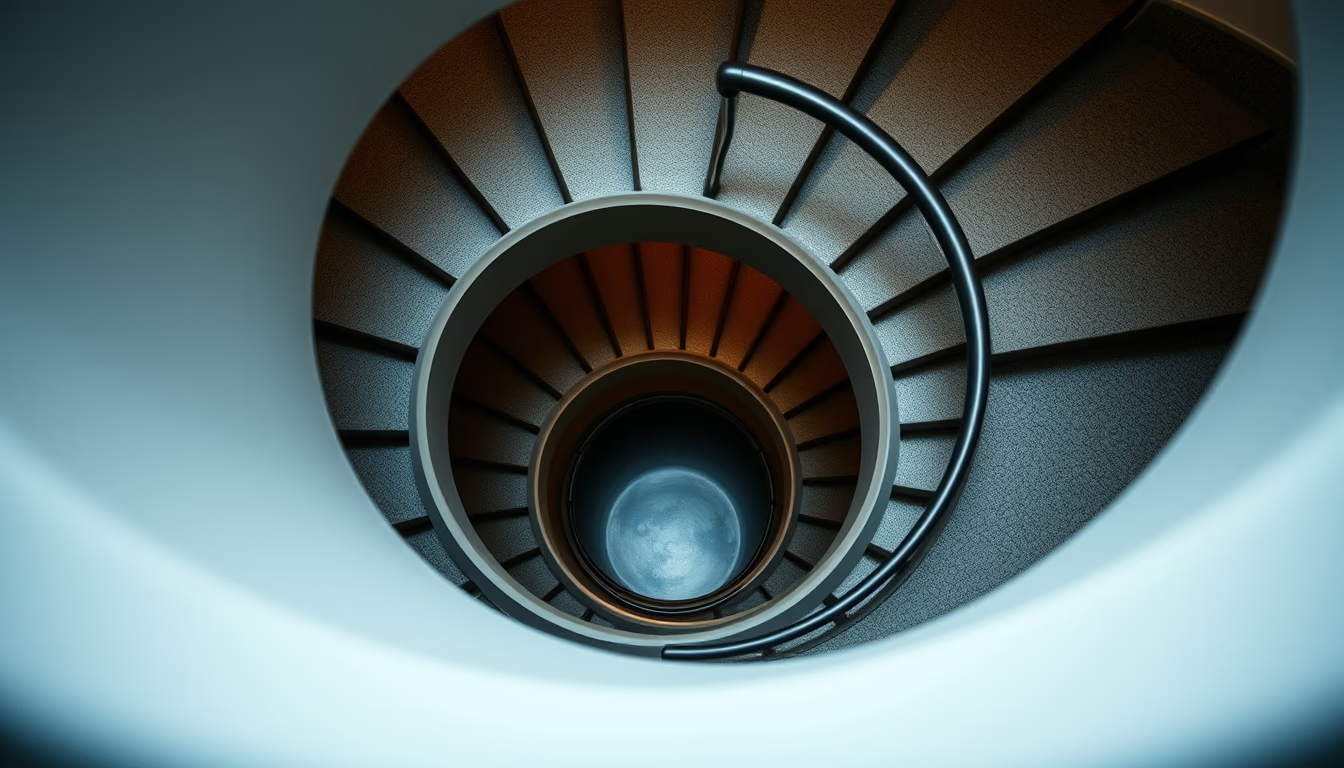
Macro close-up detail of a modernist spiral staircase, emphasizing fluid curves and structural minimalism.
About this subject
Modernist spiral staircases represent a landmark of 20th-century architecture, combining functionality and aesthetics. Inspired by the modernist movement, which prioritized simple lines and geometric forms, these structures emerged as a response to the excessive ornamentation of earlier periods. Architects like Oscar Niemeyer and Le Corbusier explored the potential of reinforced concrete to create spirals that appear to float, defying gravity. The macro close-up reveals the precision of joints and the texture of the material, often polished or painted in neutral tones to enhance the purity of form.
Helical modernist staircases gained popularity between the 1930s and 1960s, especially in residential and commercial buildings. They save vertical space and add a dynamic focal point to interiors. In Brazil, Niemeyer employed them in the Palácio da Alvorada and several private residences, integrating the staircase with tropical landscaping. Each step is calculated for safety and comfort, while the continuous handrail follows the upward motion, creating an unbroken line that guides the eye.
Interestingly, the modernist spiral staircase design influenced furniture making and kinetic art. Macro photography highlights details such as the junction between tread and central column, or how light falls on curved surfaces. This type of imagery is valued by architects and designers seeking inspiration for contemporary projects, proving that elegance lies in the smallest elements.
Today, these staircases remain symbols of sophistication and innovation, found in galleries, museums, and lofts. The macro close-up allows appreciation of the craftsmanship behind apparent simplicity, revealing the balance between structural calculation and artistic expression that defines modernism.
Frequently Asked Questions
What is the main characteristic of a modernist spiral staircase?
The main characteristic is a continuous spiral form with steps revolving around a central axis, combined with materials like reinforced concrete and minimalist lines without ornamentation.
Who were the most influential architects for this staircase style?
Oscar Niemeyer and Le Corbusier are key references. Niemeyer used helical staircases in works like the Palácio da Alvorada, while Le Corbusier integrated them into housing units such as the Unité d'Habitation.
How does macro photography contribute to the study of these staircases?
Macro photography reveals construction details like joints, textures, and light reflections, allowing analysis of technical precision and material aesthetics, essential for restoration and new design projects.
Direct URL
https://pub-c7d6a6ea828543ac903a74a341ccb2e1.r2.dev/imagens/modernist-staircase-spiral-macro-closeup-p2.avifHow to credit
Include a visible link back to UtilizAí. Copy one of the snippets below:
<a href="https://xn--utiliza-eza.com/en/midia/imagens/modernist-staircase-spiral-macro-closeup-p2">Modernist staircase spiral</a> by <a href="https://xn--utiliza-eza.com">UtilizAí</a>, licensed under <a href="https://creativecommons.org/licenses/by/4.0/">CC BY 4.0</a>.
[Modernist staircase spiral](https://xn--utiliza-eza.com/en/midia/imagens/modernist-staircase-spiral-macro-closeup-p2) by [UtilizAí](https://xn--utiliza-eza.com), CC BY 4.0
License: CC-BY-4.0