Milky way over mountain
1344×768 · AVIF · CC BY 4.0
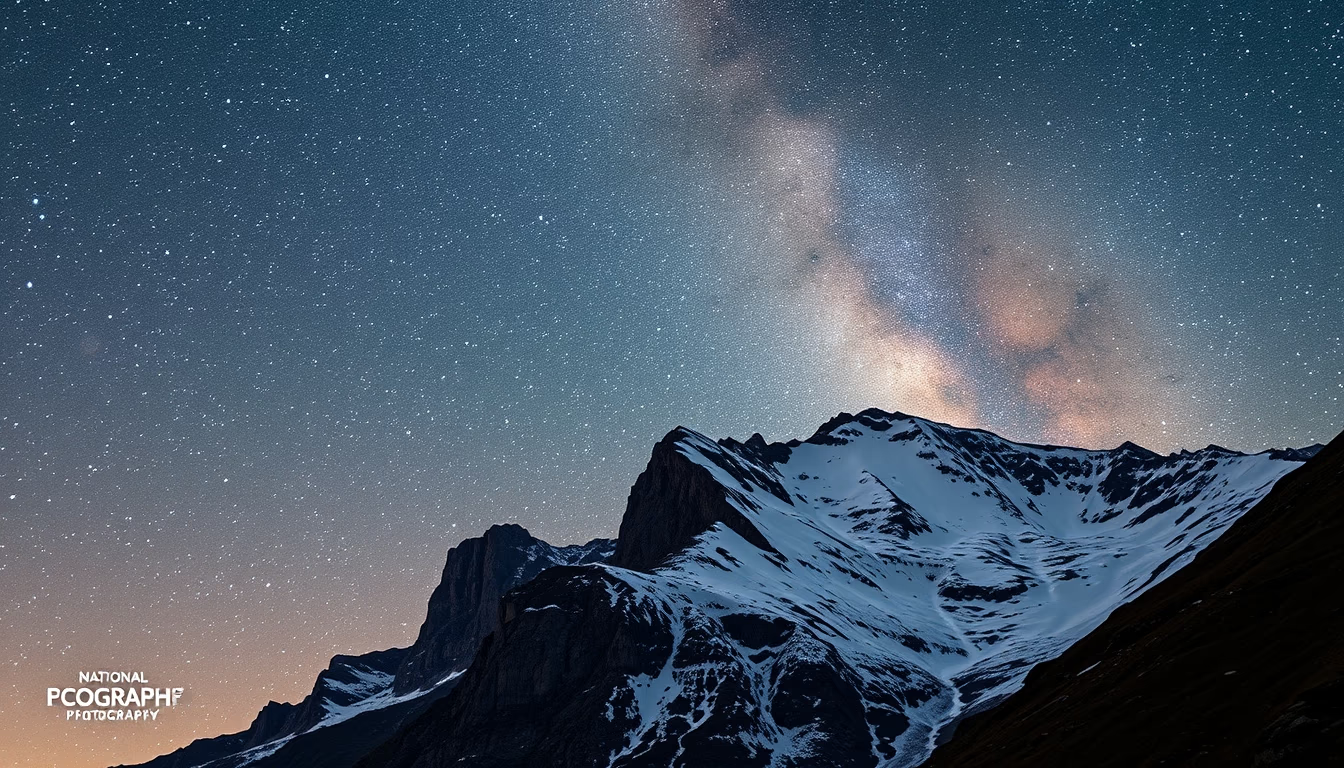
The Milky Way seen over mountains on a moonless night, revealing the galactic core in all its splendor. An image combining astronomy and landscape.
About this subject
The Milky Way is the galaxy that hosts the Solar System, composed of billions of stars, dust, and gas. On clear nights without light pollution, its milky glow is visible to the naked eye, especially during winter in the Southern Hemisphere when the galactic center is highest. Mountains are privileged settings for astronomical observation, as they distance observers from urban lights and offer drier, more stable air. Atop high peaks, such as those in the Andes or the Himalayas, the thinner atmosphere reduces turbulence, providing sharp images. The combination of mountains and the Milky Way is a classic theme in landscape astrophotography, requiring long exposures and careful planning of the galaxy's position in the sky. The Milky Way is best observed between April and September in the Southern Hemisphere, and between June and October in the Northern Hemisphere, away from the Moon. The galactic core, in the direction of the constellation Sagittarius, is the brightest and richest region in nebulae. Night photography of mountains with the Milky Way requires suitable equipment, such as cameras with high ISO sensitivity and wide-angle lenses. Stacking multiple exposures can reveal details of interstellar dust clouds. Culturally, the Milky Way has inspired mythologies in various civilizations, such as ancient Greeks who saw it as the spilled milk of Hera, and indigenous Brazilians who associated it with spirit paths. In mountainous regions, night sky observation is a growing tourist activity, with destinations like the Atacama Desert and the Alps offering certified observation sites (Starlight Reserves).
Frequently Asked Questions
What is the best time to photograph the Milky Way over mountains?
The best time varies by hemisphere: in the Southern Hemisphere, from April to September; in the Northern, from June to October. Choose a moonless night away from light pollution.
What equipment is needed for landscape astrophotography?
A camera with manual controls, a wide-angle lens (14-24mm) with aperture f/2.8 or wider, a sturdy tripod, and a remote shutter. ISO 3200-6400 and exposures of 15-30 seconds are typical.
Why are mountains good for observing the Milky Way?
Mountains lift observers above light pollution and humidity, offering darker and more stable skies. The thinner air reduces atmospheric turbulence, improving clarity.
Direct URL
https://pub-c7d6a6ea828543ac903a74a341ccb2e1.r2.dev/imagens/milky-way-over-mountain-national-geographic-style-p0.avifHow to credit
Include a visible link back to UtilizAí. Copy one of the snippets below:
<a href="https://xn--utiliza-eza.com/en/midia/imagens/milky-way-over-mountain-national-geographic-style-p0">Milky way over mountain</a> by <a href="https://xn--utiliza-eza.com">UtilizAí</a>, licensed under <a href="https://creativecommons.org/licenses/by/4.0/">CC BY 4.0</a>.
[Milky way over mountain](https://xn--utiliza-eza.com/en/midia/imagens/milky-way-over-mountain-national-geographic-style-p0) by [UtilizAí](https://xn--utiliza-eza.com), CC BY 4.0
License: CC-BY-4.0