Milky way over mountain
1344×768 · AVIF · CC BY 4.0
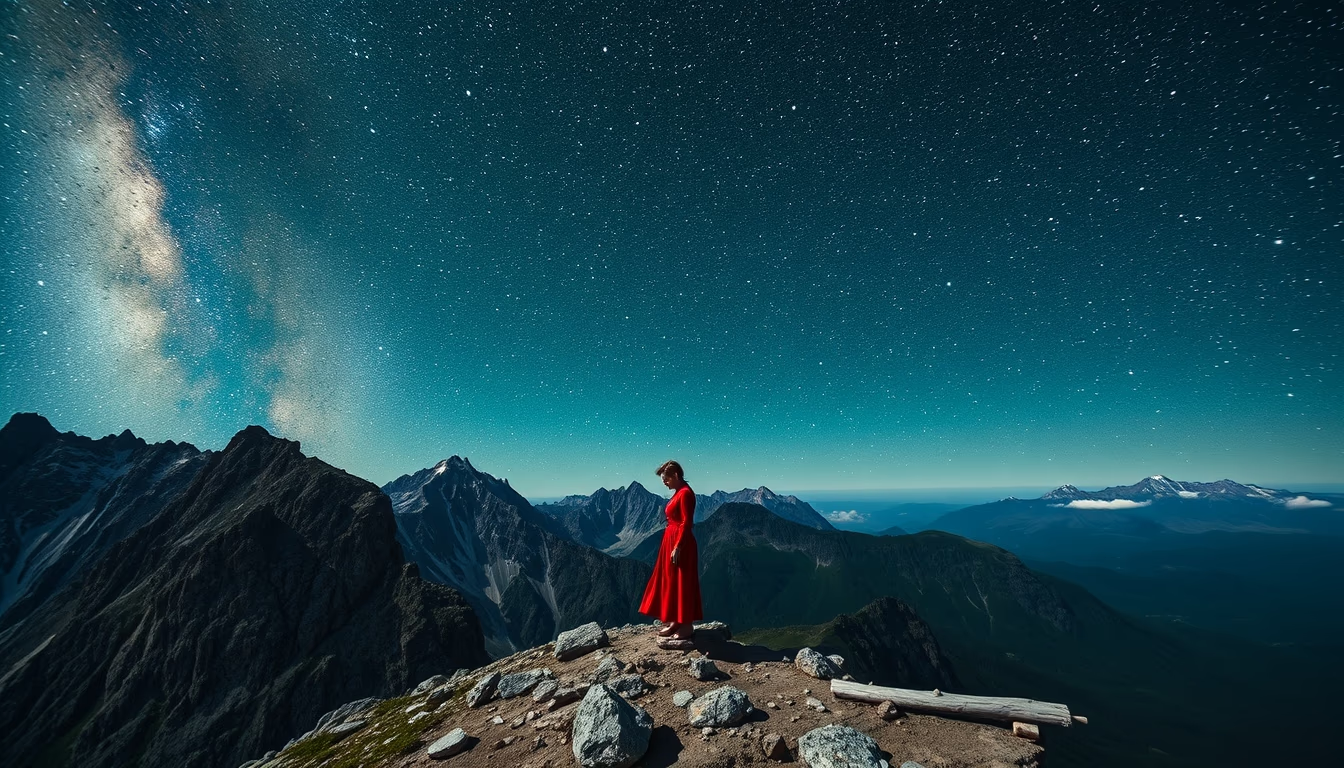
The Milky Way over a mountain is one of the most stunning natural spectacles, combining astronomy and terrestrial landscapes.
About this subject
The Milky Way is the galaxy that contains the Solar System, composed of billions of stars, gas, and dust. When observed from Earth on a moonless night far from artificial light, it appears as a milky band crossing the sky. This diffuse glow comes from the light of distant stars and the galactic plane. The core of the Milky Way, where stellar density is highest, is visible mainly between March and October in the Southern Hemisphere, and between June and September in the Northern Hemisphere. The best viewing occurs at high altitudes with low light pollution, such as mountain peaks.
Mountains provide an ideal setting for astronomical observation, as they distance observers from urban lights and offer unobstructed horizons. The combination of a mountain silhouette with the bright band of the Milky Way is one of the most sought-after subjects for astrophotographers. In Brazil, regions like Serra da Mantiqueira, Chapada dos Veadeiros, and Lençóis Maranhenses National Park are prime spots, as well as the Andes in neighboring countries. Altitude also reduces atmospheric interference, making stars sharper.
Culturally, the Milky Way holds various meanings. For ancient Greeks, it represented the spilled milk of Hera. Indigenous Brazilian peoples, such as the Tupi-Guarani, call it the 'Tapir's Path' or 'River of Stars'. In modern astronomy, studying the Milky Way helps understand the universe's structure. The galactic center, which contains a supermassive black hole called Sagittarius A*, is a region of intense radiation and star formation. Observing the Milky Way over mountains is not only a visual delight but a connection to the cosmos and the cultural traditions that revere it.
Frequently Asked Questions
What is the best time to see the Milky Way over mountains?
In the Southern Hemisphere, months from April to September offer the best view of the galactic core. In the Northern Hemisphere, from June to September. Avoid moonlight and choose locations with low light pollution, such as mountains far from cities.
Why does the Milky Way appear as a band of light in the sky?
The Milky Way is a flattened disk. Our Solar System is inside this disk, so we look into the galactic plane from within, seeing a concentration of stars and interstellar dust that forms a diffuse, glowing band.
What is needed to photograph the Milky Way over a mountain?
A camera capable of long exposures, sturdy tripod, wide-angle lens with a large aperture (f/2.8 or lower). Common settings include ISO 3200 to 6400, 15 to 30 second exposure, and manual focus set to infinity. Also essential: a dark sky location and an app like Stellarium to predict the Milky Way's position.
Direct URL
https://pub-c7d6a6ea828543ac903a74a341ccb2e1.r2.dev/imagens/milky-way-over-mountain-high-fashion-editorial-p1.avifHow to credit
Include a visible link back to UtilizAí. Copy one of the snippets below:
<a href="https://xn--utiliza-eza.com/en/midia/imagens/milky-way-over-mountain-high-fashion-editorial-p1">Milky way over mountain</a> by <a href="https://xn--utiliza-eza.com">UtilizAí</a>, licensed under <a href="https://creativecommons.org/licenses/by/4.0/">CC BY 4.0</a>.
[Milky way over mountain](https://xn--utiliza-eza.com/en/midia/imagens/milky-way-over-mountain-high-fashion-editorial-p1) by [UtilizAí](https://xn--utiliza-eza.com), CC BY 4.0
License: CC-BY-4.0





