Milky way center galactic
1344×768 · AVIF · CC BY 4.0
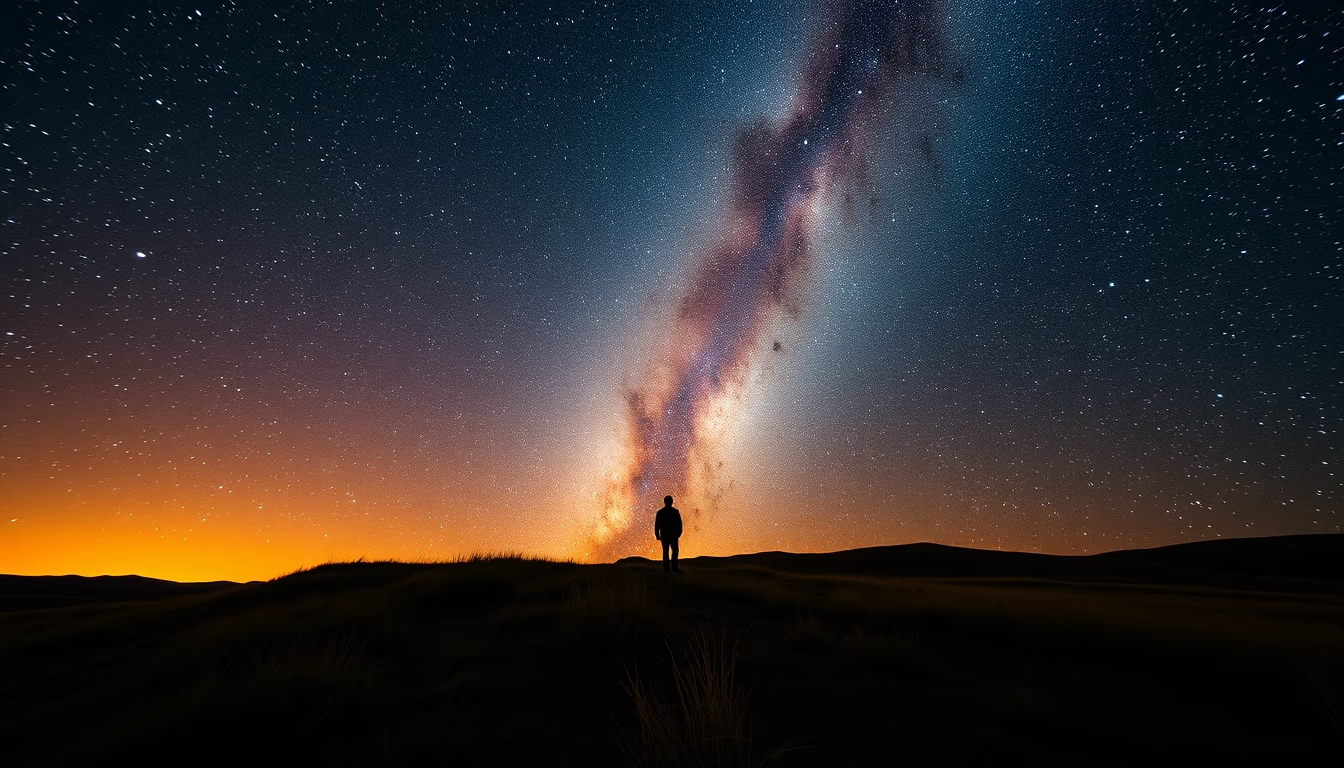
The center of the Milky Way, about 26,000 light-years from Earth, hosts a supermassive black hole and is a region of intense star formation.
About this subject
The center of the Milky Way lies in the constellation Sagittarius, roughly 26,000 light-years from our solar system. This region hosts Sagittarius A, a supermassive black hole with a mass of about four million Suns. First detected through radio astronomy in the 1970s, Sagittarius A became the first black hole whose shadow was imaged by the Event Horizon Telescope in 2022, confirming predictions of general relativity.
The galactic center is densely populated with both old and young stars, giant molecular clouds, and star clusters such as the Quintuplet Cluster. Star formation rates are high, fueled by gas and dust flowing inward. However, direct visible-light observation is blocked by thick interstellar dust, forcing astronomers to rely on infrared, radio, and X-ray wavelengths to study it.
Notable features include the Galactic Center Arc, a filamentary structure of ionized gas, and the Sgr B2 molecular cloud, one of the galaxy's most massive star-forming regions. The center also contains a stellar bar, an elongated structure that shapes the orbits of stars throughout the Milky Way. Studies suggest the central black hole may undergo episodic outbursts and jet activity, though it is currently in a quiescent state.
Understanding the Milky Way's center is crucial for astrophysics, providing a unique laboratory to test theories of black holes, stellar dynamics, and galactic evolution. Observatories like the James Webb Space Telescope and Chandra X-ray Observatory continue to unveil new details of this enigmatic region.
Frequently Asked Questions
What is Sagittarius A*?
Sagittarius A* is the supermassive black hole at the center of the Milky Way, with a mass of about 4 million Suns. It was discovered via radio emissions and is key to understanding black hole physics.
Why is the Milky Way's center not visible in visible light?
Interstellar dust in the galactic plane blocks visible light from the center. Astronomers use infrared, radio, and X-ray wavelengths to observe it.
Why is the galactic center important for science?
It serves as a unique laboratory for studying supermassive black holes, extreme star formation, and stellar dynamics under strong gravity, testing theories like general relativity.
Direct URL
https://pub-c7d6a6ea828543ac903a74a341ccb2e1.r2.dev/imagens/milky-way-center-galactic-cinematic-wide-shot-p12.avifHow to credit
Include a visible link back to UtilizAí. Copy one of the snippets below:
<a href="https://xn--utiliza-eza.com/en/midia/imagens/milky-way-center-galactic-cinematic-wide-shot-p12">Milky way center galactic</a> by <a href="https://xn--utiliza-eza.com">UtilizAí</a>, licensed under <a href="https://creativecommons.org/licenses/by/4.0/">CC BY 4.0</a>.
[Milky way center galactic](https://xn--utiliza-eza.com/en/midia/imagens/milky-way-center-galactic-cinematic-wide-shot-p12) by [UtilizAí](https://xn--utiliza-eza.com), CC BY 4.0
License: CC-BY-4.0