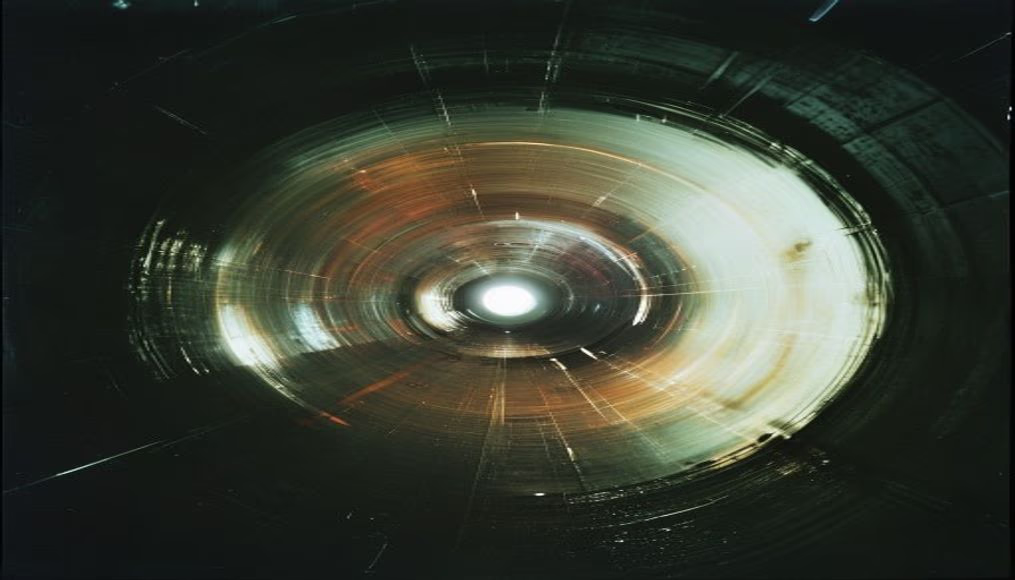
Mercury surface craters
1344×768 · AVIF · CC BY 4.0

Mercury's surface is scarred by thousands of impact craters, the result of billions of years without a significant atmosphere to shield the planet.
About this subject
Mercury, the smallest planet in the Solar System and closest to the Sun, has a surface heavily cratered resembling that of the Moon. These craters were formed by impacts of asteroids and comets over billions of years, and their preservation is due to the lack of a dense atmosphere and significant geological processes such as erosion or extensive volcanism that could reshape the terrain. The largest known impact structure on Mercury is the Caloris Basin, with a diameter of about 1,550 km. This basin was formed approximately 3.8 billion years ago and is surrounded by concentric rings of mountains. Studies from the MESSENGER spacecraft (2011-2015) revealed details of crater composition, including volcanic deposits and evidence of tectonic activity. Mercurian craters vary in size, from small marks of a few meters to vast basins. Unlike Earth, Mercury has no plate tectonics, so craters remain visible for eons. The planet's surface also features lobate scarps, formed by thermal contraction as the iron core cooled. Interestingly, some craters near the poles contain permanent water ice, shielded from direct sunlight. These characteristics make Mercury a natural laboratory for understanding impact processes and planetary evolution.
Frequently Asked Questions
How many craters are on Mercury's surface?
Mercury is estimated to have over 15,000 craters larger than 10 km in diameter, plus millions of smaller ones. The exact count varies with new observations.
What is the largest crater on Mercury?
The largest crater on Mercury is the Caloris Basin, with a diameter of about 1,550 km. It was formed by a colossal impact roughly 3.8 billion years ago.
Why does Mercury have so many craters compared to Earth?
Mercury has a very thin atmosphere (exosphere) and almost no erosion or geological activity to erase craters. Earth, on the other hand, has atmosphere, water, wind, and plate tectonics that constantly resurface the planet.
Direct URL
https://pub-c7d6a6ea828543ac903a74a341ccb2e1.r2.dev/imagens/mercury-surface-craters-studio-editorial-portrait-p7.avifHow to credit
Include a visible link back to UtilizAí. Copy one of the snippets below:
<a href="https://xn--utiliza-eza.com/en/midia/imagens/mercury-surface-craters-studio-editorial-portrait-p7">Mercury surface craters</a> by <a href="https://xn--utiliza-eza.com">UtilizAí</a>, licensed under <a href="https://creativecommons.org/licenses/by/4.0/">CC BY 4.0</a>.
[Mercury surface craters](https://xn--utiliza-eza.com/en/midia/imagens/mercury-surface-craters-studio-editorial-portrait-p7) by [UtilizAí](https://xn--utiliza-eza.com), CC BY 4.0
License: CC-BY-4.0