Mercury surface craters
1344×768 · AVIF · CC BY 4.0
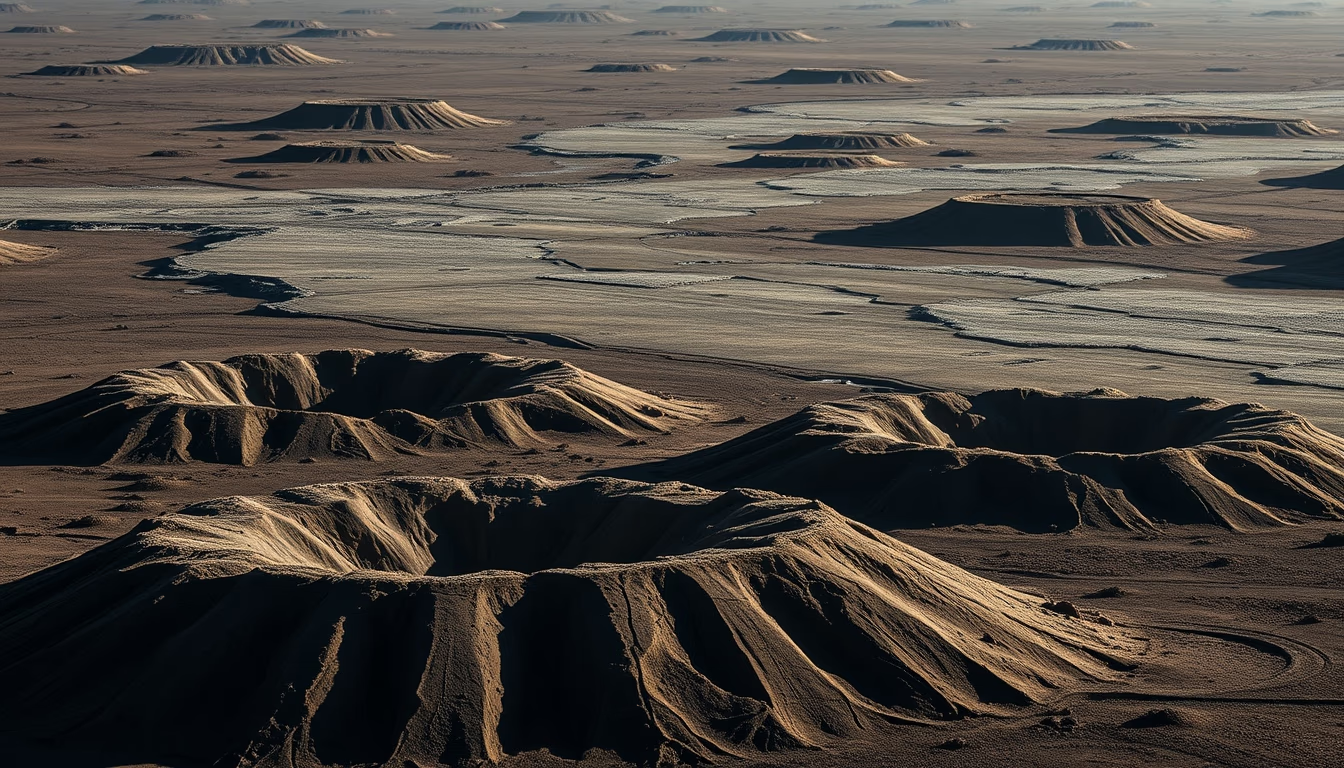
The craters on Mercury's surface reveal the intense impact history of the closest planet to the Sun, with unique features such as the giant Caloris Basin.
About this subject
Mercury, the smallest planet in the Solar System, has a heavily cratered surface reminiscent of the Moon but with distinct differences. Mercurian craters range from small pits to vast impact basins, such as the Caloris Basin, about 1,550 km in diameter. Formed approximately 3.8 billion years ago, Caloris is one of the largest impact structures in the Solar System and has been crucial for understanding the relative ages of planetary surfaces.
Unlike the Moon, Mercury has a thin exosphere and a global magnetic field, which influence crater preservation. The lack of a significant atmosphere allows impacts of all sizes to reach the surface without erosion, preserving billions of years of records. Craters like Rachmaninoff and Debussy exhibit central peaks and ray systems, indicating fresh ejecta materials.
Recent studies from the MESSENGER spacecraft revealed that Mercury's craters contain water ice in permanently shadowed areas, despite extreme daytime temperatures. This occurs because the planet's rotation axis is nearly perpendicular to its orbital plane, creating permanent shadows in some polar craters. Additionally, the composition of craters provides clues about Mercury's crust, rich in sulfur and potassium, unlike other rocky bodies.
Crater counting on Mercury has helped calibrate the geologic time scale of the inner Solar System. Regions like smooth plains, likely formed by volcanic activity, have fewer craters, indicating younger ages. This combination of impact craters and volcanism makes Mercury a natural laboratory for understanding primordial planetary processes.
Frequently Asked Questions
Why does Mercury have so many craters?
Mercury's surface is heavily cratered because its atmosphere is extremely thin, unable to disintegrate or slow down impacts. Additionally, the planet experienced intense bombardment during the first billion years of the Solar System.
What is the largest crater on Mercury?
The largest crater on Mercury is the Caloris Basin, about 1,550 km in diameter. It was formed by a massive impact approximately 3.8 billion years ago and is surrounded by concentric rings and volcanic plains.
Is there ice in Mercury's craters?
Yes, water ice deposits have been found in permanently shadowed craters near Mercury's poles, despite daytime temperatures exceeding 400°C. The ice is shielded from direct sunlight for billions of years.
Direct URL
https://pub-c7d6a6ea828543ac903a74a341ccb2e1.r2.dev/imagens/mercury-surface-craters-magazine-editorial-p12.avifHow to credit
Include a visible link back to UtilizAí. Copy one of the snippets below:
<a href="https://xn--utiliza-eza.com/en/midia/imagens/mercury-surface-craters-magazine-editorial-p12">Mercury surface craters</a> by <a href="https://xn--utiliza-eza.com">UtilizAí</a>, licensed under <a href="https://creativecommons.org/licenses/by/4.0/">CC BY 4.0</a>.
[Mercury surface craters](https://xn--utiliza-eza.com/en/midia/imagens/mercury-surface-craters-magazine-editorial-p12) by [UtilizAí](https://xn--utiliza-eza.com), CC BY 4.0
License: CC-BY-4.0