Mars rover detailed
1344×768 · AVIF · CC BY 4.0
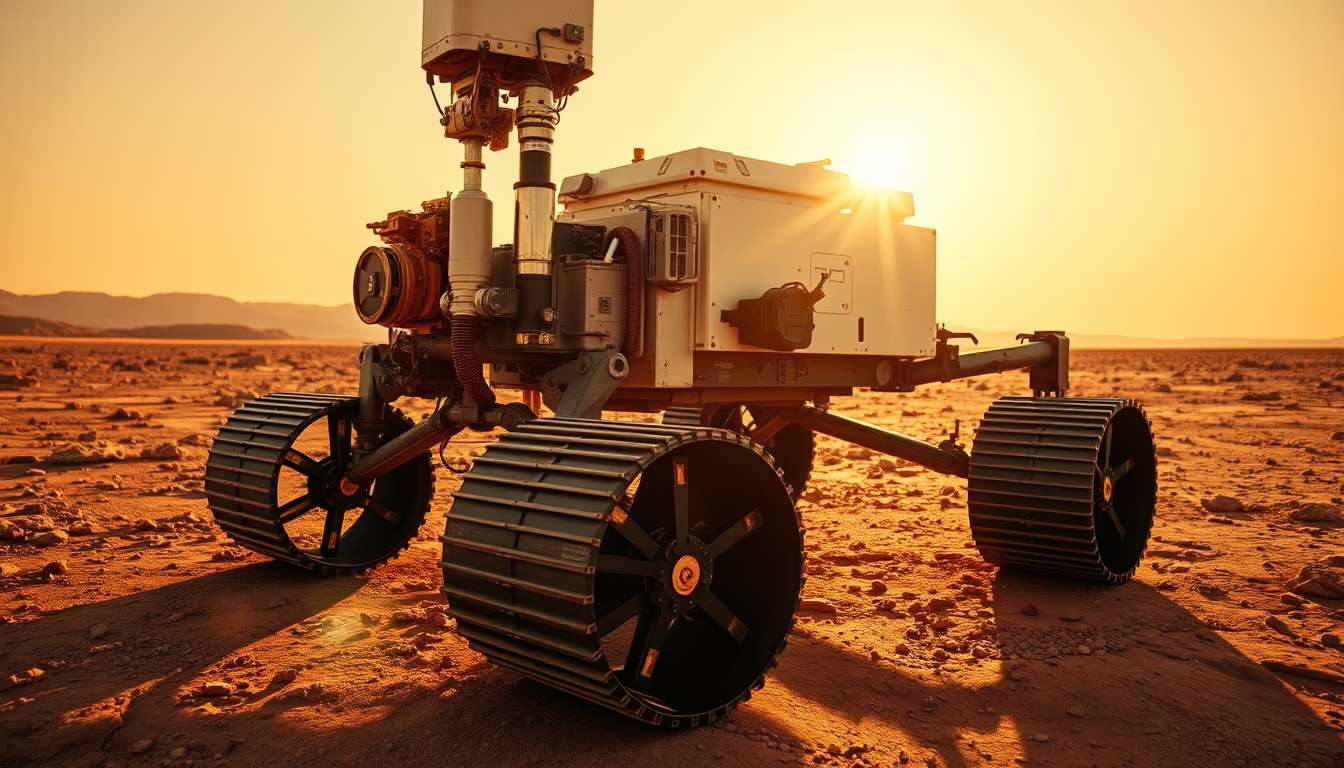
Discover the robot exploring Mars in detail: history, technology, and discoveries of the rovers that revolutionized planetary science.
About this subject
Mars rovers are robotic vehicles designed to explore the Martian surface, collect geological data, and search for signs of past life. Since the first rover, Sojourner, in 1997, NASA has sent four generations of robots: Spirit, Opportunity, Curiosity, and Perseverance. Each mission brought significant advances in autonomy, instrumentation, and resilience to the harsh Martian environment.
Curiosity, which landed in 2012, carries the largest laboratory ever sent to another planet. It has already discovered that Mars had lakes and rivers for billions of years and detected complex organic compounds. Its successor, Perseverance, landed in 2021 in Jezero Crater, an ancient river delta, to collect samples that will be returned to Earth by a future mission. The attached Ingenuity helicopter performed the first powered flight on another world.
Rovers operate under extreme conditions: temperatures ranging from -90°C to -20°C, dust storms, and intense cosmic radiation. Their systems include radioisotope thermoelectric generators and solar panels, as well as multispectral cameras, spectrometers, and drills for rock coring. Every sol (Martian day, 40 minutes longer than Earth's), rovers execute commands sent from Earth with a delay of up to 20 minutes.
Robotic exploration of Mars is a crucial step for future crewed missions. Data from Perseverance and Curiosity has already mapped resources like frozen water and minerals that could sustain human bases. Additionally, astrobiological research seeks evidence of ancient microorganisms. Each rover expands our understanding of the Red Planet's climatic and geological history.
Frequently Asked Questions
How many rovers have been sent to Mars?
As of 2024, 5 rovers have successfully landed: Sojourner (1997), Spirit and Opportunity (2004), Curiosity (2012), and Perseverance (2021). China also landed the Zhurong rover in 2021.
What is the main goal of the Perseverance rover?
Perseverance aims to collect soil and rock samples from Jezero Crater for return to Earth. It also tests oxygen production technology and studies geology searching for biosignatures.
How do rovers move on Martian terrain?
They use motorized wheels with an adaptive suspension system to overcome obstacles. Navigation relies on stereo cameras and computer vision algorithms, with commands sent via the Deep Space Network.
Direct URL
https://pub-c7d6a6ea828543ac903a74a341ccb2e1.r2.dev/imagens/mars-rover-detailed-travel-photography-p12.avifHow to credit
Include a visible link back to UtilizAí. Copy one of the snippets below:
<a href="https://xn--utiliza-eza.com/en/midia/imagens/mars-rover-detailed-travel-photography-p12">Mars rover detailed</a> by <a href="https://xn--utiliza-eza.com">UtilizAí</a>, licensed under <a href="https://creativecommons.org/licenses/by/4.0/">CC BY 4.0</a>.
[Mars rover detailed](https://xn--utiliza-eza.com/en/midia/imagens/mars-rover-detailed-travel-photography-p12) by [UtilizAí](https://xn--utiliza-eza.com), CC BY 4.0
License: CC-BY-4.0





