Mars rover detailed
1344×768 · AVIF · CC BY 4.0
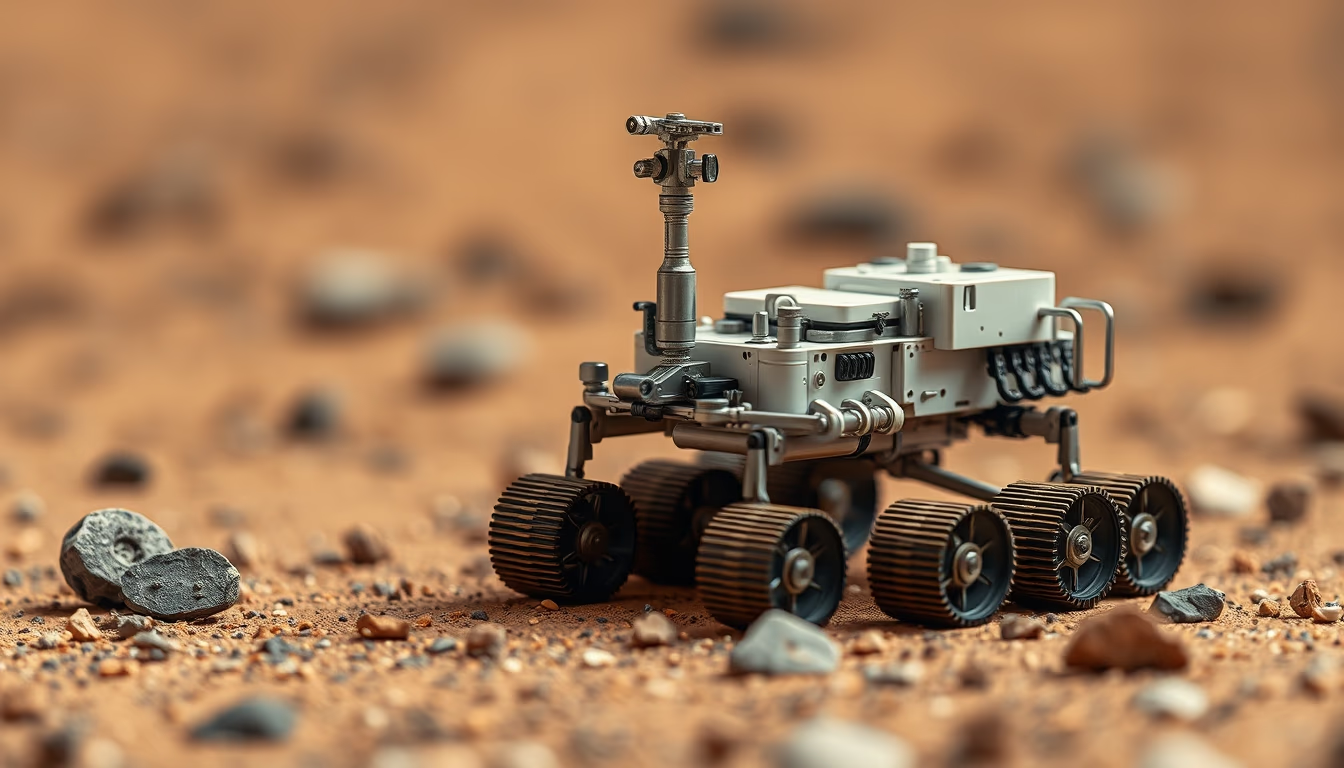
A detailed exploration of Mars rovers, robotic vehicles that revolutionized planetary science with discoveries about the red planet's past.
About this subject
Mars rovers are robotic vehicles sent by NASA and other space agencies to explore the surface of Mars. Since the first rover, Sojourner, in 1997, to the latest, Perseverance, in 2021, these missions have transformed our understanding of the planet. Sojourner was part of the Mars Pathfinder mission and demonstrated the feasibility of robotic locomotion on Mars. Then the twin rovers Spirit and Opportunity, launched in 2003, operated for years far beyond expectations, with Opportunity traveling over 45 km and lasting 15 years. Curiosity, which landed in 2012, is a car-sized mobile laboratory equipped with instruments like ChemCam, which uses a laser to analyze rocks. Perseverance is the most advanced, focused on astrobiology and collecting samples for a future sample-return mission to Earth.
The technology onboard these rovers is impressive. They feature autonomous navigation systems using stereo cameras and artificial intelligence algorithms to avoid obstacles and plan routes. Scientific instruments include spectrometers, such as Curiosity's APXS, and drills for coring rocks and collecting samples. Perseverance carries SHERLOC, which detects organic compounds, and MOXIE, which tests oxygen production from Martian CO2. Additionally, the rover brought the helicopter Ingenuity, which conducted demonstration flights in the low-pressure atmosphere.
Scientific discoveries have been revolutionary. Opportunity found evidence that Mars once had liquid water on its surface, with rock formations indicating lake environments. Curiosity detected complex organic molecules and seasonal variations of methane, suggesting possible biological or geological sources. Perseverance is collecting rock and soil samples from the ancient Jezero lake delta, which could contain signs of past microbial life. These missions also provided data on Martian climate and geology, paving the way for future crewed missions. Remarkably, Opportunity operated 14 years beyond its planned lifetime, and Perseverance remains active, sending high-resolution images and data that captivate the world.
Frequently Asked Questions
How many rovers have landed on Mars?
As of 2024, five NASA rovers have successfully landed: Sojourner, Spirit, Opportunity, Curiosity, and Perseverance. Additionally, China's Zhurong rover landed in 2021, totaling six operational rovers on Mars.
What is the main difference between Curiosity and Perseverance?
Curiosity focuses on geology and climate, while Perseverance is geared toward astrobiology and sample collection for a future return to Earth. Perseverance also carries instruments like MOXIE and the helicopter Ingenuity.
How are rovers controlled from Earth?
Due to communication delays ranging from 4 to 24 minutes, rovers are not controlled in real time. They receive pre-programmed commands in daily windows and execute tasks autonomously using navigation systems and artificial intelligence.
Direct URL
https://pub-c7d6a6ea828543ac903a74a341ccb2e1.r2.dev/imagens/mars-rover-detailed-tilt-shift-miniature-p2.avifHow to credit
Include a visible link back to UtilizAí. Copy one of the snippets below:
<a href="https://xn--utiliza-eza.com/en/midia/imagens/mars-rover-detailed-tilt-shift-miniature-p2">Mars rover detailed</a> by <a href="https://xn--utiliza-eza.com">UtilizAí</a>, licensed under <a href="https://creativecommons.org/licenses/by/4.0/">CC BY 4.0</a>.
[Mars rover detailed](https://xn--utiliza-eza.com/en/midia/imagens/mars-rover-detailed-tilt-shift-miniature-p2) by [UtilizAí](https://xn--utiliza-eza.com), CC BY 4.0
License: CC-BY-4.0