Mars rover detailed
1344×768 · AVIF · CC BY 4.0
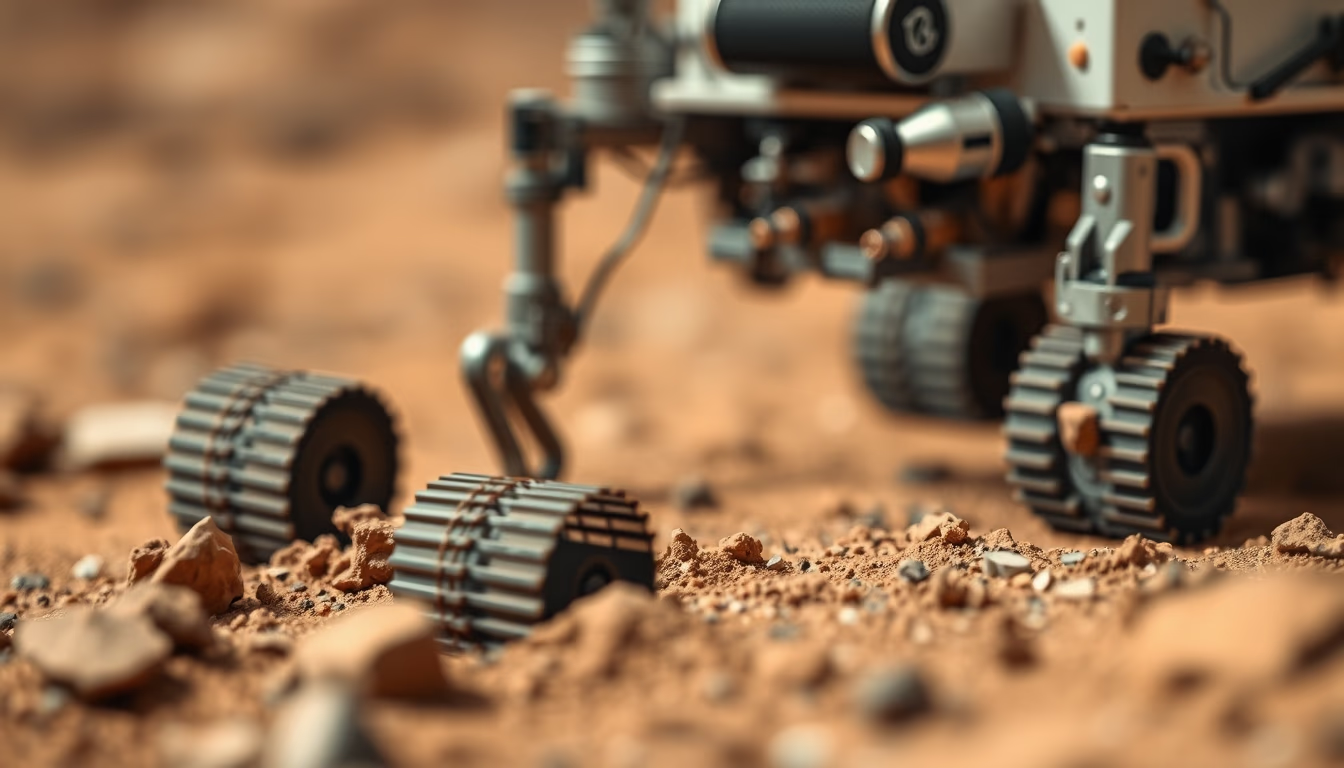
Robotic probe on Mars: technical details of rovers exploring the Martian soil and searching for signs of past life.
About this subject
Mars rovers are robotic vehicles designed to explore the Martian surface, collect samples, and conduct scientific experiments. From the first rover, Sojourner, which landed in 1997 as part of the Pathfinder mission, to the latest Perseverance, launched in 2020, technological evolution has been remarkable. Sojourner weighed only 10.5 kg and traveled about 100 meters during its mission. Curiosity, which began operations in 2012, is the size of a small car, 3 meters long and 900 kg, carrying 10 advanced scientific instruments. Perseverance incorporates sampling and caching systems for future sample return, along with the first helicopter to fly on another planet, Ingenuity.
Each rover is equipped with high-resolution cameras, spectrometers, environmental sensors, and robotic arms. Cameras like Curiosity's Mastcam and Perseverance's SuperCam allow remote analysis of rocks and soil. Rovers also have autonomous navigation systems, such as Autonav, enabling them to avoid obstacles while plotting optimized routes. Power is supplied by solar panels (Sojourner, Opportunity) or radioisotope thermoelectric generators (Curiosity, Perseverance), ensuring operation through cold nights and dust storms.
Rover discoveries have transformed our understanding of Mars. Opportunity, which operated for 14 years, confirmed the presence of liquid water in the past through hematite deposits. Curiosity found evidence of ancient lakes and organic molecules, indicating Mars once had conditions favorable for life. Perseverance, operating in Jezero Crater, investigates fossilized river deltas and seeks biosignatures. Additionally, rovers test technologies for future crewed missions, such as producing oxygen from atmospheric CO2.
Macro details of rovers reveal specific components like aluminum wheels with treads for traction on uneven terrain or the robotic arm with tools for abrasion and collection. Instruments such as PIXL (X-ray fluorescence) and SHERLOC (Raman spectroscopy) are mounted on sensor turrets, while lightning rods and communication antennas ensure connection with orbiters and Earth. Every bolt and gear is designed to withstand extreme temperatures, cosmic radiation, and daily thermal cycles from -90°C to 20°C.
Frequently Asked Questions
How many rovers have landed on Mars?
As of 2024, six rovers have landed successfully: Sojourner (1997), Spirit and Opportunity (2004), Curiosity (2012), Perseverance (2021), and China's Zhurong (2021). Opportunity and Curiosity are still partially operational, while Perseverance and Zhurong remain active.
What is the main difference between Curiosity and Perseverance?
Perseverance is more advanced, with the ability to collect and cache samples for a future return mission, and it carries the Ingenuity helicopter. Its instrument suite focuses on astrobiology and searching for signs of ancient microbial life.
How do rovers communicate with Earth?
They send data to orbiters around Mars, such as the Mars Reconnaissance Orbiter, which relay it to antennas on Earth. Direct communication is limited by long distances and obstructions.
Direct URL
https://pub-c7d6a6ea828543ac903a74a341ccb2e1.r2.dev/imagens/mars-rover-detailed-macro-closeup-p7.avifHow to credit
Include a visible link back to UtilizAí. Copy one of the snippets below:
<a href="https://xn--utiliza-eza.com/en/midia/imagens/mars-rover-detailed-macro-closeup-p7">Mars rover detailed</a> by <a href="https://xn--utiliza-eza.com">UtilizAí</a>, licensed under <a href="https://creativecommons.org/licenses/by/4.0/">CC BY 4.0</a>.
[Mars rover detailed](https://xn--utiliza-eza.com/en/midia/imagens/mars-rover-detailed-macro-closeup-p7) by [UtilizAí](https://xn--utiliza-eza.com), CC BY 4.0
License: CC-BY-4.0