Mars rover detailed
1344×768 · AVIF · CC BY 4.0
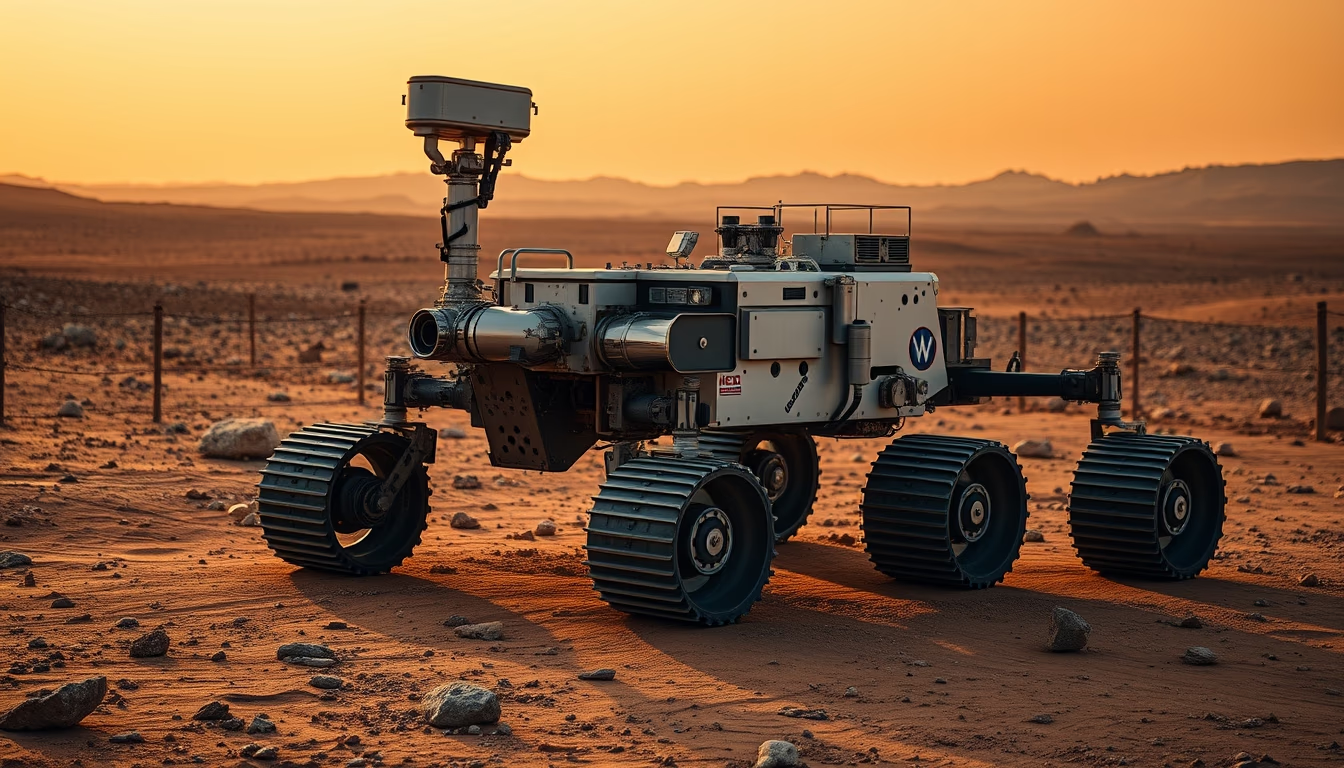
NASA's robotic rovers have been exploring Mars since 1997, transforming our knowledge of the Red Planet with geological analysis and a search for past life.
About this subject
Mars rovers are robotic vehicles designed to traverse the surface of Mars, equipped with scientific instruments to study the soil, rocks, and atmosphere. Since the first rover, Sojourner, which landed in 1997 as part of the Mars Pathfinder mission, NASA has sent increasingly sophisticated explorers. Spirit and Opportunity arrived in 2004 and operated years beyond their expected lifetimes, with Opportunity covering over 45 kilometers before being lost in 2018. Curiosity, active since 2012, made crucial discoveries by identifying evidence of an ancient aqueous environment in Gale Crater. The latest, Perseverance, landed in 2021 in Jezero Crater with the goal of collecting soil samples for a future return mission, as well as testing the Ingenuity helicopter, the first powered flight on another planet.
These vehicles rely on solar or nuclear power (such as the radioisotope thermoelectric generator on Curiosity and Perseverance) to operate in temperatures that can drop below -100°C. Communication with Earth occurs through orbiters like the Mars Reconnaissance Orbiter, which relay data within limited windows. Each rover carries cameras, spectrometers, weather sensors, and abrasion tools, such as Perseverance's drill that cuts rocks for analysis. One of the biggest technical challenges is automation: rovers must make basic navigation decisions autonomously due to a communication delay of 4 to 24 minutes.
Culturally, rovers have captured global imagination, generating iconic images like Curiosity's 'selfie' or Perseverance's landing video (known as '7 minutes of terror'). They also spurred international collaborations, such as Canada's contribution of the robotic arm for Perseverance. With each new mission, design evolves: larger wheels to avoid damage (like the holes that afflicted Curiosity), lighter instruments, and enhanced autonomous capability. The future includes missions like China's Zhurong rover (which landed in 2021) and ESA's planned Rosalind Franklin rover, slated for 2028. Data collected by these robots is fundamental to understanding Mars' geological history and preparing for future crewed missions.
Frequently Asked Questions
How many rovers have landed on Mars?
As of 2025, five rovers have successfully operated on the Martian surface: Sojourner (1997), Spirit and Opportunity (2004), Curiosity (2012), and Perseverance (2021). China's Zhurong rover landed in 2021 and is also active.
What is the difference between Curiosity and Perseverance?
Perseverance is more advanced, focusing on sample collection for return to Earth, while Curiosity studies past habitability. Perseverance carries the Ingenuity helicopter and instruments to produce oxygen from Martian CO2.
How do rovers communicate with Earth?
They send data to Mars orbiters (like Mars Reconnaissance Orbiter and MAVEN), which relay to antennas on Earth. The signal delay ranges from 4 to 24 minutes, depending on the distance between the planets.
Direct URL
https://pub-c7d6a6ea828543ac903a74a341ccb2e1.r2.dev/imagens/mars-rover-detailed-cinematic-wide-shot-p4.avifHow to credit
Include a visible link back to UtilizAí. Copy one of the snippets below:
<a href="https://xn--utiliza-eza.com/en/midia/imagens/mars-rover-detailed-cinematic-wide-shot-p4">Mars rover detailed</a> by <a href="https://xn--utiliza-eza.com">UtilizAí</a>, licensed under <a href="https://creativecommons.org/licenses/by/4.0/">CC BY 4.0</a>.
[Mars rover detailed](https://xn--utiliza-eza.com/en/midia/imagens/mars-rover-detailed-cinematic-wide-shot-p4) by [UtilizAí](https://xn--utiliza-eza.com), CC BY 4.0
License: CC-BY-4.0