Manga panels black white
1344×768 · AVIF · CC BY 4.0
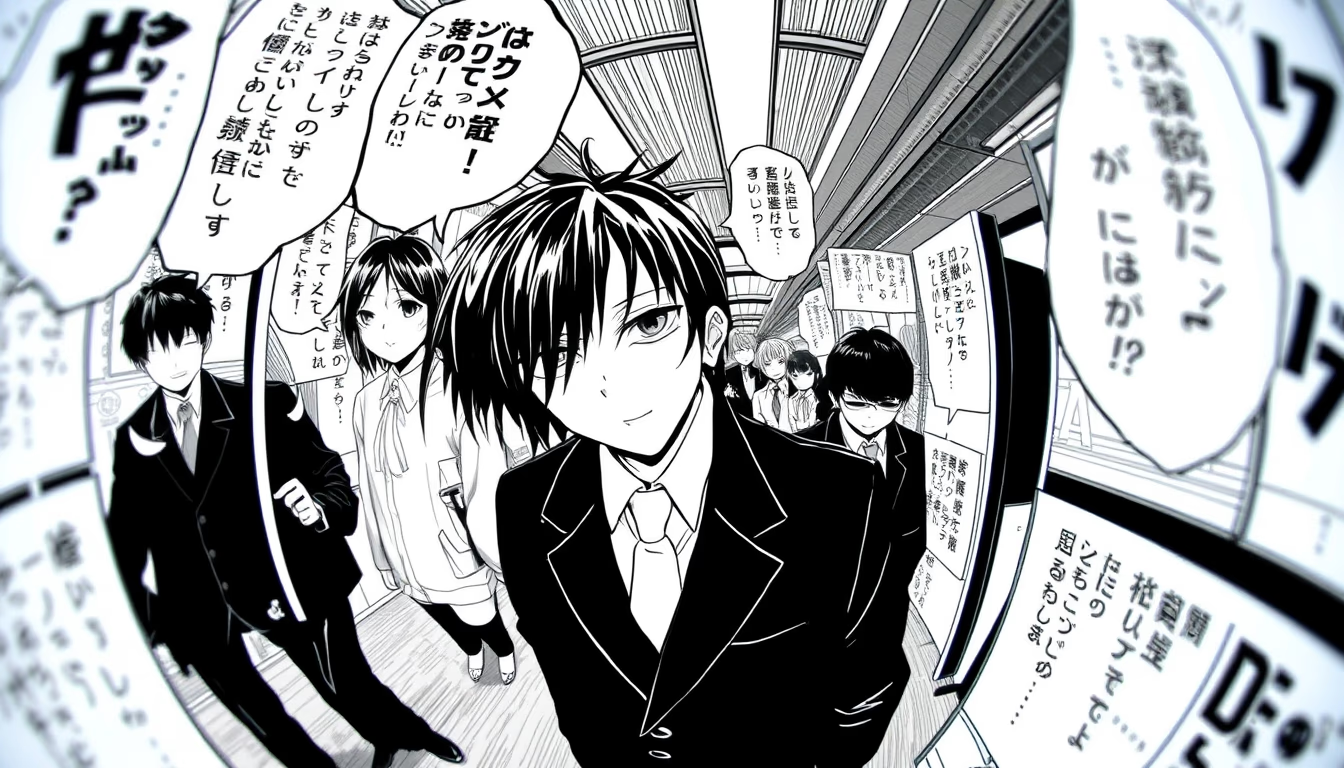
Manga artists use black-and-white panels with fisheye distortion to create visual impact and depth in action scenes.
About this subject
The sequential art of manga frequently employs black-and-white panels to tell stories dynamically and economically. The absence of color allows linework and composition to take center stage, highlighting contrasts and textures. The fisheye lens distortion technique, borrowed from photography, is used by mangakas to amplify the sense of motion and exaggerated perspective, especially in fight or chase scenes. This visual approach creates unique immersion, distorting space to guide the reader's eye across the page.
In Japan, using black and white is not only an aesthetic choice but also a practical necessity due to printing costs. This has led artists to master the use of hatching, screentones, and solid blacks to convey volume, emotion, and speed. The contrast between pure black and white is fundamental to creating impact, while lens distortion amplifies the sense of urgency or intimacy with the character.
Panel layout in manga follows a specific reading order (right to left in original, adapted in translations). Each frame functions as a camera shot: low angles, close-ups, and Dutch angles are common. Fisheye distortion, for instance, can be used to show an incoming punch or to emphasize a character's reaction, creating a cinematic effect that engages the reader.
Interestingly, the fisheye technique also appears in sports manga, such as basketball throws in works like Slam Dunk, where distortion amplifies the height and power of the movement. Thus, black-and-white panels with fisheye distortion are not merely a stylistic device but a powerful narrative tool that explores the visual language of Japanese comics.
Frequently Asked Questions
Why are manga usually black and white?
The main reason is economic: color printing is much more expensive, especially for high-circulation weekly magazines. Black and white also allows artists to focus on linework and visual storytelling, and it has become a stylistic hallmark of the medium.
What is the fisheye effect in manga?
It is a visual distortion mimicking extreme wide-angle lenses, creating curved lines and exaggerating depth. In manga, it is used to convey speed, impact, or unusual perspectives, such as in action scenes or dramatic close-ups.
How do manga panels guide reading?
In the original Japanese format, panels are read from right to left and top to bottom. The size and shape of frames control pacing: large panels for important moments, small ones for fast action. Perspective distortion also directs the eye.
Direct URL
https://pub-c7d6a6ea828543ac903a74a341ccb2e1.r2.dev/imagens/manga-panels-black-white-fish-eye-wide-angle-fresh5.avifHow to credit
Include a visible link back to UtilizAí. Copy one of the snippets below:
<a href="https://xn--utiliza-eza.com/en/midia/imagens/manga-panels-black-white-fish-eye-wide-angle-fresh5">Manga panels black white</a> by <a href="https://xn--utiliza-eza.com">UtilizAí</a>, licensed under <a href="https://creativecommons.org/licenses/by/4.0/">CC BY 4.0</a>.
[Manga panels black white](https://xn--utiliza-eza.com/en/midia/imagens/manga-panels-black-white-fish-eye-wide-angle-fresh5) by [UtilizAí](https://xn--utiliza-eza.com), CC BY 4.0
License: CC-BY-4.0