Malachite green pattern
1344×768 · AVIF · CC BY 4.0
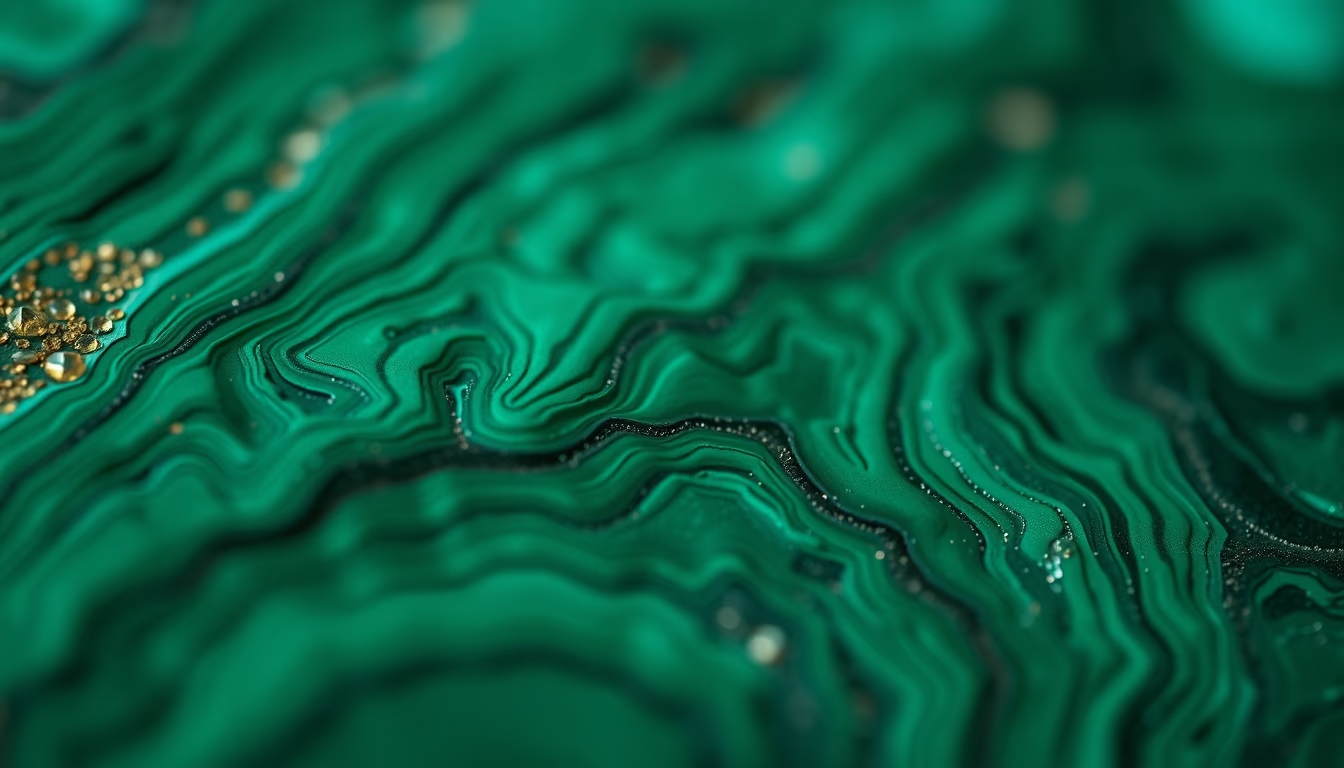
Wavy patterns in intense green characterize malachite, a copper carbonate formed in oxidation zones of copper deposits.
About this subject
Malachite is a secondary copper mineral with the chemical formula Cu₂CO₃(OH)₂. It forms through the alteration of primary copper minerals like chalcopyrite in weathering and oxidation environments. Its characteristic green color, ranging from light to dark green, is due to the presence of copper ions. Structurally, malachite crystallizes in the monoclinic system but is best known for its fibrous or concentric layered aggregates that produce wavy, banded patterns highly valued in jewelry and lapidary work.
Historically, malachite was used as a green pigment in paintings in ancient Egypt and Renaissance Europe. The name 'malachite' derives from the Greek 'malache', referring to the color of the mallow leaf. In ancient Egypt, it was ground into powder for eye shadow and used in amulets. Major deposits are found in the Democratic Republic of the Congo, Russia (Ural Mountains), Mexico, Chile, and Australia. In Brazil, it occurs in Minas Gerais, Bahia, and Goiás, associated with copper deposits.
Today, malachite is primarily used as an ornamental gemstone and in decorative objects. Because it is relatively soft (hardness 3.5 to 4 on the Mohs scale), it is easily carved. It is also used as a secondary source of copper and, to a lesser extent, as a pigment in ceramics. Collectors value specimens with well-defined patterns and vibrant colors. Malachite can be identified by its light green streak, effervescence in dilute hydrochloric acid, and characteristic color.
Frequently Asked Questions
Is malachite a precious stone?
Technically, malachite is an ornamental gemstone, but it is not considered a classic precious stone like diamond, ruby, or sapphire. It is valued for its patterns and colors, used in jewelry and decorative objects, but its relatively low hardness (3.5-4) makes it less suitable for daily wear rings.
Where can malachite be found in Brazil?
In Brazil, malachite is found mainly in Minas Gerais, Bahia, and Goiás, associated with copper deposits. Locations such as the Camaçari Mine (BA) and the Carajás region (PA) also have occurrences.
What is the difference between malachite and azurite?
Malachite and azurite are both copper carbonate minerals, but azurite is blue due to a slightly different crystal structure (Cu₃(CO₃)₂(OH)₂). They often occur together in oxidized copper deposits, forming 'malachite-azurite'.
Direct URL
https://pub-c7d6a6ea828543ac903a74a341ccb2e1.r2.dev/imagens/malachite-green-pattern-macro-closeup-p3.avifHow to credit
Include a visible link back to UtilizAí. Copy one of the snippets below:
<a href="https://xn--utiliza-eza.com/en/midia/imagens/malachite-green-pattern-macro-closeup-p3">Malachite green pattern</a> by <a href="https://xn--utiliza-eza.com">UtilizAí</a>, licensed under <a href="https://creativecommons.org/licenses/by/4.0/">CC BY 4.0</a>.
[Malachite green pattern](https://xn--utiliza-eza.com/en/midia/imagens/malachite-green-pattern-macro-closeup-p3) by [UtilizAí](https://xn--utiliza-eza.com), CC BY 4.0
License: CC-BY-4.0