Liquid cooling loop
1344×768 · AVIF · CC BY 4.0
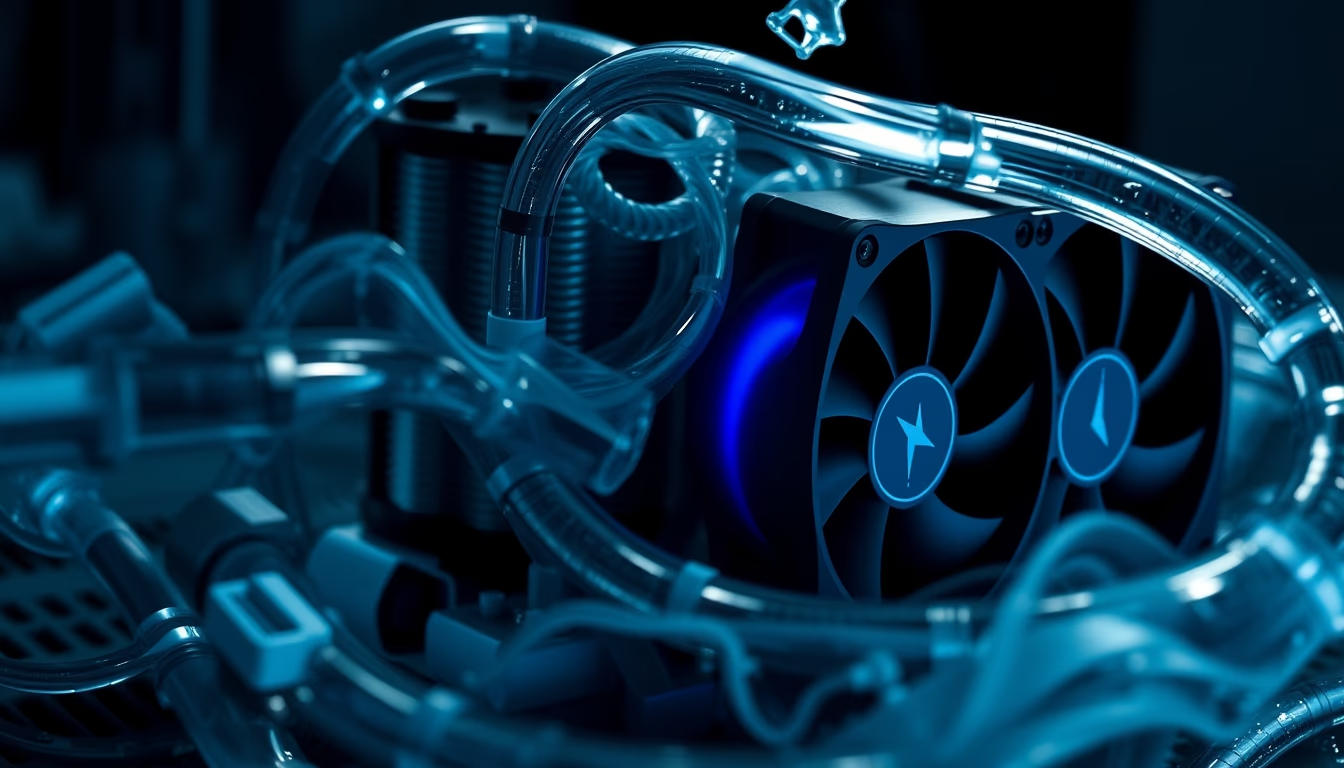
Liquid cooling loop for computers: how it works, components, and benefits for overclocking and silence.
About this subject
A liquid cooling loop is an advanced thermal dissipation system used in high-performance computers, such as workstations, servers, and especially gaming PCs and overclocking enthusiasts. Unlike traditional air coolers that rely on heat pipes and fans, a liquid loop transfers heat via a coolant, usually distilled water mixed with anticorrosive additives, that circulates through tubes, water blocks placed on hot components, radiators, and a pump.
The principle is similar to a car radiator: the pump pushes liquid through a metal block (typically copper or nickel) in contact with the CPU or GPU; heat transfers to the liquid, which then flows to a radiator where fans expel the heat into the ambient air. A reservoir maintains fluid volume and helps remove air bubbles. The superior thermal efficiency enables lower temperatures even under extreme loads, allowing higher clock frequencies and better stability.
Custom loops (hand-built) offer aesthetic customization and better performance than all-in-one (AIO) liquid coolers, but require periodic maintenance, such as coolant replacement and radiator cleaning. The modding community values the visual appeal with rigid acrylic tubes, RGB lighting, and colored fluids, turning the system into functional art. In data centers, larger loops cool server racks with greater energy efficiency, reducing air conditioning costs.
Notably, the first water-cooling systems for home PCs emerged in the early 2000s, adapted from industrial methods. Today, brands like Corsair, EK Water Blocks, and Alphacool dominate the market. Despite higher cost and installation complexity, liquid cooling is synonymous with extreme performance and silent operation when well designed.
Frequently Asked Questions
What is the difference between an AIO liquid cooler and a custom loop?
AIO (All-In-One) coolers are sealed, pre-assembled units that are easier to install and require minimal maintenance, but have limited performance. Custom loops allow you to choose each component (pump, radiator, blocks) for better cooling and personalization, though they require assembly and periodic maintenance such as fluid replacement and cleaning.
Is it safe to use distilled water in liquid cooling?
Yes, distilled water is the most common coolant because it does not conduct electricity and has low corrosiveness. Additives such as corrosion inhibitors and biocides are recommended to prevent algae growth and protect the metals in the system.
Is liquid cooling quiet?
It can be quieter than high-performance air coolers because larger radiators allow fans to spin at lower speeds. However, the pump and fans still generate noise. A well-designed loop can be nearly silent at idle and discreet under load.
Direct URL
https://pub-c7d6a6ea828543ac903a74a341ccb2e1.r2.dev/imagens/liquid-cooling-loop-fine-art-photography-p9.avifHow to credit
Include a visible link back to UtilizAí. Copy one of the snippets below:
<a href="https://xn--utiliza-eza.com/en/midia/imagens/liquid-cooling-loop-fine-art-photography-p9">Liquid cooling loop</a> by <a href="https://xn--utiliza-eza.com">UtilizAí</a>, licensed under <a href="https://creativecommons.org/licenses/by/4.0/">CC BY 4.0</a>.
[Liquid cooling loop](https://xn--utiliza-eza.com/en/midia/imagens/liquid-cooling-loop-fine-art-photography-p9) by [UtilizAí](https://xn--utiliza-eza.com), CC BY 4.0
License: CC-BY-4.0