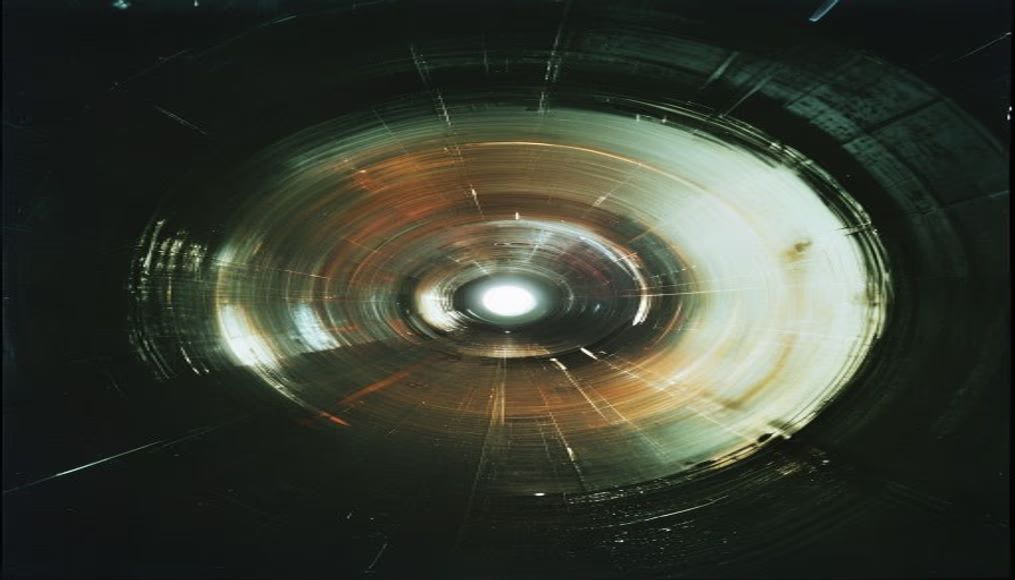
Kuiper belt distant
1344×768 · AVIF · CC BY 4.0

The Kuiper Belt is an icy region beyond Neptune, filled with dwarf planets and primordial bodies from the early Solar System.
About this subject
The Kuiper Belt is a vast, disk-shaped region beyond Neptune's orbit, extending roughly from 30 to 50 astronomical units from the Sun. It hosts thousands of icy bodies, including dwarf planets such as Pluto, Eris, Makemake, and Haumea. These objects are considered fossils of the early Solar System, preserving material that never coalesced into larger planets.
Theoretically proposed by Gerard Kuiper in 1951, the belt was confirmed observationally in the 1990s with the detection of 1992 QB1. The Kuiper Belt is much larger and more massive than the asteroid belt between Mars and Jupiter, containing hundreds of thousands of objects over 100 km in diameter. Its composition is dominated by water, methane, and ammonia ices, along with rock.
NASA's New Horizons mission, which flew by Pluto in 2015, provided the most detailed data on a Kuiper Belt object. Later, the probe visited Arrokoth (2014 MU69), a binary primordial world in the belt. The Kuiper Belt is also the source of short-period comets, like Halley's Comet, and its structure helps understand the dynamical evolution of the outer Solar System.
Interestingly, the Kuiper Belt is believed to extend far beyond what we directly observe, forming a diffuse halo called the scattered disk. There is ongoing debate about a possible undiscovered larger planet in the region, known as Planet Nine, which might influence the orbits of distant belt objects.
Frequently Asked Questions
What is the difference between the Kuiper Belt and the Oort Cloud?
The Kuiper Belt is a nearby, disk-shaped region from 30 to 50 AU from the Sun, containing icy bodies and dwarf planets. The Oort Cloud is a distant sphere up to 100,000 AU, with trillions of long-period comets.
How many objects are in the Kuiper Belt?
It is estimated that there are over 100,000 objects with diameters above 100 km, plus millions of smaller ones. Only a few thousand have been cataloged so far.
Is Pluto still considered part of the Kuiper Belt?
Yes, Pluto is the largest known object in the Kuiper Belt. Although reclassified as a dwarf planet in 2006, it orbits within the region and is one of its most iconic members.
Direct URL
https://pub-c7d6a6ea828543ac903a74a341ccb2e1.r2.dev/imagens/kuiper-belt-distant-lo-fi-disposable-camera-p10.avifHow to credit
Include a visible link back to UtilizAí. Copy one of the snippets below:
<a href="https://xn--utiliza-eza.com/en/midia/imagens/kuiper-belt-distant-lo-fi-disposable-camera-p10">Kuiper belt distant</a> by <a href="https://xn--utiliza-eza.com">UtilizAí</a>, licensed under <a href="https://creativecommons.org/licenses/by/4.0/">CC BY 4.0</a>.
[Kuiper belt distant](https://xn--utiliza-eza.com/en/midia/imagens/kuiper-belt-distant-lo-fi-disposable-camera-p10) by [UtilizAí](https://xn--utiliza-eza.com), CC BY 4.0
License: CC-BY-4.0