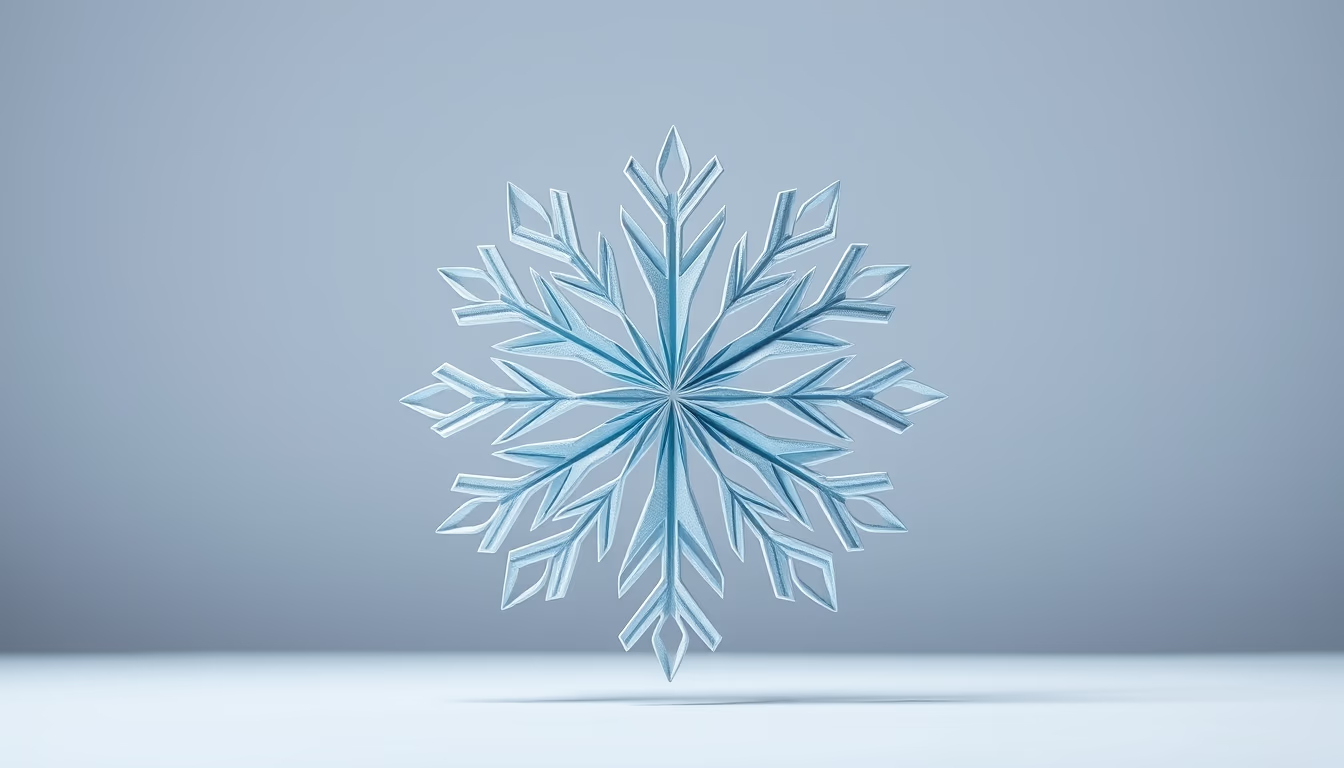
Kirigami snowflake
1344×768 · AVIF · CC BY 4.0

Kirigami snowflakes combine origami folds with precise cuts, creating three-dimensional paper ornaments for seasonal decoration.
About this subject
Kirigami, from the Japanese words 'kiru' (to cut) and 'kami' (paper), is an ancient technique that expands origami by allowing cuts in the paper. Unlike traditional snowflakes made only with scissors, the kirigami snowflake uses strategic folds to create more complex three-dimensional structures, such as stars and prisms. This art became popular in Japan during the Heian period (794-1185) and was adapted by Western artisans in the 19th century, when paper became more affordable.
In practice, a kirigami snowflake is created from a square sheet of paper, typically thin like tissue paper or washi, which undergoes a sequence of parallel and diagonal folds. After folding, the artist uses a craft knife or scissors to cut symmetrical patterns inspired by the natural crystallization of snow. The result is a delicate piece that can be opened like a rotating fan or hung as a mobile, ideal for decorating Christmas trees, windows, and winter parties.
Culturally, the kirigami snowflake represents ephemerality and the beauty of nature, values important to Japanese aesthetics. In Europe, the tradition of cutting paper ornaments emerged in Germany and Switzerland with 'scherenschnitte' (scissor cuts), which influenced modern design. Today, kirigami snowflakes are an educational activity that develops motor coordination and geometric sense, taught in schools and workshops. Artisans experiment with metallic paper, recycled materials, and even acetate, expanding creative possibilities.
Frequently Asked Questions
What is the difference between kirigami and origami?
In origami, the piece is created solely by folding, with no cuts. In kirigami, scissors or a craft knife are allowed, enabling openings and more elaborate three-dimensional shapes.
How to make a kirigami snowflake step by step?
Start with a square of thin paper. Fold in half into a triangle, then into a smaller triangle, and once more. Cut patterns along the edges and folds, such as triangles, circles, and zigzags. Unfold carefully to reveal the symmetrical snowflake.
What are the best papers for kirigami snowflakes?
Thin and strong papers, like tissue paper, Japanese washi, or lightweight printer paper, are ideal. They allow precise cuts and hold shape after opening. Avoid thick paper, which may tear.
Direct URL
https://pub-c7d6a6ea828543ac903a74a341ccb2e1.r2.dev/imagens/kirigami-snowflake-studio-editorial-portrait-fresh6.avifHow to credit
Include a visible link back to UtilizAí. Copy one of the snippets below:
<a href="https://xn--utiliza-eza.com/en/midia/imagens/kirigami-snowflake-studio-editorial-portrait-fresh6">Kirigami snowflake</a> by <a href="https://xn--utiliza-eza.com">UtilizAí</a>, licensed under <a href="https://creativecommons.org/licenses/by/4.0/">CC BY 4.0</a>.
[Kirigami snowflake](https://xn--utiliza-eza.com/en/midia/imagens/kirigami-snowflake-studio-editorial-portrait-fresh6) by [UtilizAí](https://xn--utiliza-eza.com), CC BY 4.0
License: CC-BY-4.0