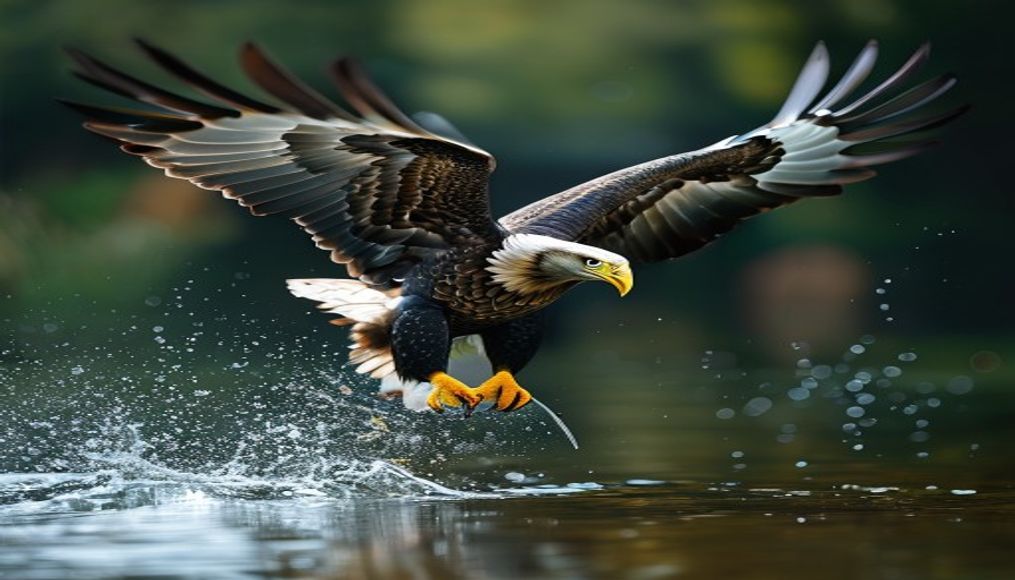
Kingfisher diving water
1344×768 · AVIF · CC BY 4.0

The kingfisher, an agile and colorful bird, performs precise dives into rivers and lakes to catch fish with impressive speed.
About this subject
Kingfishers belong to the family Alcedinidae and are found worldwide, with a strong presence in tropical regions. In Brazil, species such as the ringed kingfisher (Megaceryle torquata) and the green kingfisher (Chloroceryle americana) are common near water bodies. These birds have long, sharp bills adapted for spearing prey, and vibrant plumage ranging from blue and green to orange.
The kingfisher's dive is a biomechanical marvel. From a perch, it scans for prey, adjusts its dive angle, and folds its wings at impact to reduce water resistance. Its eyes feature a nictitating membrane that protects vision underwater, allowing precise calculation of fish position. Studies indicate dive speeds can reach 40 km/h.
These birds inhabit riverbanks, lakes, mangroves, and even coastal areas. They play a key role in controlling populations of small fish and aquatic invertebrates. Interestingly, some species, like the common kingfisher (Alcedo atthis), migrate seasonally, while others are resident. Nesting in burrows dug into dirt banks or arboreal termite mounds is also a distinctive trait.
For nature photographers, capturing the dive moment demands patience and knowledge of the bird's behavior. Morning or late afternoon light often enhances the plumage colors. Although challenging, sighting a kingfisher in action rewards any attentive observer.
Frequently Asked Questions
Why does the kingfisher dive with such precision?
The kingfisher has adaptations like nictitating membranes and the ability to adjust its dive angle. It calculates the prey's position before diving, folding its wings to reduce drag upon water entry.
Where can I find kingfishers in Brazil?
Species like the ringed kingfisher and green kingfisher are common in rivers, lakes, and mangroves across Brazil. The Amazon region and Pantanal offer good observation opportunities.
How fast does a kingfisher dive?
Studies indicate dive speeds can reach up to 40 km/h at the moment of impact. This speed, combined with visual precision, ensures efficient capture of fish.
Direct URL
https://pub-c7d6a6ea828543ac903a74a341ccb2e1.r2.dev/imagens/kingfisher-diving-water-travel-photography-p0.avifHow to credit
Include a visible link back to UtilizAí. Copy one of the snippets below:
<a href="https://xn--utiliza-eza.com/en/midia/imagens/kingfisher-diving-water-travel-photography-p0">Kingfisher diving water</a> by <a href="https://xn--utiliza-eza.com">UtilizAí</a>, licensed under <a href="https://creativecommons.org/licenses/by/4.0/">CC BY 4.0</a>.
[Kingfisher diving water](https://xn--utiliza-eza.com/en/midia/imagens/kingfisher-diving-water-travel-photography-p0) by [UtilizAí](https://xn--utiliza-eza.com), CC BY 4.0
License: CC-BY-4.0