Jupiter great red spot
1344×768 · AVIF · CC BY 4.0
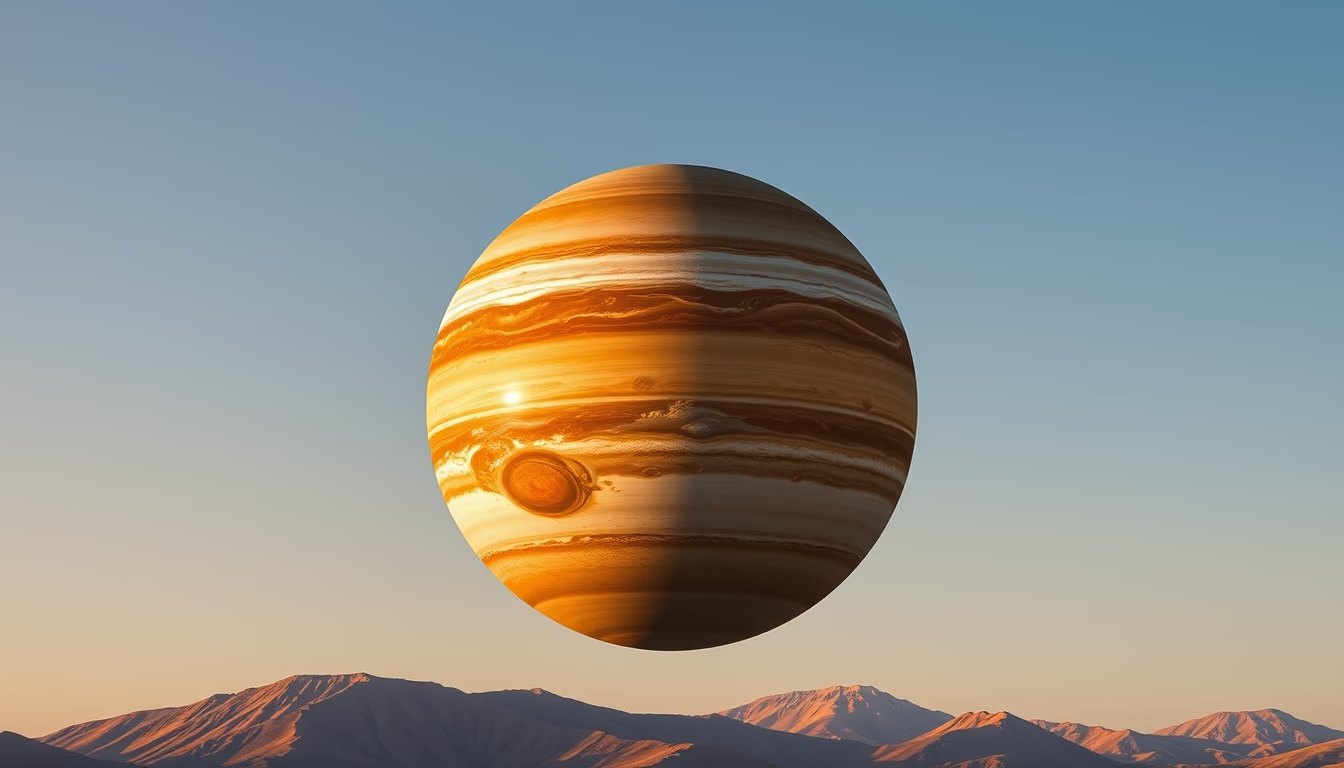
Jupiter's Great Red Spot is a giant anticyclonic storm, larger than Earth, observed for centuries on the gas giant.
About this subject
Jupiter's Great Red Spot is a planetary-scale atmospheric phenomenon, a persistent storm located in the planet's southern hemisphere. Discovered probably in the 17th century, possibly by Giovanni Cassini or Robert Hooke, it has been observed continuously since the 19th century. Its size is so vast that it could swallow Earth whole, although it is slowly shrinking: in the late 19th century, it had a diameter of about 41,000 km; today it measures approximately 16,000 km. The characteristic reddish color is not fully explained, but it is believed to result from chemical compounds such as phosphorus, sulfur, or complex hydrocarbons brought up by updrafts.
The storm rotates counterclockwise, with winds at the edge exceeding 400 km/h, and its centuries-long duration is attributed to Jupiter's lack of a solid surface: unlike terrestrial storms, it does not lose energy through ground friction. The Red Spot's clouds are higher and colder than their surroundings, reaching altitudes of 8 km above the surrounding clouds. NASA's Juno spacecraft, orbiting Jupiter since 2016, has provided detailed data on the storm's vertical structure and depth, revealing that its roots may extend 300 to 500 km below the cloud tops.
Besides the Great Red Spot, Jupiter has other storms and cloud bands, but none as long-lasting and iconic. Historical observation of the Red Spot has helped science understand the atmospheric dynamics of gas giants and exoplanets. Its decreasing size has intrigued scientists, who monitor its evolution hoping to better understand climate changes on Jupiter. The Spot remains one of the most fascinating targets for amateur and professional astronomy.
Frequently Asked Questions
Why is Jupiter's Great Red Spot red?
The reddish color is not fully understood, but it is believed to be caused by chemical compounds such as phosphorus, sulfur, or complex hydrocarbons brought up by updrafts from Jupiter's deep atmosphere.
Is the Great Red Spot shrinking?
Yes, the storm is slowly shrinking. In the late 19th century, its diameter was about 41,000 km; today it measures approximately 16,000 km. It is unknown whether it will continue to shrink or stabilize.
How long has the Great Red Spot existed?
Reliable observations date back to the 17th century, over 350 years. However, the storm may be much older, as Jupiter lacks a solid surface to dissipate storms.
Direct URL
https://pub-c7d6a6ea828543ac903a74a341ccb2e1.r2.dev/imagens/jupiter-great-red-spot-travel-photography-p11.avifHow to credit
Include a visible link back to UtilizAí. Copy one of the snippets below:
<a href="https://xn--utiliza-eza.com/en/midia/imagens/jupiter-great-red-spot-travel-photography-p11">Jupiter great red spot</a> by <a href="https://xn--utiliza-eza.com">UtilizAí</a>, licensed under <a href="https://creativecommons.org/licenses/by/4.0/">CC BY 4.0</a>.
[Jupiter great red spot](https://xn--utiliza-eza.com/en/midia/imagens/jupiter-great-red-spot-travel-photography-p11) by [UtilizAí](https://xn--utiliza-eza.com), CC BY 4.0
License: CC-BY-4.0