Jupiter great red spot
1344×768 · AVIF · CC BY 4.0
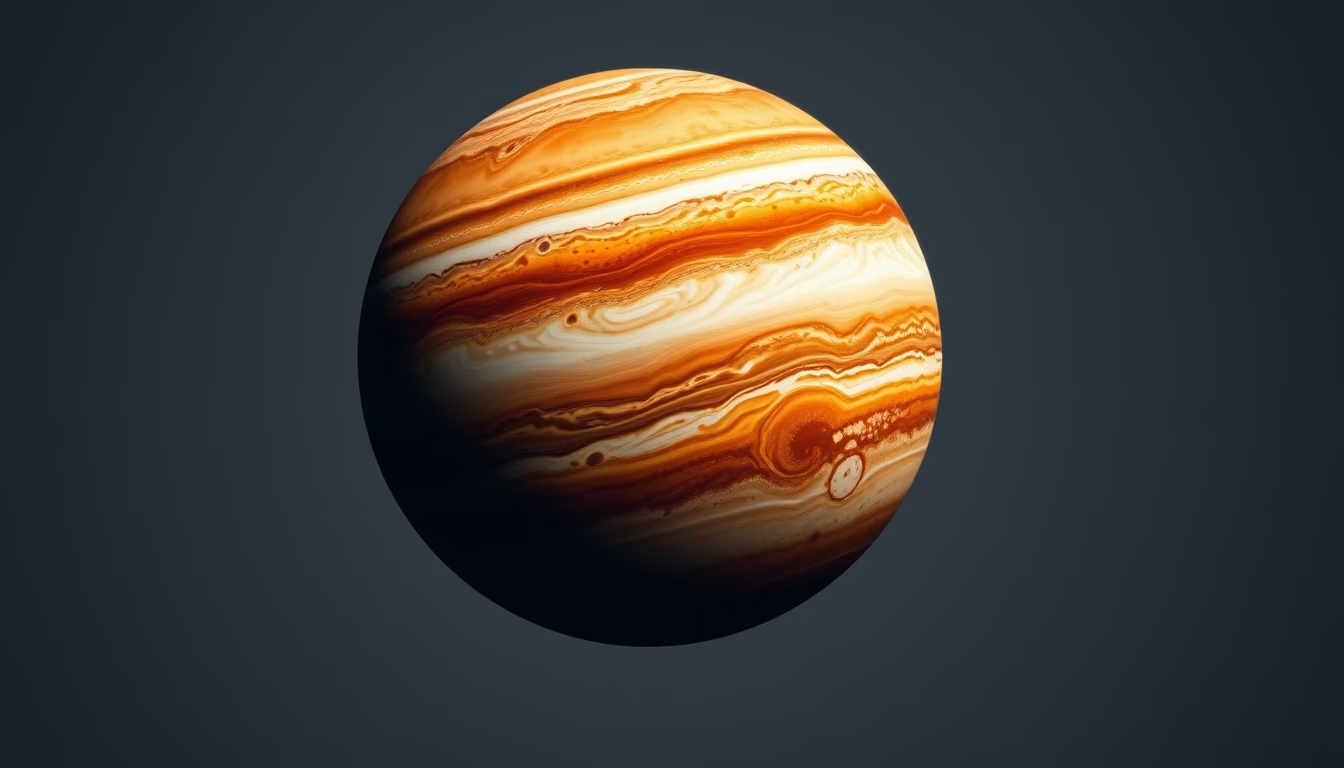
Jupiter's Great Red Spot is a giant anticyclonic storm, larger than Earth, that has persisted for centuries.
About this subject
Jupiter's Great Red Spot is the most famous storm in the Solar System. It is a high-pressure anticyclone located in Jupiter's southern hemisphere, approximately 22 degrees south of the planet's equator. With a diameter of about 16,000 kilometers, the storm is larger than Earth's diameter (12,742 km), although it has been shrinking over recent decades. Historical observations suggest the spot has been visible since the 17th century, possibly as early as 1665 when Giovanni Cassini described it as a 'permanent spot.' However, ancient Chinese records indicate it may have been known for over 350 years. The distinctive reddish color is not fully explained, but it is believed to be caused by chemical compounds such as phosphorus, sulfur, or hydrocarbons in the Jovian atmosphere, reacting to solar ultraviolet radiation. Wind speeds at the storm's edge reach 432 km/h, and the spot rotates counterclockwise, completing one revolution every six Earth days. The Great Red Spot holds crucial scientific importance for understanding atmospheric dynamics on gas giants. Unlike Earth storms, which last weeks, it persists due to the lack of a solid surface to dissipate its energy. Missions like NASA's Voyager, Galileo, and Juno have provided detailed data, revealing the storm extends hundreds of kilometers below the cloud tops. Interestingly, the spot appears to be shrinking: in the 19th century, it was estimated to be 40,000 km in diameter. Scientists believe it could disappear completely within a few decades, though the exact sustaining mechanism remains under study. The Great Red Spot is an icon of popular astronomy and a testament to the complexity of planetary phenomena.
Frequently Asked Questions
Why is the Great Red Spot red?
The red color is not fully understood, but it is believed to result from chemical compounds such as phosphorus, sulfur, or hydrocarbons reacting to solar ultraviolet radiation. The color can vary from deep red to light orange over time.
Could the Great Red Spot disappear?
Yes, observations show the spot has been shrinking since the 19th century, when it was about 40,000 km in diameter. It now measures about 16,000 km, and scientists estimate it could vanish within a few decades if the trend continues.
How big is the Great Red Spot compared to Earth?
The spot's diameter is about 16,000 km, larger than Earth's 12,742 km. This means the giant storm could contain more than one Earth planet inside it.
Direct URL
https://pub-c7d6a6ea828543ac903a74a341ccb2e1.r2.dev/imagens/jupiter-great-red-spot-studio-editorial-portrait-p4.avifHow to credit
Include a visible link back to UtilizAí. Copy one of the snippets below:
<a href="https://xn--utiliza-eza.com/en/midia/imagens/jupiter-great-red-spot-studio-editorial-portrait-p4">Jupiter great red spot</a> by <a href="https://xn--utiliza-eza.com">UtilizAí</a>, licensed under <a href="https://creativecommons.org/licenses/by/4.0/">CC BY 4.0</a>.
[Jupiter great red spot](https://xn--utiliza-eza.com/en/midia/imagens/jupiter-great-red-spot-studio-editorial-portrait-p4) by [UtilizAí](https://xn--utiliza-eza.com), CC BY 4.0
License: CC-BY-4.0