Jupiter great red spot
1344×768 · AVIF · CC BY 4.0
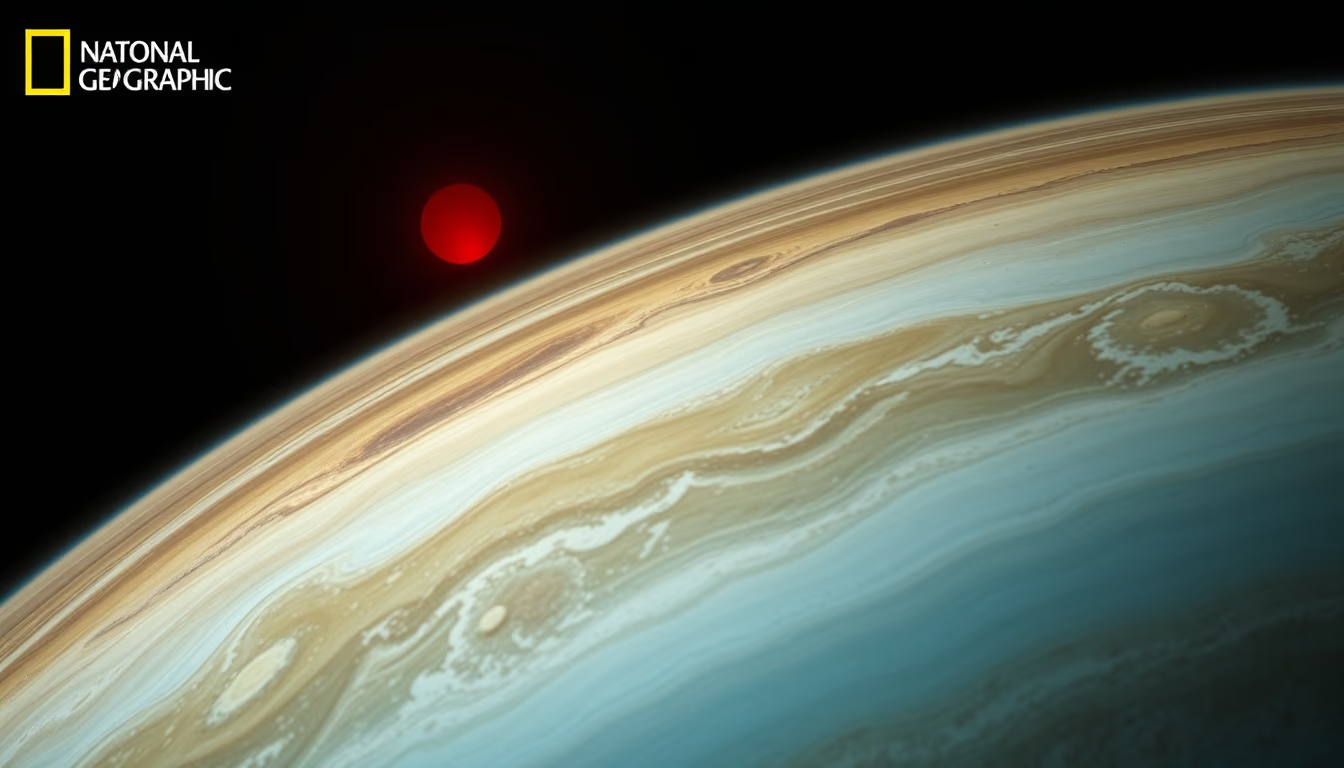
Jupiter's Great Red Spot is a persistent anticyclonic storm in the southern hemisphere, observed for centuries and larger than Earth.
About this subject
The Great Red Spot is an anticyclonic storm located in Jupiter's southern hemisphere, with winds reaching up to 432 km/h. Its current diameter is about 16,000 km, still large enough to encompass Earth. Observations date back to the 17th century, possibly as early as 1665 when astronomer Giovanni Cassini described it as a “permanent spot”. This longevity makes it one of the longest-lasting meteorological phenomena in the Solar System.
Scientifically, the Great Red Spot serves as a natural laboratory for studying atmospheric dynamics. Its distinctive reddish color is attributed to chemical reactions involving phosphorus, sulfur, and organic compounds in Jupiter's atmosphere, though the exact mechanisms remain debated. The storm rotates counterclockwise, characteristic of a high-pressure system in the southern hemisphere.
In recent decades, the Great Red Spot has drawn attention for its progressive shrinking. In the 19th century, its diameter was estimated at around 40,000 km, but modern observations, including data from NASA's Juno spacecraft, show a significant reduction. The cause of this contraction is still unknown, but it may be related to changes in Jupiter's global atmospheric circulation. Juno, orbiting since 2016, has provided detailed images and measurements of the storm's depth, revealing that it extends hundreds of kilometers below the cloud tops.
Interestingly, the Great Red Spot is not unique: Jupiter has other similar storms, such as Oval BA, which formed in the 2000s. However, none match the fame or scale of the Great Red Spot. Studying it helps scientists understand extreme weather phenomena on Jupiter and exoplanets, and it continues to captivate astronomers and astronomy enthusiasts alike.
Frequently Asked Questions
How long has the Great Red Spot existed?
It has been observed for at least 350 years, since 1665, but informal records suggest it may be even older.
Why is the Great Red Spot red?
The red color comes from chemical reactions in the atmosphere, likely involving phosphorus, sulfur, and organic compounds reacting to solar radiation.
Is the Great Red Spot shrinking?
Yes, observations show it has decreased from about 40,000 km in diameter in the 19th century to about 16,000 km today, but the cause is not yet fully understood.
Direct URL
https://pub-c7d6a6ea828543ac903a74a341ccb2e1.r2.dev/imagens/jupiter-great-red-spot-national-geographic-style-p12.avifHow to credit
Include a visible link back to UtilizAí. Copy one of the snippets below:
<a href="https://xn--utiliza-eza.com/en/midia/imagens/jupiter-great-red-spot-national-geographic-style-p12">Jupiter great red spot</a> by <a href="https://xn--utiliza-eza.com">UtilizAí</a>, licensed under <a href="https://creativecommons.org/licenses/by/4.0/">CC BY 4.0</a>.
[Jupiter great red spot](https://xn--utiliza-eza.com/en/midia/imagens/jupiter-great-red-spot-national-geographic-style-p12) by [UtilizAí](https://xn--utiliza-eza.com), CC BY 4.0
License: CC-BY-4.0