Jupiter great red spot
1344×768 · AVIF · CC BY 4.0
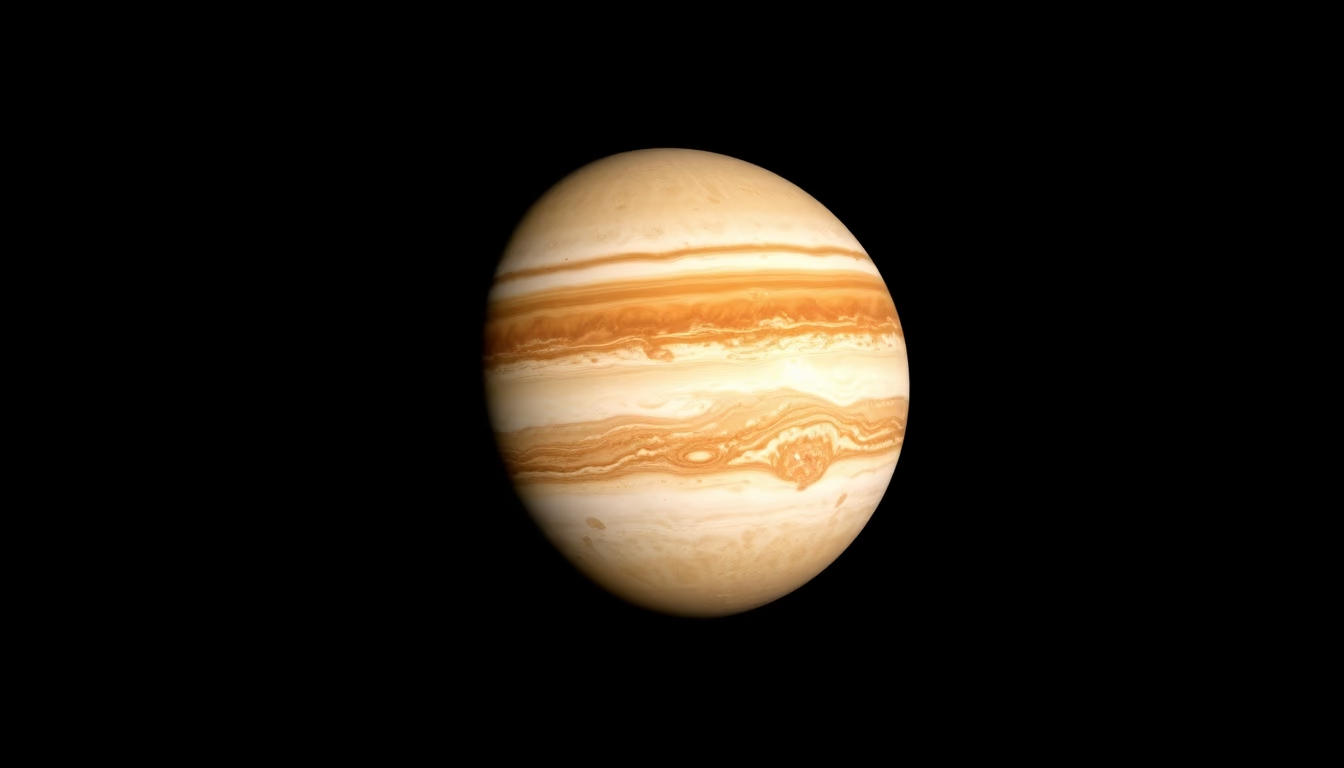
Jupiter's Great Red Spot is a giant anticyclonic storm that has lasted for centuries, larger than Earth.
About this subject
The Great Red Spot is one of Jupiter's most iconic features, visible even through small telescopes. It is a persistent anticyclonic storm located in the planet's southern hemisphere at 22° South latitude. Observed continuously since 1830, historical records suggest it was already seen in the 17th century, possibly by astronomer Giovanni Cassini in 1665. The current spot measures about 16,000 kilometers in diameter, large enough to swallow Earth, though it has been steadily shrinking over the decades. Its varying color, from deep red to pale orange, is attributed to chemical compounds such as phosphorus, sulfur, or complex hydrocarbons, not yet fully understood. The storm rotates counterclockwise, with winds reaching 680 km/h at the edge, and its vertical depth is estimated at hundreds of kilometers. Recent observations from the Juno spacecraft revealed a complex structure with deep roots in Jupiter's atmosphere. Scientists believe the storm's energy comes from lower atmospheric layers, fed by the planet's internal heat. Despite its impressive size, the Great Red Spot is not permanent: changes in its shape and color indicate it may eventually dissipate, but the exact mechanisms sustaining it for so long are still under study.
Frequently Asked Questions
How long has Jupiter's Great Red Spot lasted?
The storm has been observed continuously for at least 190 years, with evidence suggesting it existed since the 17th century. However, it is shrinking and may disappear in decades or centuries.
Why is the Great Red Spot red?
The exact color is still debated, but it is believed to be due to chemical compounds such as phosphorus, sulfur, or hydrocarbons that react to solar ultraviolet radiation in the upper atmosphere.
Is the Great Red Spot the largest storm in the Solar System?
Yes, it is the largest known storm, though it has shrunk. At its peak, it could hold three Earths. Currently, it is still larger than Earth's diameter.
Direct URL
https://pub-c7d6a6ea828543ac903a74a341ccb2e1.r2.dev/imagens/jupiter-great-red-spot-minimalist-composition-p7.avifHow to credit
Include a visible link back to UtilizAí. Copy one of the snippets below:
<a href="https://xn--utiliza-eza.com/en/midia/imagens/jupiter-great-red-spot-minimalist-composition-p7">Jupiter great red spot</a> by <a href="https://xn--utiliza-eza.com">UtilizAí</a>, licensed under <a href="https://creativecommons.org/licenses/by/4.0/">CC BY 4.0</a>.
[Jupiter great red spot](https://xn--utiliza-eza.com/en/midia/imagens/jupiter-great-red-spot-minimalist-composition-p7) by [UtilizAí](https://xn--utiliza-eza.com), CC BY 4.0
License: CC-BY-4.0





