Jupiter great red spot
1344×768 · AVIF · CC BY 4.0
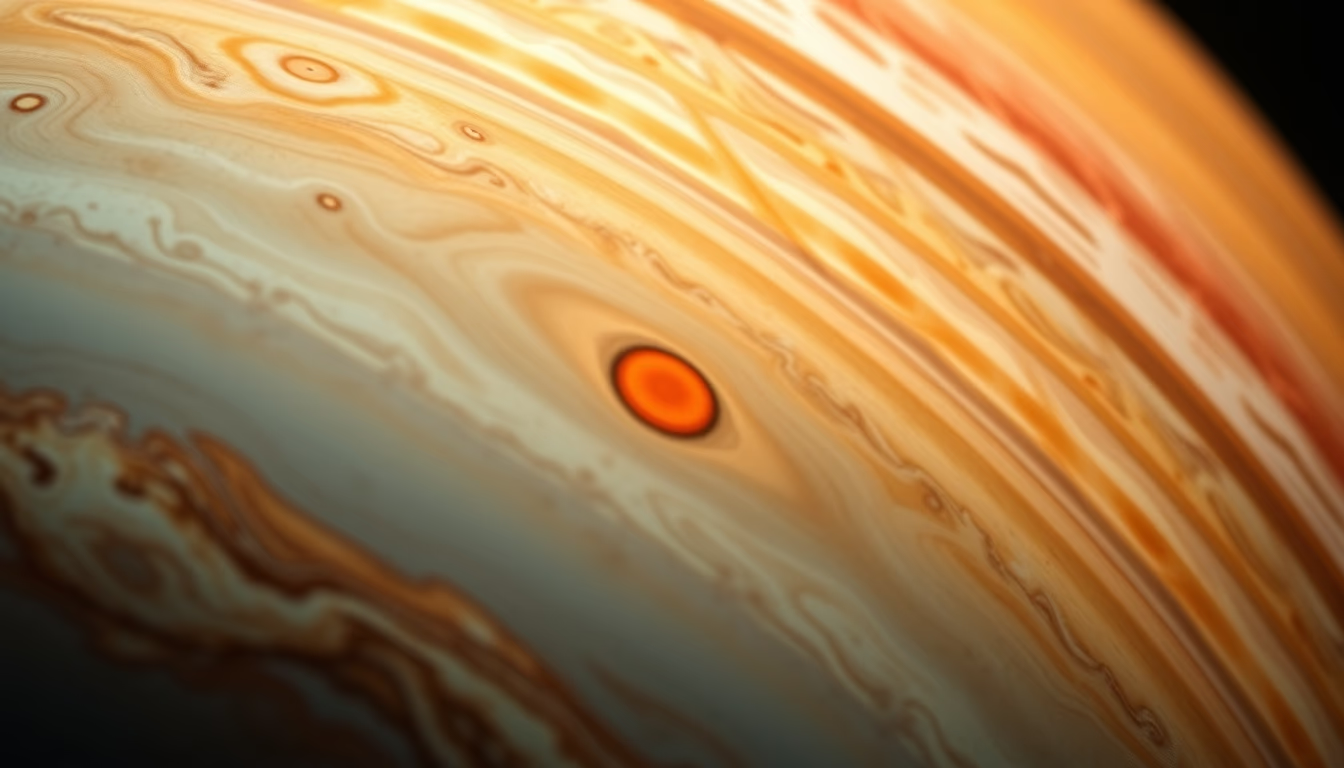
Jupiter's Great Red Spot is a persistent anticyclonic storm larger than Earth, observed for centuries.
About this subject
Jupiter's Great Red Spot is one of the most iconic atmospheric phenomena in the Solar System. It is a persistent anticyclonic high-pressure storm located in the planet's southern hemisphere, observed for at least 350 years. With a current diameter of approximately 16,000 kilometers, it is large enough to swallow Earth whole. The spot is believed to be fueled by gas currents from deeper layers of Jupiter's atmosphere, rotating counterclockwise every six Earth days.
The distinctive reddish coloration remains under study. The most accepted hypotheses point to chemical compounds such as phosphorus, sulfur, or organic hydrocarbons that rise from the depths and react with ultraviolet radiation from the Sun. Historical observations indicate that the spot was once much larger, shrinking progressively over time. In the 19th century, measurements suggested a diameter of up to 40,000 kilometers, enough to fit three Earths side by side. Recent data from the Juno spacecraft show that the storm extends hundreds of kilometers below the cloud tops.
Records from astronomers like Giovanni Cassini in 1665 describe a permanent spot in the same location, though there is no consensus on whether it was the same structure. The longevity of the Great Red Spot intrigues scientists, as typical Earth storms last weeks. Computer models suggest that smaller vortices merge and transfer energy to the main system, sustaining its lifespan. However, current shrinkage rates raise the possibility that the spot may disappear within decades, an event that astronomers will closely monitor.
Beyond its scientific value, the spot has become a cultural icon, often used to represent Jupiter in films and illustrations. It also serves as a natural laboratory to study fluid dynamics and climate at extreme scales. NASA's Juno mission, in orbit since 2016, continues to provide detailed data on its structure, composition, and evolution, helping to unravel the secrets of this colossal Jovian storm.
Frequently Asked Questions
How big is Jupiter's Great Red Spot?
Currently, the spot is about 16,000 kilometers in diameter, large enough to swallow Earth. In the past it was much larger, reaching 40,000 kilometers in the 19th century.
Why is the Great Red Spot red?
The reddish color likely comes from chemical compounds such as phosphorus, sulfur, or hydrocarbons that rise from deeper layers and react with ultraviolet sunlight.
Will the Great Red Spot disappear?
Observations show it is shrinking gradually. Models suggest it may dissipate within decades, but there is no certainty yet.
Direct URL
https://pub-c7d6a6ea828543ac903a74a341ccb2e1.r2.dev/imagens/jupiter-great-red-spot-macro-closeup-p6.avifHow to credit
Include a visible link back to UtilizAí. Copy one of the snippets below:
<a href="https://xn--utiliza-eza.com/en/midia/imagens/jupiter-great-red-spot-macro-closeup-p6">Jupiter great red spot</a> by <a href="https://xn--utiliza-eza.com">UtilizAí</a>, licensed under <a href="https://creativecommons.org/licenses/by/4.0/">CC BY 4.0</a>.
[Jupiter great red spot](https://xn--utiliza-eza.com/en/midia/imagens/jupiter-great-red-spot-macro-closeup-p6) by [UtilizAí](https://xn--utiliza-eza.com), CC BY 4.0
License: CC-BY-4.0