Juno jupiter polar
1344×768 · AVIF · CC BY 4.0
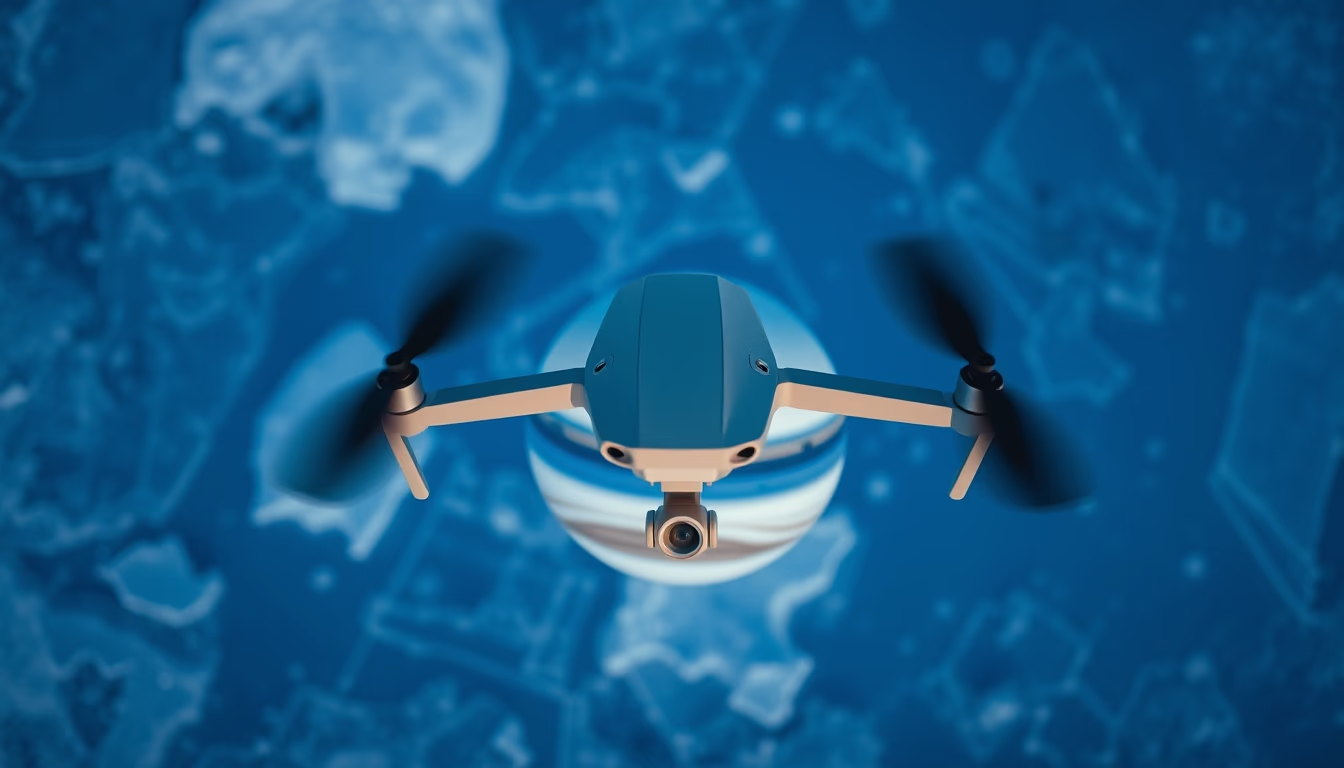
NASA's Juno spacecraft revealed stunning details of Jupiter's poles, including persistent cyclones and giant storms.
About this subject
The Juno mission, launched in 2011 and inserted into Jupiter's orbit in 2016, aims to study the composition, gravitational field, and magnetic field of the Solar System's largest planet. Before Juno, Jupiter's poles were largely unknown, as previous missions (like Voyager and Galileo) primarily observed equatorial and temperate regions. The first close-up images of the poles, captured during perijoves, revealed a chaotic and fascinating landscape.
At the north pole, Juno identified a set of eight giant cyclones arranged in an octagonal pattern, each up to 4,000 kilometers in diameter. These cyclones are extremely stable and have persisted for years, challenging previous atmospheric models. The south pole features five cyclones organized in a pentagon. Wind speeds in these vortices exceed 350 km/h, and the clouds are composed mainly of ammonia and ammonium hydrosulfide, at different altitudes than those observed at other latitudes.
Juno's polar discoveries also include detection of intense ultraviolet auroras, different from Earth's auroras, and direct measurement of the magnetic field, revealing a complex, non-dipolar dynamo. Jupiter's magnetic axis is tilted only 10 degrees, making the polar auroras more stable than Earth's. Additionally, Juno data suggest that the planet's core may be diffuse and partially dissolved, rather than a well-defined rocky core.
The Juno mission, originally planned until 2021, has been extended to September 2025 (or until the end of the spacecraft's life). Each orbit lasts about 53 days, allowing close flybys that collect unique data. Polar images, processed by citizen scientists, have become iconic and helped reshape our understanding of gas giants. Future missions, such as Europa Clipper, will benefit from Juno's knowledge of Jupiter's magnetic and radiation environment.
Frequently Asked Questions
How many cyclones were found at Jupiter's poles by the Juno spacecraft?
Eight cyclones were discovered at the north pole arranged in an octagon, while the south pole has five cyclones forming a pentagon.
What is the wind speed in Jupiter's polar cyclones?
Wind speeds in these vortices can exceed 350 km/h, with sustained winds making them extremely stable.
Why are Jupiter's polar auroras different from Earth's?
Jupiter's magnetic axis is tilted only 10 degrees relative to its rotation axis, making the auroras more stable and localized, and they are much more intense due to the strong magnetic field.
Direct URL
https://pub-c7d6a6ea828543ac903a74a341ccb2e1.r2.dev/imagens/juno-jupiter-polar-magazine-editorial-fresh1.avifHow to credit
Include a visible link back to UtilizAí. Copy one of the snippets below:
<a href="https://xn--utiliza-eza.com/en/midia/imagens/juno-jupiter-polar-magazine-editorial-fresh1">Juno jupiter polar</a> by <a href="https://xn--utiliza-eza.com">UtilizAí</a>, licensed under <a href="https://creativecommons.org/licenses/by/4.0/">CC BY 4.0</a>.
[Juno jupiter polar](https://xn--utiliza-eza.com/en/midia/imagens/juno-jupiter-polar-magazine-editorial-fresh1) by [UtilizAí](https://xn--utiliza-eza.com), CC BY 4.0
License: CC-BY-4.0