Juno jupiter polar
1344×768 · AVIF · CC BY 4.0

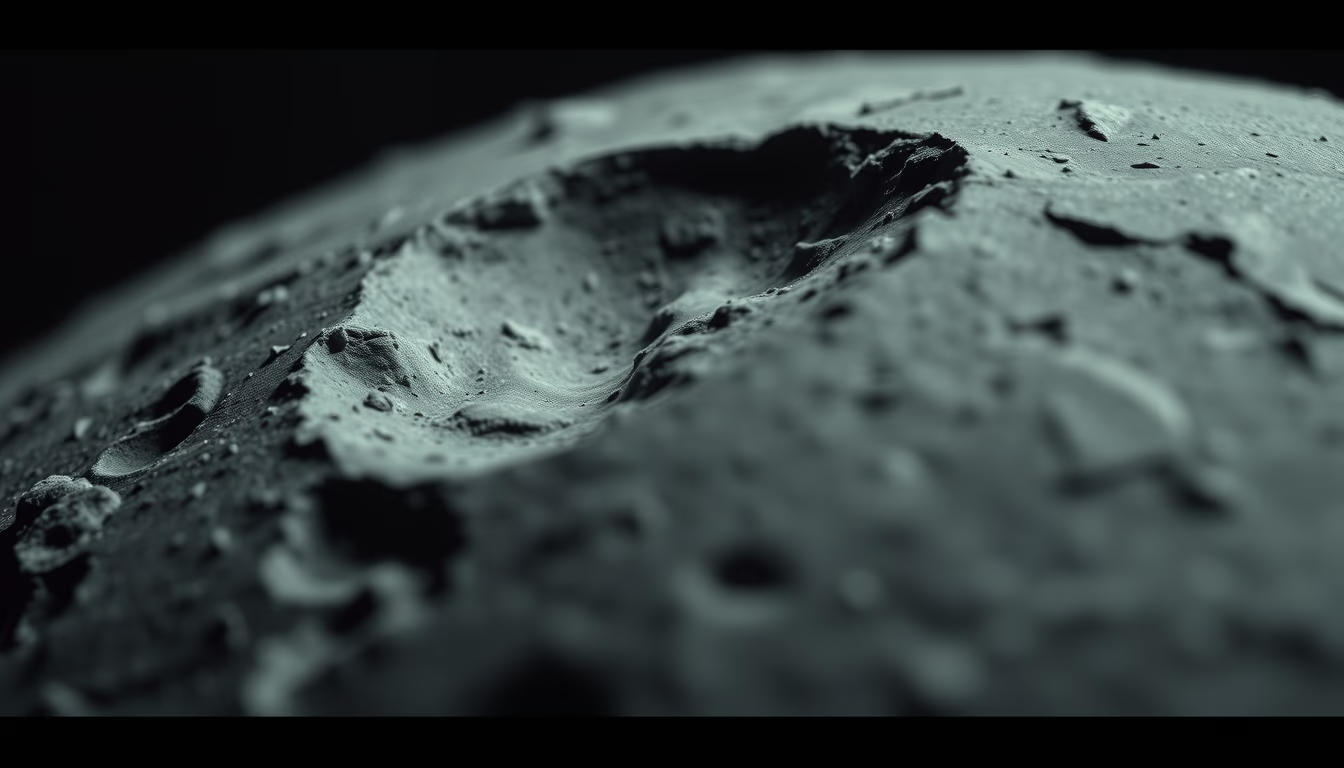
NASA's Juno spacecraft has been orbiting Jupiter since 2016, revealing unprecedented details about its polar regions and internal structure.
About this subject
NASA's Juno mission, launched in 2011 and inserted into Jupiter's orbit in 2016, aims to study the origin, evolution, and structure of the largest planet in the Solar System. Unlike previous missions that focused on Jupiter's equator, Juno adopted a highly elliptical polar orbit, passing as close as 4,200 km above the cloud tops. This trajectory allowed its instruments, such as the microwave radiometer and magnetometer, to probe the depths of the atmosphere and the planet's magnetic field.
Jupiter's polar regions turned out to be radically different from expectations. Instead of a uniform surface, Juno detected massive cyclones grouped in polygons: eight at the north pole and nine at the south pole, each hundreds of kilometers in diameter. These cyclones are arranged in stable geometric patterns, a unique atmospheric phenomenon in the Solar System. Additionally, the south pole features a permanent aurora, driven by charged particles from the circumplanetary plasma.
The spacecraft also mapped Jupiter's gravitational field with unprecedented precision, revealing that the planet's core is partially diffuse and diluted, without a clear boundary between core and mantle. This suggests Jupiter may have suffered a giant impact during its formation, mixing its internal materials. Another important discovery was high-latitude lightning, similar to Earth's but on much larger scales, energizing polar storms.
The Juno mission was originally scheduled to end in 2018 but was extended until 2025 to continue monitoring polar cyclones and perform flybys of Ganymede, Europa, and Io. In 2021, Juno flew by Ganymede, Jupiter's largest moon, providing detailed data on its icy crust and magnetic field. Juno's legacy includes not only understanding Jovian poles but also insights into atmospheric dynamics and giant planet evolution.
Frequently Asked Questions
Why does Juno orbit Jupiter in a polar trajectory?
The polar orbit allows the spacecraft to pass directly over the poles, collecting data on polar regions and the magnetic field that are inaccessible from an equatorial orbit.
How many cyclones were found at each of Jupiter's poles?
Eight cyclones were found at the north pole and nine at the south pole, all arranged in stable geometric patterns.
What was Juno's key discovery about Jupiter's core?
The core is partially diffuse and diluted, without a clear boundary, suggesting Jupiter may have suffered a giant impact during its formation.
Direct URL
https://pub-c7d6a6ea828543ac903a74a341ccb2e1.r2.dev/imagens/juno-jupiter-polar-isometric-flat-lay-fresh10.avifHow to credit
Include a visible link back to UtilizAí. Copy one of the snippets below:
<a href="https://xn--utiliza-eza.com/en/midia/imagens/juno-jupiter-polar-isometric-flat-lay-fresh10">Juno jupiter polar</a> by <a href="https://xn--utiliza-eza.com">UtilizAí</a>, licensed under <a href="https://creativecommons.org/licenses/by/4.0/">CC BY 4.0</a>.
[Juno jupiter polar](https://xn--utiliza-eza.com/en/midia/imagens/juno-jupiter-polar-isometric-flat-lay-fresh10) by [UtilizAí](https://xn--utiliza-eza.com), CC BY 4.0
License: CC-BY-4.0