Iridescent holographic foil
1344×768 · AVIF · CC BY 4.0
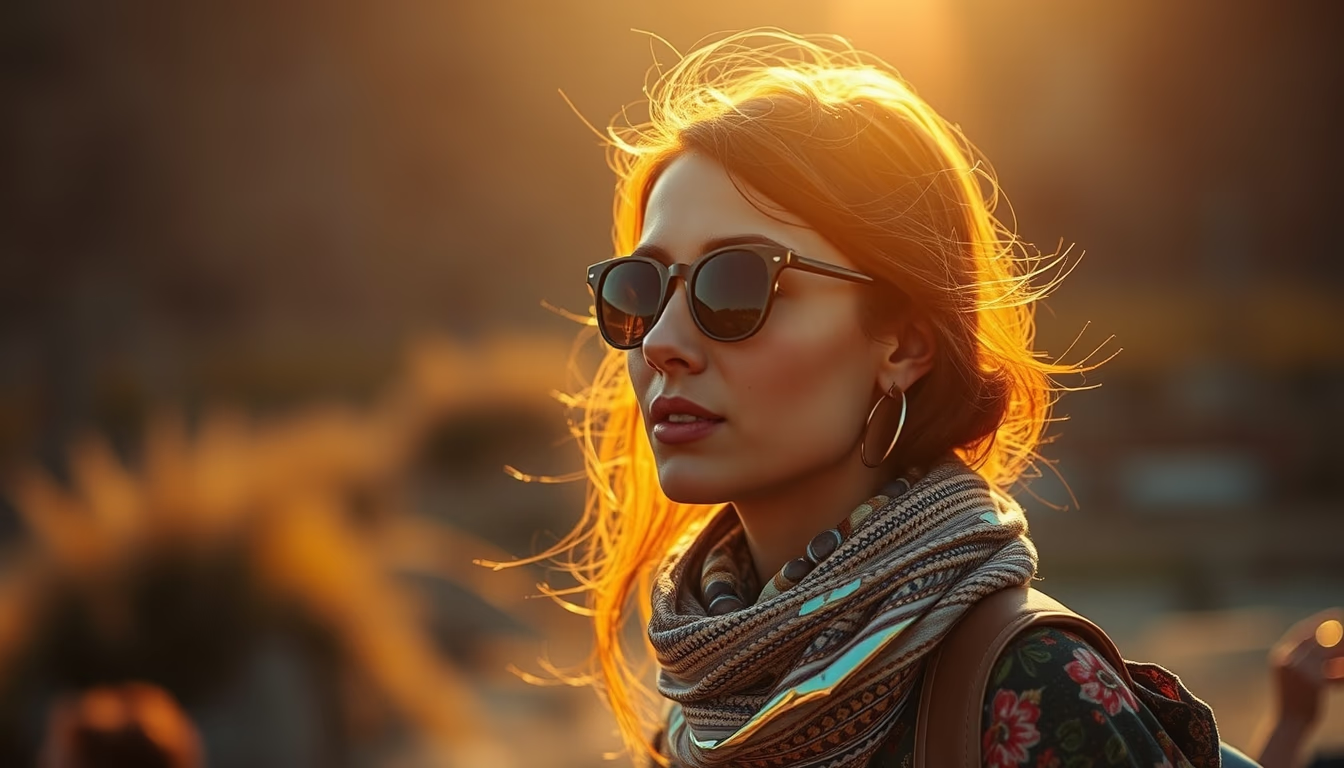
Iridescent holographic foil creates dynamic visual effects in travel photography, blending prismatic colors with metallic textures.
About this subject
Iridescent holographic foil is a material made from thin polymer layers with micro-embossed diffraction gratings that split light into a spectrum of colors depending on the viewing angle. This iridescence results from constructive and destructive interference of light waves on the microscopic grooves. Initially developed for security and document authentication, the material quickly spread to graphic design and packaging, and later to creative photography.
In travel photography, holographic foil is often used as a foreground element or backdrop to add abstract color layers and reflections. Placed over lenses, mirrors, or transparent surfaces, it distorts light and creates ethereal textures that can turn urban or natural landscapes into surreal compositions. Abstract photographers use the foil to simulate aurora borealis, colored fog, or prismatic refractions without digital post-production.
An interesting fact: the use of holography in analog photography dates back to the 1980s, when artists like David Hockney experimented with holographic paper collages. Today, foil is affordable in craft stores and can be combined with natural light or flash for unpredictable results. Its popularity on social media has also boosted techniques like 'prism photography', where the material serves as a portable physical filter for travel, weighing less than 20 grams and fitting in any bag.
It is worth noting that although the term 'holographic' evokes 3D images, the foil does not produce true holograms, only light diffraction. For abstract photography, this limitation is irrelevant, as the goal is precisely to use the surface as a malleable prism that reflects and refracts the surrounding environment.
Frequently Asked Questions
What is iridescent holographic foil?
It is a thin polymer film with micro-embossed diffraction gratings that split light into shifting colors based on the viewing angle. It is used in creative photography to create prismatic reflections and abstract textures.
How is holographic foil used in travel photography?
It can be placed near the lens, on mirrors, or over transparent surfaces to distort background light. It also works as an improvised reflector, adding colored patches to urban or natural scenes without digital editing.
What are the advantages of this material for abstract photos?
It is lightweight, portable, and inexpensive; eliminates the need for post-production; produces unique, non-reproducible effects with each shot, encouraging on-location visual experimentation.
Direct URL
https://pub-c7d6a6ea828543ac903a74a341ccb2e1.r2.dev/imagens/iridescent-holographic-foil-travel-photography-p4.avifHow to credit
Include a visible link back to UtilizAí. Copy one of the snippets below:
<a href="https://xn--utiliza-eza.com/en/midia/imagens/iridescent-holographic-foil-travel-photography-p4">Iridescent holographic foil</a> by <a href="https://xn--utiliza-eza.com">UtilizAí</a>, licensed under <a href="https://creativecommons.org/licenses/by/4.0/">CC BY 4.0</a>.
[Iridescent holographic foil](https://xn--utiliza-eza.com/en/midia/imagens/iridescent-holographic-foil-travel-photography-p4) by [UtilizAí](https://xn--utiliza-eza.com), CC BY 4.0
License: CC-BY-4.0