Intel core processor
1344×768 · AVIF · CC BY 4.0
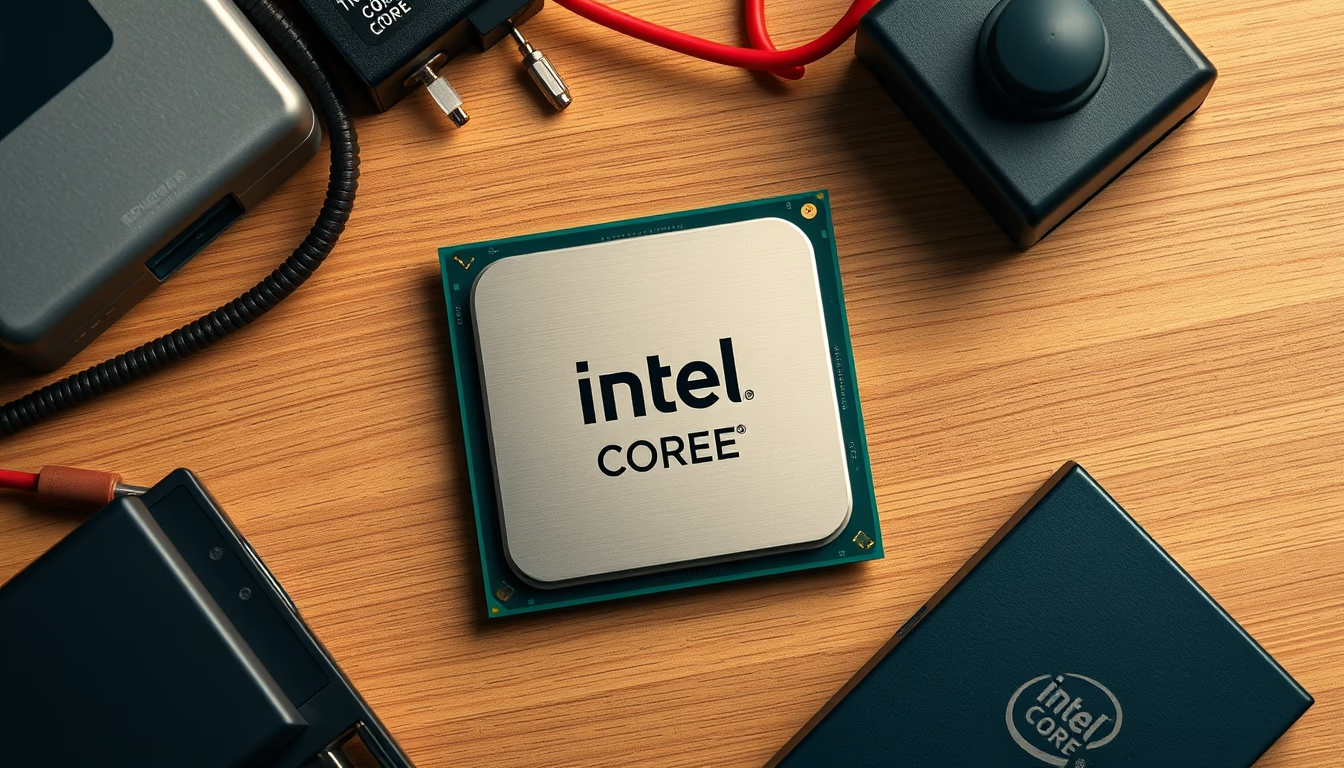
Intel Core processors power millions of personal computers, combining multiple cores and energy efficiency for performance across diverse tasks.
About this subject
The Intel Core processor line, launched in 2006, replaced the Pentium 4 and Core Duo, marking the beginning of the multi-core era in personal computing. The Core architecture brought significant improvements in energy efficiency and performance per watt, setting a new standard for desktop and notebook CPUs.
Over the years, the Core family expanded into the i3, i5, i7, and i9 series, each offering different levels of cores, threads, and cache. Microarchitectures such as Nehalem, Sandy Bridge, Haswell, Skylake, Coffee Lake, Alder Lake, and Raptor Lake introduced innovations like Hyper-Threading (allowing each core to process two threads simultaneously), Turbo Boost (dynamic frequency increase), and increasingly capable integrated graphics. Starting with the 12th generation (Alder Lake), Intel adopted a hybrid design with high-performance cores (P-cores) and efficient cores (E-cores), optimizing the balance between power and consumption.
Intel Core processors are ubiquitous: from ultra-thin laptops to high-performance workstations, servers, and embedded systems. Competition with AMD Ryzen spurred rapid innovation, resulting in CPUs with dozens of cores and support for DDR5 memory and PCIe 5.0. Models like the Core i9-13900K achieve 24 cores (8 P + 16 E) and 32 threads, with turbo frequencies exceeding 5.5 GHz.
Beyond raw performance, the Core platform integrates technologies like Intel Optane Memory support, Intel Deep Learning Boost (for AI acceleration), and Thunderbolt 4. Constant evolution ensures that, even with the rise of ARM and RISC-V architectures, Intel Core processors remain central to personal and professional computing ecosystems.
Frequently Asked Questions
What differentiates an Intel Core i3 from an i7?
The main difference is performance: i3 is entry-level (fewer cores/threads and smaller cache), i5 is mid-range, i7 offers high performance with more cores, Hyper-Threading, and more aggressive Turbo Boost. The choice depends on budget and tasks.
What is the hybrid architecture of 12th-gen Intel Core processors?
It combines high-performance cores (P-cores) for heavy tasks and efficient cores (E-cores) for background processes, optimizing energy consumption and multitasking performance. The operating system automatically assigns tasks.
Do Intel Core processors have integrated graphics?
Most desktop and mobile models include an integrated GPU (Intel UHD Graphics or Iris Xe), allowing video output without a dedicated card. Exceptions are 'F'-suffix variants (e.g., i5-13400F), which lack integrated video.
Direct URL
https://pub-c7d6a6ea828543ac903a74a341ccb2e1.r2.dev/imagens/intel-core-processor-isometric-flat-lay-p8.avifHow to credit
Include a visible link back to UtilizAí. Copy one of the snippets below:
<a href="https://xn--utiliza-eza.com/en/midia/imagens/intel-core-processor-isometric-flat-lay-p8">Intel core processor</a> by <a href="https://xn--utiliza-eza.com">UtilizAí</a>, licensed under <a href="https://creativecommons.org/licenses/by/4.0/">CC BY 4.0</a>.
[Intel core processor](https://xn--utiliza-eza.com/en/midia/imagens/intel-core-processor-isometric-flat-lay-p8) by [UtilizAí](https://xn--utiliza-eza.com), CC BY 4.0
License: CC-BY-4.0