Horsehead nebula dark
1344×768 · AVIF · CC BY 4.0
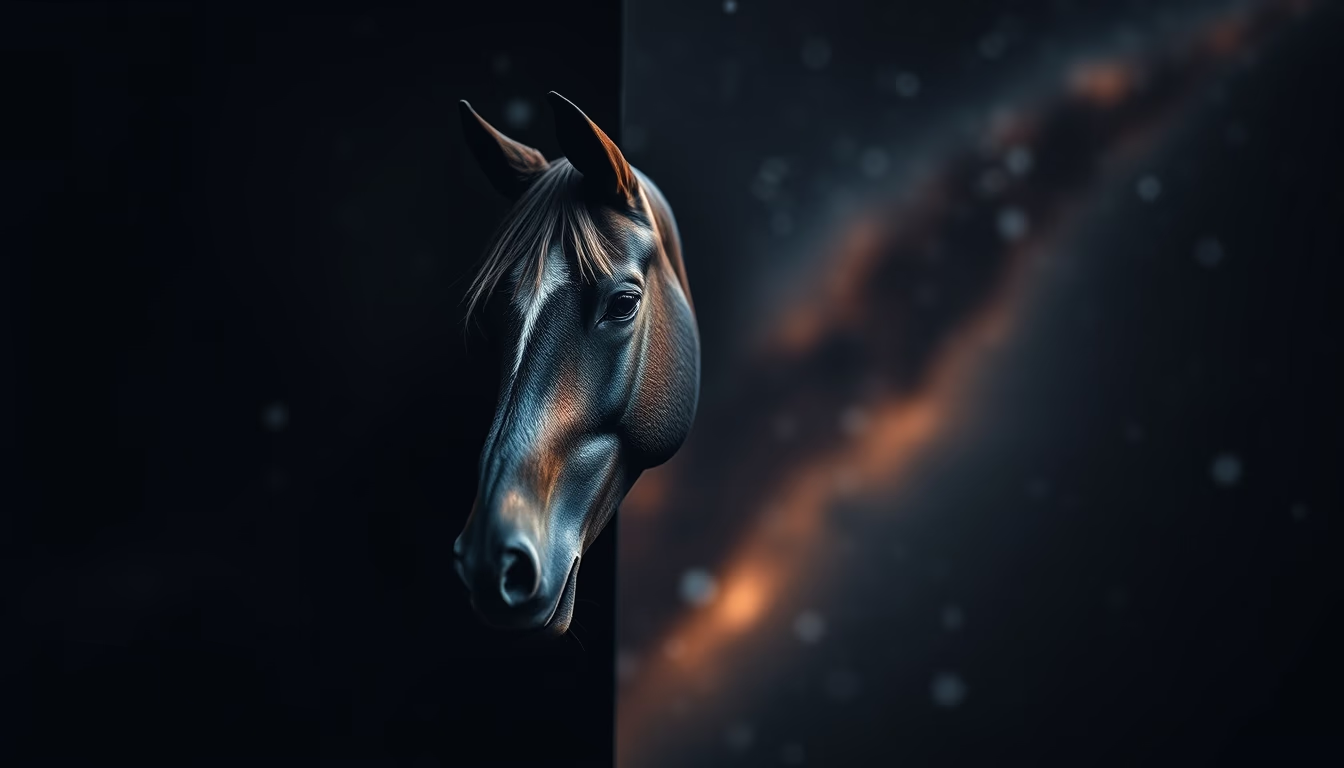
The Horsehead Nebula is a dark cloud of dust and gas in the constellation Orion, famous for its silhouette resembling a horse's head.
About this subject
The Horsehead Nebula, cataloged as Barnard 33, is one of the most iconic dark nebulae in the night sky. Located approximately 1,500 light-years from Earth in the constellation Orion, it is part of the Orion Molecular Cloud Complex, a vast star-forming region. Its distinctive shape is created by dense clouds of interstellar dust that block the light from stars and bright nebulae behind it, forming a dark silhouette against the reddish glow of the IC 434 emission nebula.
The structure of the Horsehead is about 3.5 light-years in diameter and consists mainly of molecular hydrogen and dust. The reddish color surrounding it comes from hydrogen ionized by the nearby massive star Sigma Orionis. The dark nebula does not emit its own light; its visibility depends on the contrast with the emission nebula behind it. This makes it a challenging target for amateur astrophotographers, requiring long exposures and special filters.
The Horsehead Nebula was discovered by Scottish astronomer Williamina Fleming in 1888 on a photographic plate taken at the Harvard College Observatory. Since then, it has become one of the most photographed objects by space and ground-based telescopes, including the Hubble Space Telescope, which captured detailed images of its filamentary structure. Studies indicate that the nebula is slowly dissipating due to ultraviolet radiation from nearby hot stars, and its shape may disappear in a few million years.
For observers in the southern hemisphere, the Horsehead is visible during the winter months (January to March), though it is a low-surface-brightness object. Under dark skies, it can be seen with moderate-aperture telescopes, but H-alpha filters significantly enhance contrast. The nebula also serves as an important natural laboratory for studying interstellar chemistry and star formation, as its dense regions may collapse to give birth to new stars.
Frequently Asked Questions
How was the Horsehead Nebula discovered?
It was discovered in 1888 by Scottish astronomer Williamina Fleming while examining a photographic plate from the Harvard College Observatory.
Why is the Horsehead Nebula dark?
It is a dark nebula composed of dense dust and gas that blocks the light from stars and bright nebulae behind it, creating a silhouette.
Where is the Horsehead Nebula located?
It is located in the constellation Orion, about 1,500 light-years from Earth, near the star Sigma Orionis.
Direct URL
https://pub-c7d6a6ea828543ac903a74a341ccb2e1.r2.dev/imagens/horsehead-nebula-dark-tilt-shift-miniature-p8.avifHow to credit
Include a visible link back to UtilizAí. Copy one of the snippets below:
<a href="https://xn--utiliza-eza.com/en/midia/imagens/horsehead-nebula-dark-tilt-shift-miniature-p8">Horsehead nebula dark</a> by <a href="https://xn--utiliza-eza.com">UtilizAí</a>, licensed under <a href="https://creativecommons.org/licenses/by/4.0/">CC BY 4.0</a>.
[Horsehead nebula dark](https://xn--utiliza-eza.com/en/midia/imagens/horsehead-nebula-dark-tilt-shift-miniature-p8) by [UtilizAí](https://xn--utiliza-eza.com), CC BY 4.0
License: CC-BY-4.0