Horsehead nebula dark
1344×768 · AVIF · CC BY 4.0
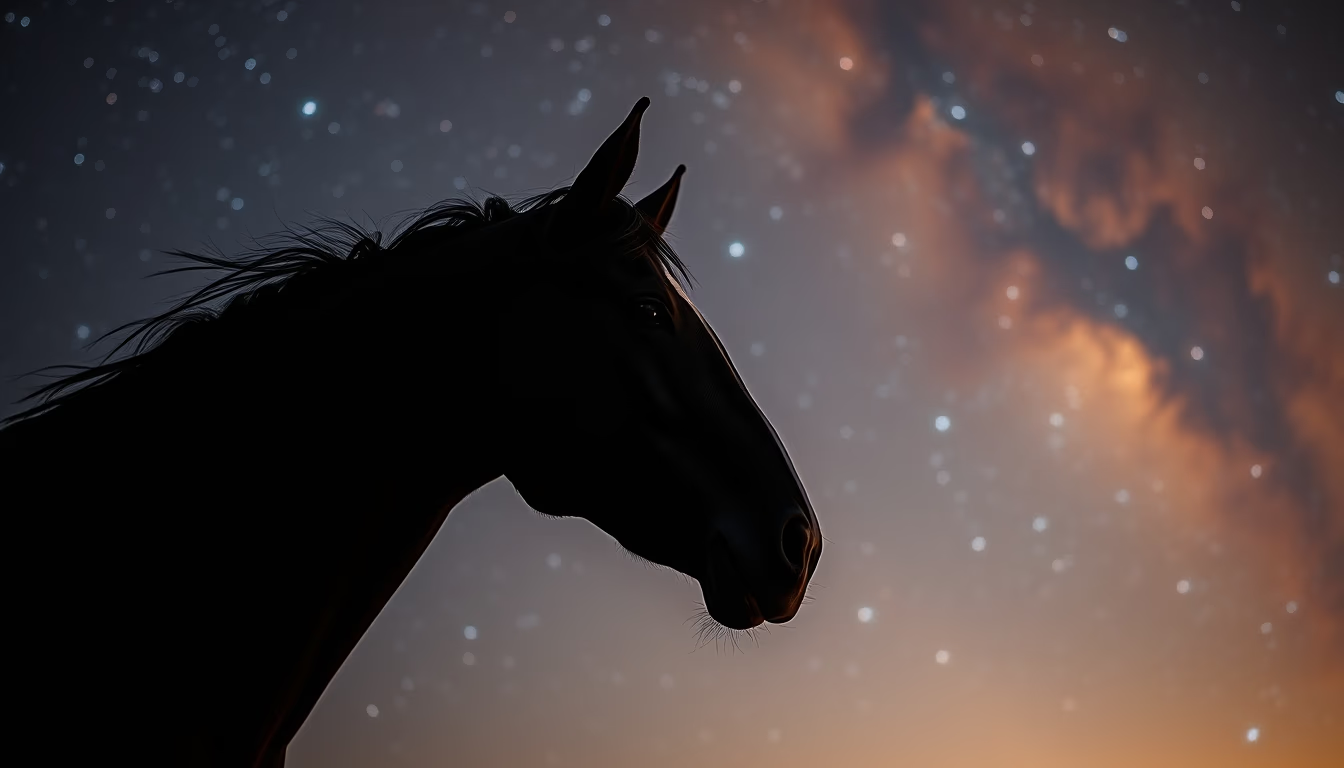
The Horsehead Nebula (Barnard 33) is a dark nebula in the constellation Orion, one of the most iconic objects in the night sky.
About this subject
The Horsehead Nebula, cataloged as Barnard 33, is a dark nebula located in the constellation Orion, approximately 1,500 light-years from Earth. It is part of the Orion Molecular Cloud Complex, a vast star-forming region that also houses the Orion Nebula (M42) and the famous Orion's Belt. Its distinctive horse-head shape is created by a dense cloud of dust and gas that blocks the light from the bright emission nebula IC 434 behind it. This dark silhouette contrasts with the reddish background of ionized hydrogen, producing one of the most recognizable images in astronomy.
Discovered in 1888 by astronomer Williamina Fleming from a photographic plate taken at Harvard College Observatory, the nebula has become a frequent target for astrophotographers and professional telescopes. Despite its fame, the Horsehead is a difficult object to observe visually in amateur telescopes due to its low surface brightness. Astronomers use special filters to capture its contrast, and the region serves as a natural laboratory for studying star formation, as the dark clouds are collapsing to give birth to new stars.
The Orion complex where the Horsehead resides is one of the closest and most active star-forming regions. The dark nebula itself is composed mainly of interstellar dust and molecular hydrogen, with extremely low temperatures. The cloud's density is so high that it absorbs visible light, but in infrared wavelengths, the Horsehead reveals young stars embedded within. Images from the Hubble Space Telescope and the James Webb Space Telescope have shown stunning details of this structure, including filaments of dust and gas in motion.
Beyond its scientific value, the Horsehead Nebula holds an important place in popular culture, often used as a symbol of the cosmos and space exploration. Its iconic shape inspires artists and educators, and its location near Orion's Belt makes it easy for amateur astronomers to find. With the advancement of astrophotography, it has become one of the most photographed objects in the sky, representing the beauty and mystery of dark nebulae.
Frequently Asked Questions
Where is the Horsehead Nebula located?
The Horsehead Nebula is located in the constellation Orion, about 1,500 light-years from Earth, just south of the star Alnitak, the easternmost star of Orion's Belt.
Why is the Horsehead Nebula dark?
It is dark because it is a dense cloud of dust and gas that blocks the light from the emission nebula IC 434 behind it. The dust absorbs visible light, creating the distinctive silhouette.
Can the Horsehead Nebula be seen with amateur telescopes?
Visually it is very difficult due to low surface brightness, but with astrophotography and special filters it can be captured. Larger telescopes and CCD cameras help reveal its contrast.
Direct URL
https://pub-c7d6a6ea828543ac903a74a341ccb2e1.r2.dev/imagens/horsehead-nebula-dark-cinematic-wide-shot-p10.avifHow to credit
Include a visible link back to UtilizAí. Copy one of the snippets below:
<a href="https://xn--utiliza-eza.com/en/midia/imagens/horsehead-nebula-dark-cinematic-wide-shot-p10">Horsehead nebula dark</a> by <a href="https://xn--utiliza-eza.com">UtilizAí</a>, licensed under <a href="https://creativecommons.org/licenses/by/4.0/">CC BY 4.0</a>.
[Horsehead nebula dark](https://xn--utiliza-eza.com/en/midia/imagens/horsehead-nebula-dark-cinematic-wide-shot-p10) by [UtilizAí](https://xn--utiliza-eza.com), CC BY 4.0
License: CC-BY-4.0