Hdmi cable golden
1344×768 · AVIF · CC BY 4.0
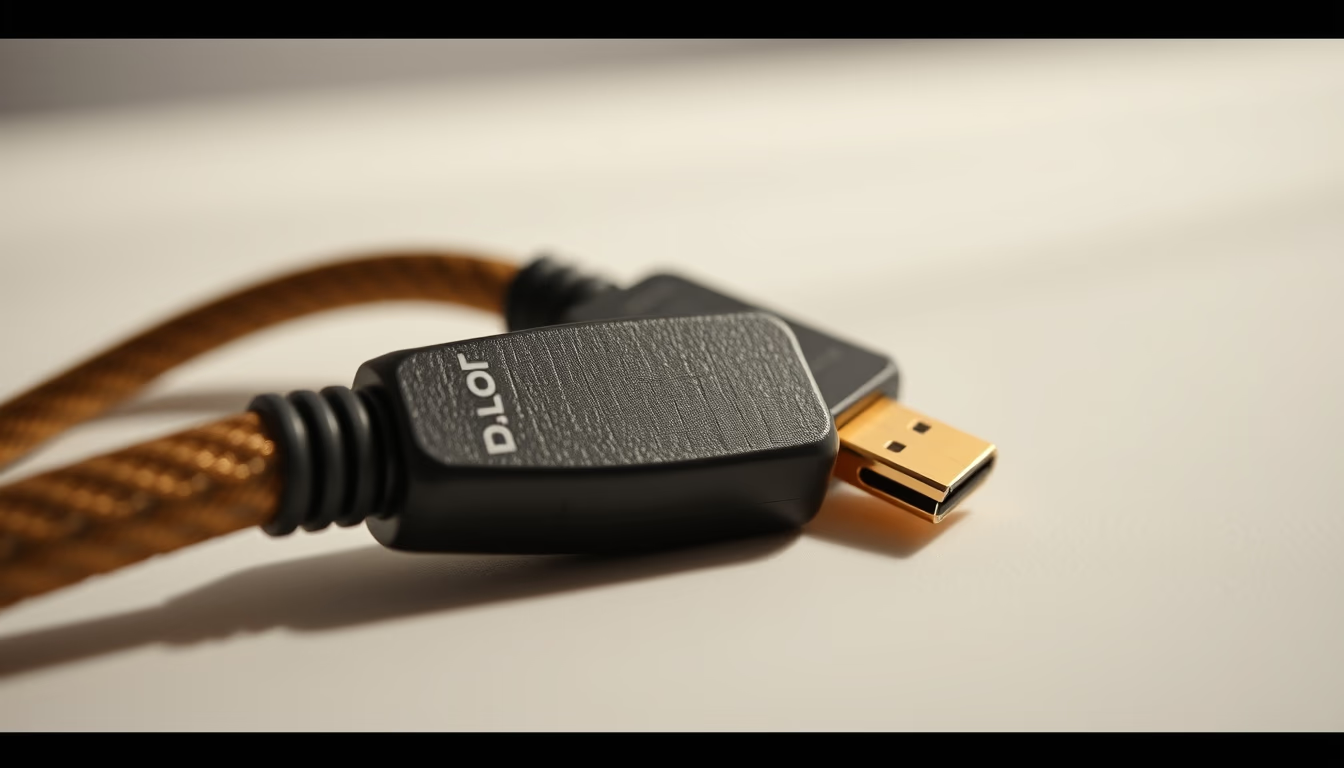
HDMI cable with gold-plated connectors: understand why gold plating improves high-definition digital audio and video transmission.
About this subject
The HDMI (High-Definition Multimedia Interface) cable is the most widely used standard for transmitting high-definition digital audio and video between devices such as TVs, monitors, game consoles, and media players. Gold-plated connectors, while visually appealing, serve an important technical purpose: gold is highly resistant to corrosion and has excellent electrical conductivity, ensuring reliable contact over long periods. This is crucial to avoid signal loss in high-performance cables, especially at the high transmission speeds required by HDMI 2.0 and 2.1 versions.
Introduced in 2002 by a consortium of companies including Hitachi, Panasonic, Sony, and Toshiba, HDMI replaced analog connections like VGA and composite cables. Over the years, the standard has evolved to support increasingly higher resolutions: from Full HD (1080p) to 4K and 8K, with refresh rates up to 120 Hz in HDMI 2.1. The maximum bandwidth of HDMI 2.1 reaches 48 Gbps, enabling uncompressed video transmission and high-resolution multichannel audio, such as Dolby Atmos and DTS:X.
Gold plating on connectors is not exclusive to HDMI; it is common in professional audio cables like RCA and XLR. However, in consumer HDMI cables, gold is often applied only as a thin surface layer, and the coating thickness varies. Cables with nickel-plated or chromed connectors may degrade over time due to oxidation, while gold maintains signal integrity. Despite this, for short distances (up to 5 meters), the practical difference between a gold-plated cable and a good-quality cable with nickel-plated connectors may be imperceptible to most users.
Interestingly, some HDMI cables with gold-plated connectors are marketed as "premium" or "high speed," but certification by HDMI Licensing Administrator ensures that certified cables undergo rigorous testing regardless of connector material. Buyers should prioritize cables that meet the required HDMI version for their equipment, such as the "Ultra High Speed HDMI Cable" label for HDMI 2.1, rather than focusing solely on the connector color.
Frequently Asked Questions
Does gold plating on HDMI cables really make a difference in signal quality?
Yes, but only in specific situations. Gold is corrosion-resistant and maintains good conductivity, which is beneficial in humid environments or for frequent connections. For short cables and typical home use, the practical difference is small compared to quality nickel-plated connectors.
Do all gold-plated HDMI cables support 4K or 8K?
No. The ability to transmit 4K or 8K depends on the HDMI version and cable bandwidth, not just the connector material. Look for certified cables that specify support for the desired resolution, such as "High Speed" or "Ultra High Speed" labels.
What is the difference between HDMI 2.0 and HDMI 2.1 for gold cables?
Both can use gold connectors, but HDMI 2.1 offers much higher bandwidth (48 Gbps vs. 18 Gbps for 2.0), enabling 8K at 60 Hz and 4K at 120 Hz. HDMI 2.1 cables usually require specific certification and may have more robust construction, but gold plating is optional.
Direct URL
https://pub-c7d6a6ea828543ac903a74a341ccb2e1.r2.dev/imagens/hdmi-cable-golden-magazine-editorial-p4.avifHow to credit
Include a visible link back to UtilizAí. Copy one of the snippets below:
<a href="https://xn--utiliza-eza.com/en/midia/imagens/hdmi-cable-golden-magazine-editorial-p4">Hdmi cable golden</a> by <a href="https://xn--utiliza-eza.com">UtilizAí</a>, licensed under <a href="https://creativecommons.org/licenses/by/4.0/">CC BY 4.0</a>.
[Hdmi cable golden](https://xn--utiliza-eza.com/en/midia/imagens/hdmi-cable-golden-magazine-editorial-p4) by [UtilizAí](https://xn--utiliza-eza.com), CC BY 4.0
License: CC-BY-4.0