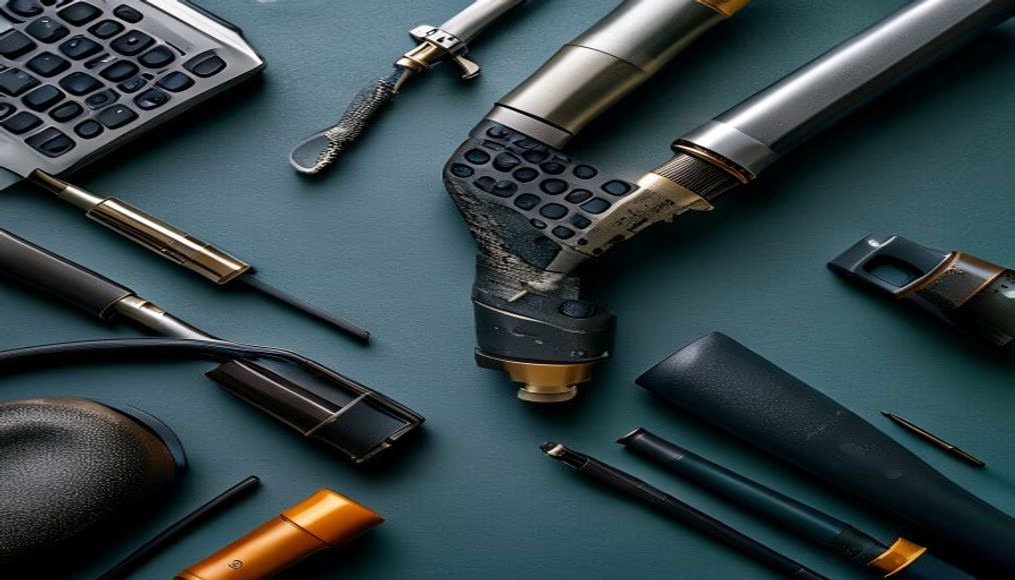
Hdmi cable golden
1344×768 · AVIF · CC BY 4.0

HDMI cables with gold-plated connectors offer improved signal transmission and corrosion resistance, popular in high-fidelity audio and video setups.
About this subject
The HDMI (High-Definition Multimedia Interface) cable is the global standard for transmitting high-definition digital audio and video between devices such as TVs, monitors, projectors, and consoles. The version with gold-plated connectors is often associated with higher durability and signal quality, though the real benefit is corrosion resistance, since gold does not tarnish. In humid environments or with temperature fluctuations, this protective layer prevents contact loss over time.
HDMI technology was introduced in 2002, replacing analog connections like VGA and RCA. It has undergone several revisions: HDMI 1.4 (2009) supported 3D and Ethernet, HDMI 2.0 (2013) enabled 4K at 60 Hz, and HDMI 2.1 (2017) reached 48 Gbps, supporting 8K variable refresh rate and technologies like VRR (variable refresh rate) and eARC. The Type A connector (19 pins) is the most common in consumer devices, while Type C (mini) and D (micro) are used in cameras and smartphones.
In Brazil, the popularity of HDMI grew with the shift to high-definition TVs in the 2010s. Although the digital standard eliminates analog interference, low-quality cables can cause artifacts or sync failures. Gold-plated cables are often marketed as "premium," but the practical difference from well-shielded copper cables is minimal over short distances, under 5 meters. For long distances, cables with amplifiers or fiber optics are more effective.
Fun fact: the gold on connectors is not pure but a 24K or 22K alloy deposited by electroplating over a nickel base. Typical thickness is 0.5 to 2 micrometers. The golden aesthetic also attracts consumers building themed setups, such as the "lo-fi disposable camera" style mentioned in the tags, a trend among retro computing and analog photography enthusiasts.
Frequently Asked Questions
Do gold-plated HDMI cables really improve image quality?
Over short distances (up to 5 meters), the difference is negligible. The main benefit is corrosion resistance, not performance increase. The digital HDMI standard delivers identical signal regardless of connector material, as long as the cable meets specifications.
Which HDMI version is needed for 4K 60Hz?
HDMI 2.0 is sufficient for 4K at 60 Hz with 10-bit color depth. For 4K at 120 Hz or 8K, HDMI 2.1 is required.
How to identify a good quality HDMI cable?
Check for HDMI certification (hologram sticker), triple shielding (to prevent interference), and appropriate wire gauge (AWG 28 or smaller for long distances). Gold-plated cables do not guarantee quality if the construction is poor.
Direct URL
https://pub-c7d6a6ea828543ac903a74a341ccb2e1.r2.dev/imagens/hdmi-cable-golden-lo-fi-disposable-camera-p11.avifHow to credit
Include a visible link back to UtilizAí. Copy one of the snippets below:
<a href="https://xn--utiliza-eza.com/en/midia/imagens/hdmi-cable-golden-lo-fi-disposable-camera-p11">Hdmi cable golden</a> by <a href="https://xn--utiliza-eza.com">UtilizAí</a>, licensed under <a href="https://creativecommons.org/licenses/by/4.0/">CC BY 4.0</a>.
[Hdmi cable golden](https://xn--utiliza-eza.com/en/midia/imagens/hdmi-cable-golden-lo-fi-disposable-camera-p11) by [UtilizAí](https://xn--utiliza-eza.com), CC BY 4.0
License: CC-BY-4.0