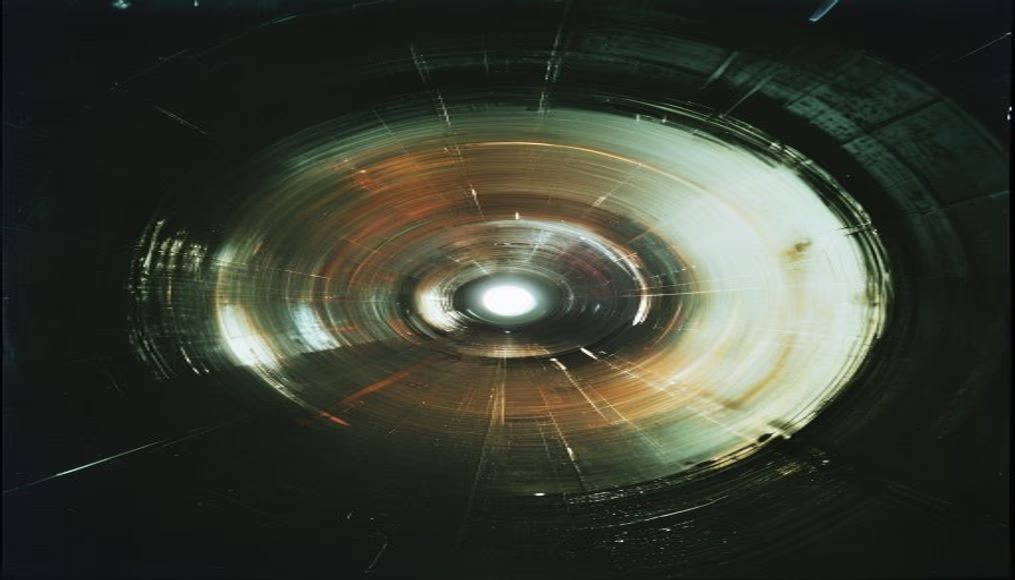
Gravitational lensing visualization
1344×768 · AVIF · CC BY 4.0

Gravitational lensing is a phenomenon predicted by general relativity that distorts and magnifies light from distant objects due to the presence of mass between them and the observer.
About this subject
Gravitational lensing occurs when light from a distant source, such as a galaxy or quasar, passes near a massive object (e.g., a galaxy cluster) and its path is bent by the gravitational field. This effect was predicted by Albert Einstein in 1911 and confirmed during the 1919 solar eclipse, when the apparent position of stars near the Sun was measured to be deflected exactly as general relativity predicted. Since then, gravitational lensing has become a crucial tool in astrophysics.
There are two main types: strong lensing, which produces multiple distorted images of the source (as in the famous Einstein Cross, where a quasar behind a galaxy appears four times), and weak lensing, which causes subtle distortions in the shapes of distant galaxies. Strong lensing allows studying mass distribution in objects like galaxy clusters, revealing the presence of dark matter. Weak lensing is used to map dark matter on large scales, statistically, by correlating galaxy shapes.
One of the most striking examples is the Abell 2218 cluster, where hundreds of gravitational arcs are visible, formed by light from distant galaxies being magnified and deformed. Gravitational lensing has also enabled the discovery of extremely distant galaxies, such as MACS0647-JD, observed with the help of natural lenses. Additionally, the phenomenon serves as a test for relativity and helps determine the Hubble constant, the expansion rate of the universe.
Interestingly, gravitational lensing can create optical effects like Einstein rings and image crossings. These phenomena not only beautify the cosmos but provide valuable information about mass distribution, the geometry of the universe, and the nature of dark energy.
Frequently Asked Questions
How does gravitational lensing confirm the theory of general relativity?
Gravitational lensing was predicted by general relativity as a consequence of spacetime curvature by mass. Confirmation came in 1919, when star positions during a solar eclipse appeared shifted exactly as predicted. Subsequent observations of multiple quasar images and gravitational arcs provided further evidence.
What is the difference between strong and weak lensing?
Strong lensing produces multiple distorted and magnified images of a single source, visible to the eye in astronomical images. Weak lensing causes subtle distortions in the shapes of background galaxies, detectable only through statistical analysis. Strong lensing is used to study individual objects, while weak lensing maps dark matter distribution on large scales.
Why is gravitational lensing used to study dark matter?
Dark matter does not emit light, but its mass bends light from distant sources. By analyzing distortions caused by gravitational lensing, astronomers can map the total mass distribution (including dark matter) in galaxy clusters and on cosmic scales, revealing its presence and density.
Direct URL
https://pub-c7d6a6ea828543ac903a74a341ccb2e1.r2.dev/imagens/gravitational-lensing-visualization-travel-photography-p8.avifHow to credit
Include a visible link back to UtilizAí. Copy one of the snippets below:
<a href="https://xn--utiliza-eza.com/en/midia/imagens/gravitational-lensing-visualization-travel-photography-p8">Gravitational lensing visualization</a> by <a href="https://xn--utiliza-eza.com">UtilizAí</a>, licensed under <a href="https://creativecommons.org/licenses/by/4.0/">CC BY 4.0</a>.
[Gravitational lensing visualization](https://xn--utiliza-eza.com/en/midia/imagens/gravitational-lensing-visualization-travel-photography-p8) by [UtilizAí](https://xn--utiliza-eza.com), CC BY 4.0
License: CC-BY-4.0