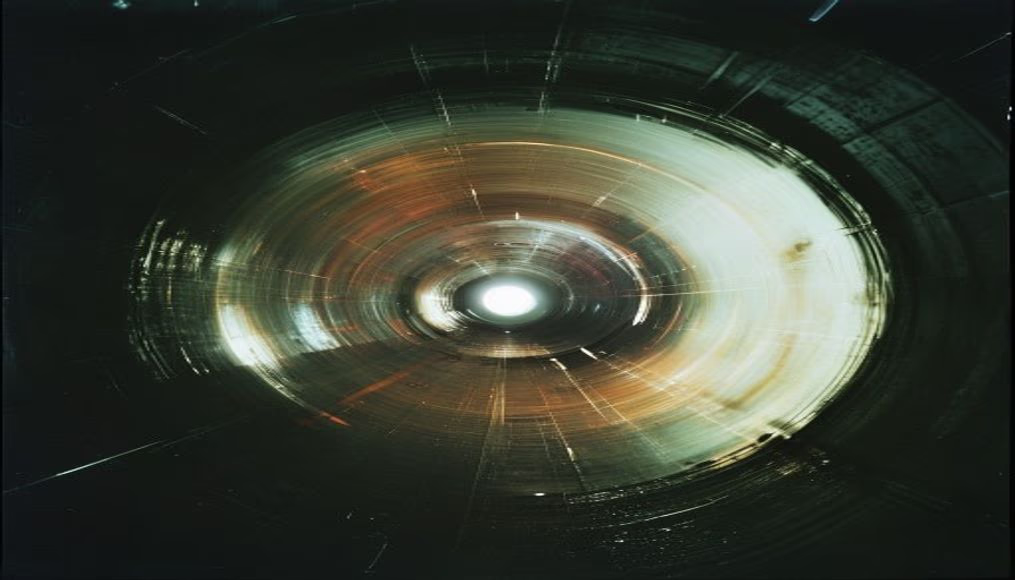
Gravitational lensing visualization
1344×768 · AVIF · CC BY 4.0

Gravitational lensing is an Einstein-predicted phenomenon that bends light from distant objects, revealing invisible galaxies and black holes.
About this subject
Gravitational lensing occurs when light from a distant source, such as a galaxy or quasar, is bent by the gravitational field of an intervening massive object, like a galaxy cluster. This effect was predicted by Albert Einstein in his 1915 General Theory of Relativity, which describes gravity as a curvature of spacetime. The greater the mass of the object, the stronger the curvature and the more the light rays are deflected.
The first confirmed example was the Twin Quasar (Q0957+561), discovered in 1979, which appeared as two images of the same object due to the gravitational lensing of an intervening galaxy. There are three main types: strong lensing, producing multiple images or Einstein rings; weak lensing, subtly distorting the shapes of background galaxies; and microlensing, temporarily brightening individual stars, useful for detecting exoplanets.
This phenomenon is a crucial tool in modern astronomy. It allows mapping of dark matter distribution, which emits no light but reveals its presence through gravitational distortions. It also enables observation of galaxies so distant that without the amplification from lensing, they would be invisible even to powerful telescopes like the James Webb Space Telescope. An iconic example is the Abell 2218 galaxy cluster, which distorts background galaxy light into elongated arcs.
Beyond scientific utility, gravitational lensing has cosmological implications. By studying how light is bent, astronomers can test gravity theories on cosmic scales and measure the universe's expansion rate, contributing to the understanding of dark energy. The term "gravitational lens" was coined by physicist John Michell in the 18th century, but the effect was not observed until decades after Einstein's prediction.
Frequently Asked Questions
How does gravitational lensing work?
Gravitational lensing works because the gravity of a massive object, like a galaxy, curves spacetime around it. Light passing near that object follows this curvature, altering its path. This can magnify, distort, or create multiple images of the distant light source.
Why is gravitational lensing important for astronomy?
It allows study of dark matter, which emits no light but is detected through gravitational distortions. It also magnifies very distant and ancient galaxies, helping understand universe evolution. Microlensing is used to find exoplanets.
Famous examples of gravitational lenses?
The Twin Quasar (Q0957+561) was the first discovered in 1979. Other examples include the Cross Einstein Ring (RX J1131-1231) and Abell 2218 galaxy cluster, showing gravitational arcs. The Hubble Telescope has photographed many such phenomena.
Direct URL
https://pub-c7d6a6ea828543ac903a74a341ccb2e1.r2.dev/imagens/gravitational-lensing-visualization-magazine-editorial-p6.avifHow to credit
Include a visible link back to UtilizAí. Copy one of the snippets below:
<a href="https://xn--utiliza-eza.com/en/midia/imagens/gravitational-lensing-visualization-magazine-editorial-p6">Gravitational lensing visualization</a> by <a href="https://xn--utiliza-eza.com">UtilizAí</a>, licensed under <a href="https://creativecommons.org/licenses/by/4.0/">CC BY 4.0</a>.
[Gravitational lensing visualization](https://xn--utiliza-eza.com/en/midia/imagens/gravitational-lensing-visualization-magazine-editorial-p6) by [UtilizAí](https://xn--utiliza-eza.com), CC BY 4.0
License: CC-BY-4.0