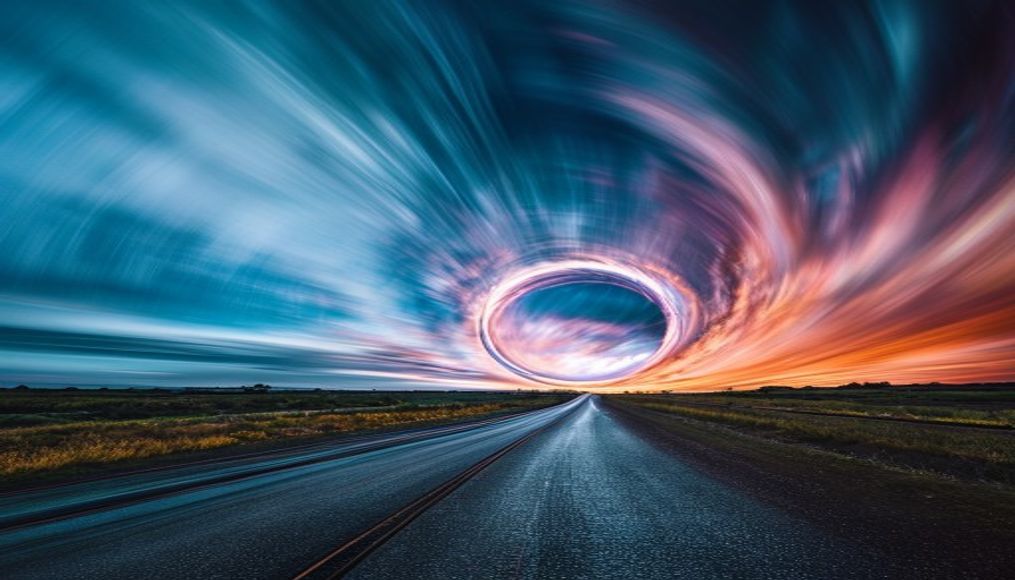
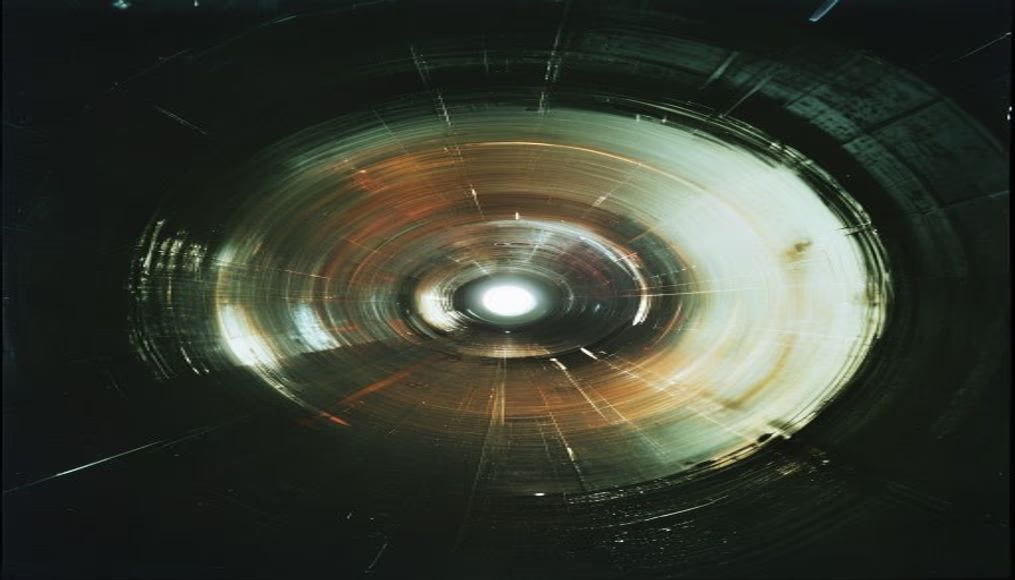
Gravitational lensing visualization
1344×768 · AVIF · CC BY 4.0

Gravitational lensing is a phenomenon predicted by general relativity where the gravity of massive objects bends light from distant galaxies, creating distorted and multiple images.
About this subject
Gravitational lensing occurs when light from a distant source, such as a galaxy or quasar, passes near a massive object (e.g., a galaxy cluster or black hole) and its path is curved by gravity. This effect, predicted by Albert Einstein in 1915, acts as a natural lens, magnifying and distorting the image of the background source. Three main types exist: strong lensing, which produces arcs and multiple images; weak lensing, which subtly distorts galaxy shapes; and microlensing, causing temporary brightness variations.
The first confirmed observation of gravitational lensing was in 1979 with the Twin Quasar (Q0957+561), appearing as two close objects. Since then, the phenomenon has become an essential tool in astrophysics. It allows study of very distant and faint galaxies otherwise invisible, mapping dark matter distribution in clusters, and measuring the Hubble constant precisely. The Hubble Space Telescope captured iconic images like the Abell 2218 arc and the Einstein Ring of SDSS J0946+1006.
Interestingly, gravitational lensing can also reveal exoplanets: when a star passes in front of another, microlensing can detect planets around the lens star. Moreover, the phenomenon is used to test modified gravity theories and search for primordial black holes. In 2023, the James Webb Telescope observed MACS0647-JD, the most distant known galaxy, amplified by gravitational lensing. Visualizations of this effect, common in computer simulations, help explain how light travels through the curved universe.
Frequently Asked Questions
What is strong gravitational lensing?
Strong gravitational lensing is when the distortion is pronounced, creating multiple images, arcs, or Einstein rings. It requires nearly perfect alignment between source, lens, and observer.
How does gravitational lensing help map dark matter?
Weak lensing subtly distorts the shapes of background galaxies. By measuring these distortions on large scales, astronomers can infer the distribution of dark matter, which emits no light but affects gravity.
What is the difference between gravitational lensing and microlensing?
In microlensing, the lens is a small object (star or planet) and the effect is temporary, lasting days or months. The source's light is magnified without forming distinguishable multiple images.
Direct URL
https://pub-c7d6a6ea828543ac903a74a341ccb2e1.r2.dev/imagens/gravitational-lensing-visualization-macro-closeup-p3.avifHow to credit
Include a visible link back to UtilizAí. Copy one of the snippets below:
<a href="https://xn--utiliza-eza.com/en/midia/imagens/gravitational-lensing-visualization-macro-closeup-p3">Gravitational lensing visualization</a> by <a href="https://xn--utiliza-eza.com">UtilizAí</a>, licensed under <a href="https://creativecommons.org/licenses/by/4.0/">CC BY 4.0</a>.
[Gravitational lensing visualization](https://xn--utiliza-eza.com/en/midia/imagens/gravitational-lensing-visualization-macro-closeup-p3) by [UtilizAí](https://xn--utiliza-eza.com), CC BY 4.0
License: CC-BY-4.0