Gravitational lensing visualization
1344×768 · AVIF · CC BY 4.0
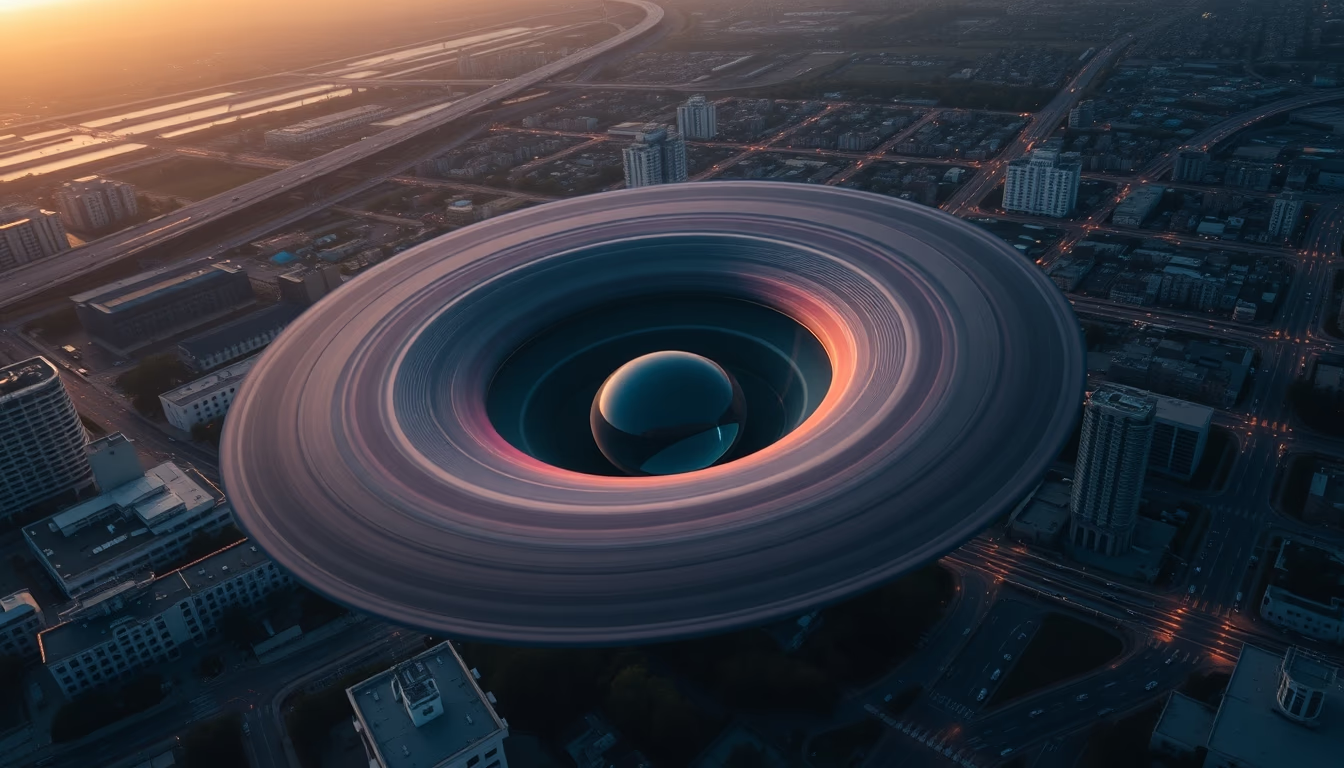
Gravitational lenses are space-time distortions predicted by Einstein, magnifying and bending light from distant objects to reveal invisible galaxies.
About this subject
Gravitational lensing is a phenomenon predicted by Einstein's General Theory of Relativity, published in 1915. The core idea is that a massive object, such as a galaxy or galaxy cluster, warps the space-time around it. When light from a distant source, like a galaxy or quasar, passes near that mass, its path is bent, similar to what an optical lens does with visible light. This effect was first confirmed during the 1919 solar eclipse, when Arthur Eddington observed that light from stars near the Sun was deflected, proving Einstein's theory.
There are two main types of gravitational lensing: strong and weak. In strong lensing, the alignment between source, lens, and observer is so precise that multiple images of the same source form, along with Einstein rings or giant arcs. A classic example is the Einstein Cross, where a distant quasar appears as four points around a central galaxy. Weak lensing, on the other hand, causes subtle distortions in the shapes of background galaxies, allowing astronomers to map the distribution of dark matter, which emits no light. Scientists use this effect to study the large-scale structure of the universe and measure cosmological parameters.
Observatories like the Hubble Space Telescope and the James Webb Space Telescope capture stunning images of gravitational lenses. They enable us to see galaxies so distant that without the magnification effect they would be invisible. For instance, the galaxy MACS0647-JD, one of the most distant ever discovered, was detected thanks to a gravitational lens. Additionally, the phenomenon helps test modified gravity theories and study galaxy evolution across cosmic time.
Frequently Asked Questions
What causes gravitational lensing?
Gravitational lensing is caused by the warping of space-time around massive objects like galaxies or black holes, as predicted by Einstein's general relativity.
How are gravitational lenses used in astronomy?
They are used to magnify distant galaxies, map dark matter, measure the universe's expansion, and test gravity theories. They also help discover exoplanets via microlensing.
Can gravitational lensing be seen with the naked eye?
No, the effects are too subtle and only detectable with powerful telescopes. Distorted images and Einstein rings require high-resolution observations.
Direct URL
https://pub-c7d6a6ea828543ac903a74a341ccb2e1.r2.dev/imagens/gravitational-lensing-visualization-aerial-drone-shot-p2.avifHow to credit
Include a visible link back to UtilizAí. Copy one of the snippets below:
<a href="https://xn--utiliza-eza.com/en/midia/imagens/gravitational-lensing-visualization-aerial-drone-shot-p2">Gravitational lensing visualization</a> by <a href="https://xn--utiliza-eza.com">UtilizAí</a>, licensed under <a href="https://creativecommons.org/licenses/by/4.0/">CC BY 4.0</a>.
[Gravitational lensing visualization](https://xn--utiliza-eza.com/en/midia/imagens/gravitational-lensing-visualization-aerial-drone-shot-p2) by [UtilizAí](https://xn--utiliza-eza.com), CC BY 4.0
License: CC-BY-4.0