Fiber optic transceiver
1344×768 · AVIF · CC BY 4.0
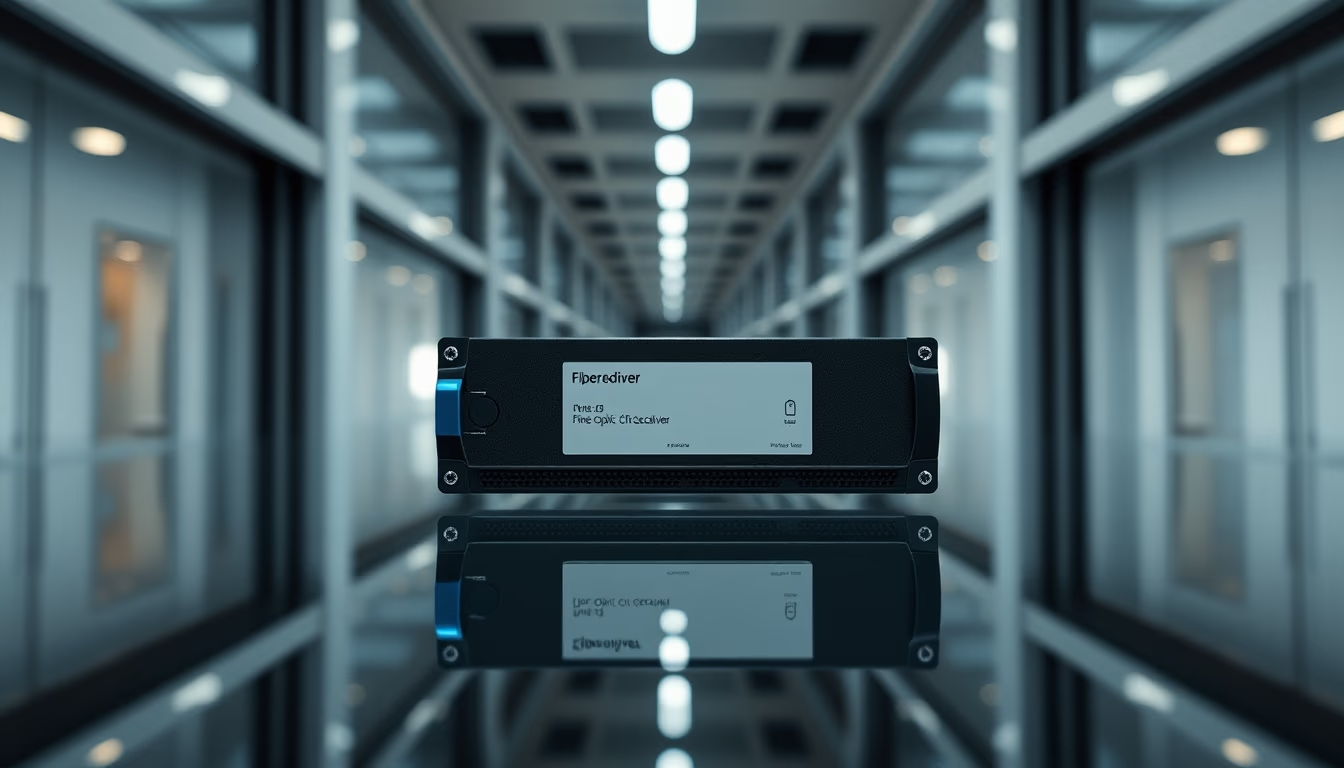
Fiber optic transceivers convert electrical signals to optical for high-speed transmission, essential in data centers and telecommunications.
About this subject
Fiber optic transceivers are electronic devices that integrate a transmitter and a receiver into a single module, converting electrical signals into light and vice versa. They are fundamental components in modern communication networks, enabling long-distance data transmission with high bandwidth and low signal loss. Common form factors include SFP (Small Form-Factor Pluggable), SFP+ (for 10 Gbps), QSFP (Quad SFP, for 40/100 Gbps), and QSFP-DD, each designed for specific data rates and distances ranging from hundreds of meters to tens of kilometers.
These devices operate at defined wavelengths, such as 850 nm (multimode) for short distances and 1310 nm or 1550 nm (single-mode) for long distances. The choice of fiber type and transceiver depends on the application: local area networks (LAN), data centers, metropolitan area networks (MAN), or submarine links. In data centers, QSFP transceivers are widely used for interconnecting switches and servers, supporting standards like 40G, 100G, and 400G Ethernet. In telecommunications, DWDM (Dense Wavelength Division Multiplexing) modules allow multiplexing multiple wavelengths onto a single fiber, multiplying transmission capacity.
A notable feature is that transceivers are hot-pluggable, meaning they can be inserted or removed without powering down the equipment, simplifying maintenance and upgrades. The evolution of transceivers follows the growing demand for bandwidth driven by services like video streaming, cloud computing, and IoT. Current research is moving towards 800 Gbps and 1.6 Tbps modules, using techniques like PAM4 modulation and silicon photonics. The architectural photography tag may refer to the physical arrangement of transceivers in server racks, highlighting their industrial design.
Frequently Asked Questions
What is the difference between SFP and SFP+ transceivers?
SFP (Small Form-Factor Pluggable) supports data rates up to 1 Gbps, while SFP+ is an enhanced version for up to 10 Gbps. They share the same physical size but are electrically incompatible.
Can fiber optic transceivers be used in home networks?
Yes, but they are more common in enterprise environments. In home networks, they are typically used in fiber connections to the modem (ONT) or in managed switches that accept SFP modules.
What does it mean for a transceiver to be 'hot-pluggable'?
It means the module can be inserted or removed from the equipment without powering it off, allowing maintenance, replacement, or upgrade without network interruption.
Direct URL
https://pub-c7d6a6ea828543ac903a74a341ccb2e1.r2.dev/imagens/fiber-optic-transceiver-architectural-photography-p8.avifHow to credit
Include a visible link back to UtilizAí. Copy one of the snippets below:
<a href="https://xn--utiliza-eza.com/en/midia/imagens/fiber-optic-transceiver-architectural-photography-p8">Fiber optic transceiver</a> by <a href="https://xn--utiliza-eza.com">UtilizAí</a>, licensed under <a href="https://creativecommons.org/licenses/by/4.0/">CC BY 4.0</a>.
[Fiber optic transceiver](https://xn--utiliza-eza.com/en/midia/imagens/fiber-optic-transceiver-architectural-photography-p8) by [UtilizAí](https://xn--utiliza-eza.com), CC BY 4.0
License: CC-BY-4.0