Exoplanet earth-like
1344×768 · AVIF · CC BY 4.0
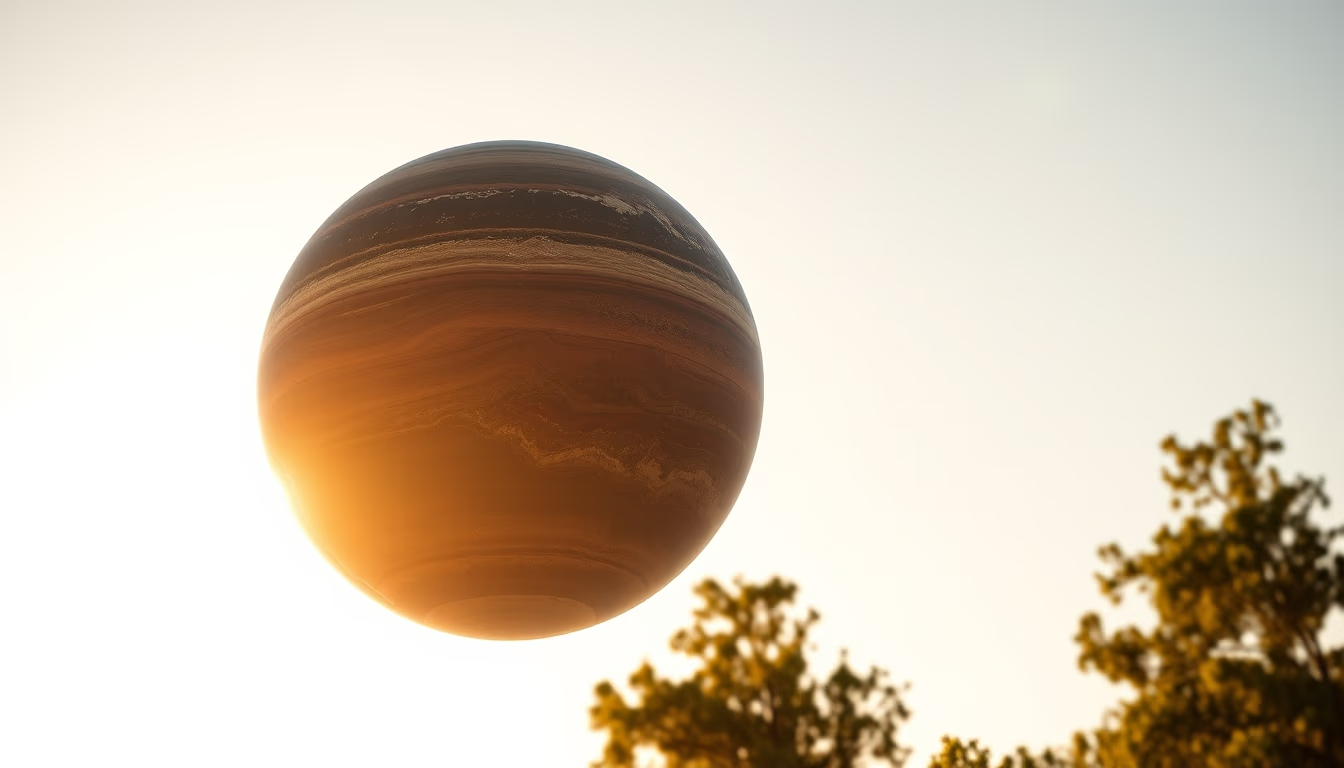
Earth-like exoplanets, located in the habitable zone of their stars, spark scientific interest for their potential to harbor life.
About this subject
Exoplanets are planets that orbit stars beyond our Solar System. Since the first exoplanet discovery in 1992, over 5,000 have been cataloged, with thousands of candidates awaiting confirmation. Among these worlds, so-called "Earth-like exoplanets" are those with size and mass close to Earth's and located in the habitable zone of their stars, the region where temperatures allow liquid water to exist on the surface, a key requirement for life as we know it.
The search for these planets is one of the most active fields in modern astronomy. NASA's Kepler Space Telescope, launched in 2009, identified thousands of candidates, many in multi-planet systems. In 2016, Proxima Centauri b was announced, orbiting the closest star to the Sun, just 4.2 light-years away. The TRAPPIST-1 system, with seven rocky planets, three in the habitable zone, is also a frequent study target, located 40 light-years from Earth.
Confirming life on an Earth-like exoplanet would require analyzing its atmosphere for biosignatures, such as the simultaneous presence of oxygen and methane. Future telescopes like the James Webb (launched in 2021) and PLATO (planned for 2026) aim to perform these observations. Although no exoplanet has yet been confirmed as habitable, each new discovery brings us closer to understanding our place in the universe and whether we are alone.
Interestingly, the classification "Earth-like" is not precise: planets with masses up to ten times Earth's are called super-Earths, and many may have very different compositions, such as global oceans or thick atmospheres. Even within the habitable zone, factors like stellar activity, planetary age, and atmospheric composition play crucial roles in actual habitability. Nonetheless, the search continues, driving technological advances and international collaborations.
Frequently Asked Questions
What is an Earth-like exoplanet?
It is a rocky planet with size and mass similar to Earth's, orbiting in the habitable zone of its star, where liquid water could exist on the surface.
How many Earth-like exoplanets have been discovered?
Dozens of candidates have been identified, but none confirmed as truly habitable. Notable examples include Proxima Centauri b and the planets of the TRAPPIST-1 system.
How do astronomers detect exoplanets?
Main techniques include the transit method (observing tiny dips in stellar brightness as a planet passes in front) and radial velocity (measuring tiny stellar wobbles caused by the planet's gravitational pull).
Direct URL
https://pub-c7d6a6ea828543ac903a74a341ccb2e1.r2.dev/imagens/exoplanet-earth-like-travel-photography-p9.avifHow to credit
Include a visible link back to UtilizAí. Copy one of the snippets below:
<a href="https://xn--utiliza-eza.com/en/midia/imagens/exoplanet-earth-like-travel-photography-p9">Exoplanet earth-like</a> by <a href="https://xn--utiliza-eza.com">UtilizAí</a>, licensed under <a href="https://creativecommons.org/licenses/by/4.0/">CC BY 4.0</a>.
[Exoplanet earth-like](https://xn--utiliza-eza.com/en/midia/imagens/exoplanet-earth-like-travel-photography-p9) by [UtilizAí](https://xn--utiliza-eza.com), CC BY 4.0
License: CC-BY-4.0