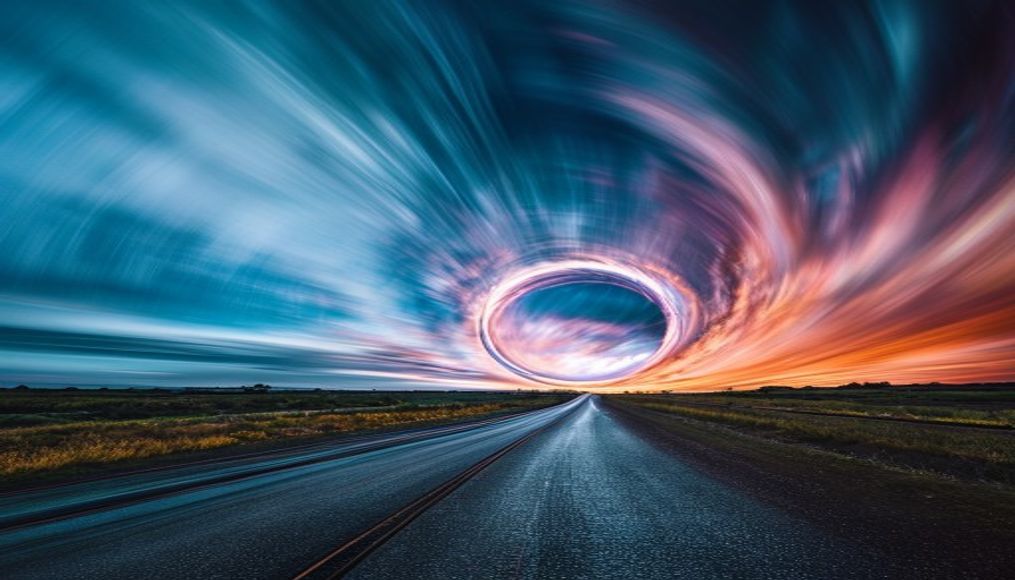
Eclipse solar diamond ring
1344×768 · AVIF · CC BY 4.0

The diamond ring effect during a total solar eclipse is a spectacular optical phenomenon that occurs seconds before and after totality.
About this subject
The diamond ring effect is one of the most striking moments of a total solar eclipse. It occurs when the Moon nearly completely covers the solar disk, leaving only a thin arc of sunlight visible. At that instant, a bright point of light, resembling a diamond, appears at the edge of the lunar disk, surrounded by the thin ring of the solar chromosphere. This effect results from the last sunlight passing through the Moon's valleys, creating the illusion of a sparkling jewel.
The name "diamond ring" was popularized by American astronomer William Campbell in 1905 after observing the total eclipse of August 30 that year. The phenomenon is extremely brief, lasting only a few seconds, and is one of the most photographed and anticipated moments by eclipse chasers. During totality, the solar corona becomes visible, but the diamond ring marks both the end and the beginning of the total phase.
Safe observation requires proper solar filters before and after totality. During the brief diamond ring moment, the light is intense and can damage the retina. Amateur and professional astronomers often plan expeditions to specific regions where the total eclipse will be visible, such as the next major total eclipse crossing Brazil on August 12, 2026, passing through northern and northeastern states.
Interestingly, the diamond ring effect serves as a test for the accuracy of eclipse predictions. Small variations in lunar topography affect the exact timing of the phenomenon, providing valuable data for selenography. Additionally, the color of the "diamond" can range from white to yellowish, depending on the depth of the solar atmosphere the light traverses.
Frequently Asked Questions
What causes the diamond ring effect in a solar eclipse?
The effect is caused by the last sunlight passing through valleys and irregularities of the lunar terrain, creating a bright point on the edge of the lunar disk while the rest of the Sun is covered.
Is it safe to look directly at the diamond ring without protection?
No. Even during the brief diamond ring moment, sunlight is still intense enough to cause permanent retinal damage. Certified solar filters are required.
When is the next total solar eclipse visible in Brazil?
The next total solar eclipse visible in Brazil will occur on August 12, 2026, with the path of totality passing through the states of Amazonas, Pará, Maranhão, Piauí, Ceará, Rio Grande do Norte, and Paraíba.
Direct URL
https://pub-c7d6a6ea828543ac903a74a341ccb2e1.r2.dev/imagens/eclipse-solar-diamond-ring-commercial-product-photography-p0.avifHow to credit
Include a visible link back to UtilizAí. Copy one of the snippets below:
<a href="https://xn--utiliza-eza.com/en/midia/imagens/eclipse-solar-diamond-ring-commercial-product-photography-p0">Eclipse solar diamond ring</a> by <a href="https://xn--utiliza-eza.com">UtilizAí</a>, licensed under <a href="https://creativecommons.org/licenses/by/4.0/">CC BY 4.0</a>.
[Eclipse solar diamond ring](https://xn--utiliza-eza.com/en/midia/imagens/eclipse-solar-diamond-ring-commercial-product-photography-p0) by [UtilizAí](https://xn--utiliza-eza.com), CC BY 4.0
License: CC-BY-4.0