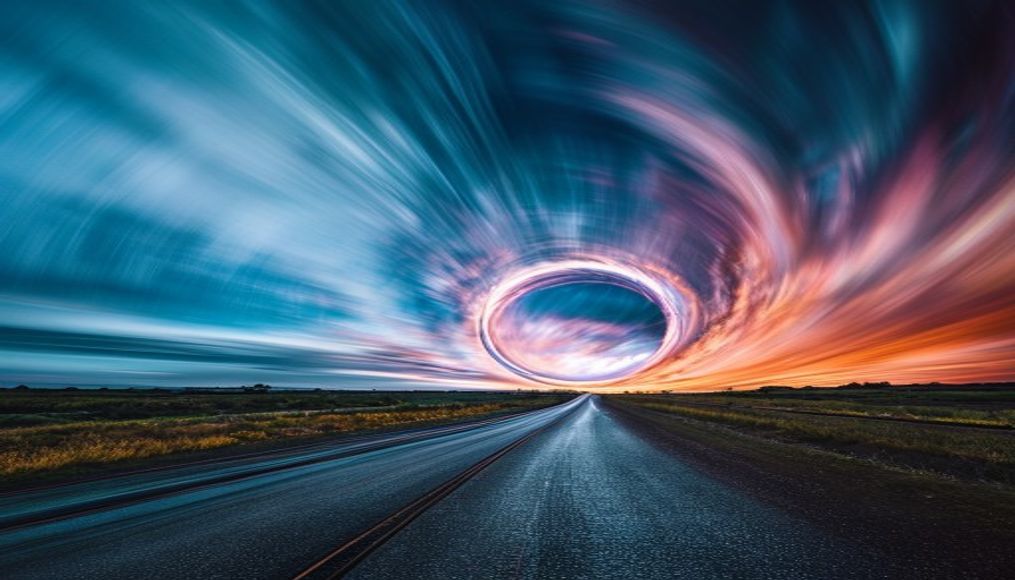
Dark matter visualization
1344×768 · AVIF · CC BY 4.0

Explore dark matter visualization, one of the cosmos' greatest unknowns, with data revealing its influence on galaxy formation.
About this subject
Dark matter is a hypothetical form of matter that does not emit, absorb, or reflect light, making it invisible to conventional telescopes. Its existence is inferred through its gravitational effects on visible matter, such as galaxy rotation and light bending in gravitational lensing. Dark matter is estimated to constitute about 27% of the universe's mass-energy content, while ordinary (baryonic) matter accounts for only 5%.
The first evidence emerged in the 1930s when astronomer Fritz Zwicky observed that galaxies in the Coma Cluster moved so fast they should fly apart unless unseen mass held them together. Decades later, Vera Rubin confirmed these findings by studying spiral galaxy rotation curves. Today, standard cosmological models like Lambda-CDM rely on dark matter to explain the large-scale structure of the universe.
Candidate particles include WIMPs (Weakly Interacting Massive Particles) and axions. Experiments such as the Large Hadron Collider and underground detectors search for direct detection. Dark matter visualization combines computer simulations and observational data to map its distribution, as in the Illustris project, which recreates cosmic evolution.
Though invisible, dark matter is crucial for galaxy formation and even life. Without its gravitational pull, ordinary matter would not have clumped to form stars and planets. Understanding this mysterious component continues to drive physics and astronomy, linking the particle microcosm to the macrocosm of the universe.
Frequently Asked Questions
How do scientists know dark matter exists if it is invisible?
Scientists infer dark matter's existence through its gravitational effects on visible matter, such as galaxy rotation speeds and light distortion in gravitational lensing. These effects cannot be explained without additional invisible mass.
What is the difference between dark matter and dark energy?
Dark matter is a form of matter that attracts gravitationally and helps form cosmic structures. Dark energy is a repulsive force accelerating the universe's expansion. Both are dominant components but with opposite effects.
Can dark matter be detected in a laboratory?
Yes, many experiments seek to detect dark matter particles directly. Examples include underground detectors (e.g., LUX-ZEPLIN) and the Large Hadron Collider, which attempt to produce or capture WIMPs or axions.
Direct URL
https://pub-c7d6a6ea828543ac903a74a341ccb2e1.r2.dev/imagens/dark-matter-visualization-studio-editorial-portrait-p0.avifHow to credit
Include a visible link back to UtilizAí. Copy one of the snippets below:
<a href="https://xn--utiliza-eza.com/en/midia/imagens/dark-matter-visualization-studio-editorial-portrait-p0">Dark matter visualization</a> by <a href="https://xn--utiliza-eza.com">UtilizAí</a>, licensed under <a href="https://creativecommons.org/licenses/by/4.0/">CC BY 4.0</a>.
[Dark matter visualization](https://xn--utiliza-eza.com/en/midia/imagens/dark-matter-visualization-studio-editorial-portrait-p0) by [UtilizAí](https://xn--utiliza-eza.com), CC BY 4.0
License: CC-BY-4.0