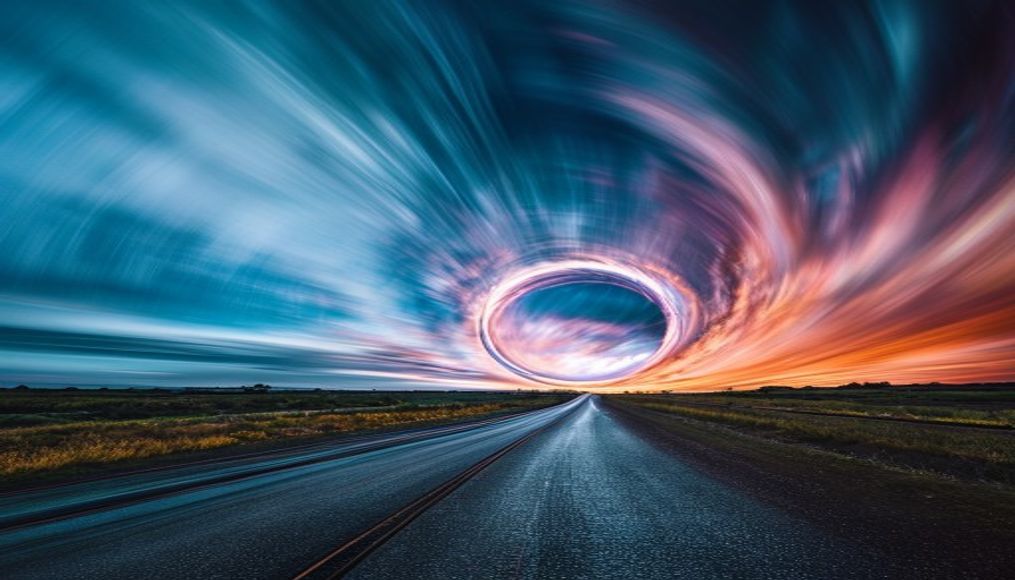
Dark matter visualization
1344×768 · AVIF · CC BY 4.0

Dark matter is a hypothetical form of matter that does not emit light, but its existence is inferred from gravitational effects on galaxies and clusters.
About this subject
Dark matter constitutes about 85% of the total matter in the universe, according to estimates based on cosmological observations. Its existence was first proposed in the 1930s by astronomer Fritz Zwicky while studying the Coma Cluster. He noticed that galaxies moved so fast they should fly apart, unless invisible mass provided extra gravity.
Today, the strongest evidence comes from rotation curves of spiral galaxies like the Milky Way. The speed of stars at the edges does not drop as expected from visible matter, indicating a dark matter halo. Other clues include gravitational lensing in clusters and fluctuations in the cosmic microwave background.
Despite decades of searches, dark matter has never been directly detected. Popular candidates include weakly interacting massive particles (WIMPs) and axions. Experiments like LUX and XENON1T look for rare signals in underground laboratories, while telescopes like Fermi map possible annihilation signals from galactic centers.
The distribution map of dark matter, derived from simulations such as the Illustris project, reveals a cosmic web of filaments and voids. This structure influences galaxy formation and the evolution of the universe. Understanding its nature is one of the biggest challenges in modern physics, potentially revolutionizing our knowledge of particles and gravitation.
Frequently Asked Questions
What is dark matter?
It is a hypothetical form of matter that does not interact with light but exerts gravitational influence. Its existence explains galactic motions and the large-scale structure.
How do we know dark matter exists?
Through indirect evidence: galactic rotation curves, gravitational lensing, structure formation, and the cosmic microwave background.
What is the difference between dark matter and dark energy?
Dark matter attracts gravitationally and forms matter, while dark energy causes the accelerated expansion of the universe.
Direct URL
https://pub-c7d6a6ea828543ac903a74a341ccb2e1.r2.dev/imagens/dark-matter-visualization-film-grain-authentic-p11.avifHow to credit
Include a visible link back to UtilizAí. Copy one of the snippets below:
<a href="https://xn--utiliza-eza.com/en/midia/imagens/dark-matter-visualization-film-grain-authentic-p11">Dark matter visualization</a> by <a href="https://xn--utiliza-eza.com">UtilizAí</a>, licensed under <a href="https://creativecommons.org/licenses/by/4.0/">CC BY 4.0</a>.
[Dark matter visualization](https://xn--utiliza-eza.com/en/midia/imagens/dark-matter-visualization-film-grain-authentic-p11) by [UtilizAí](https://xn--utiliza-eza.com), CC BY 4.0
License: CC-BY-4.0