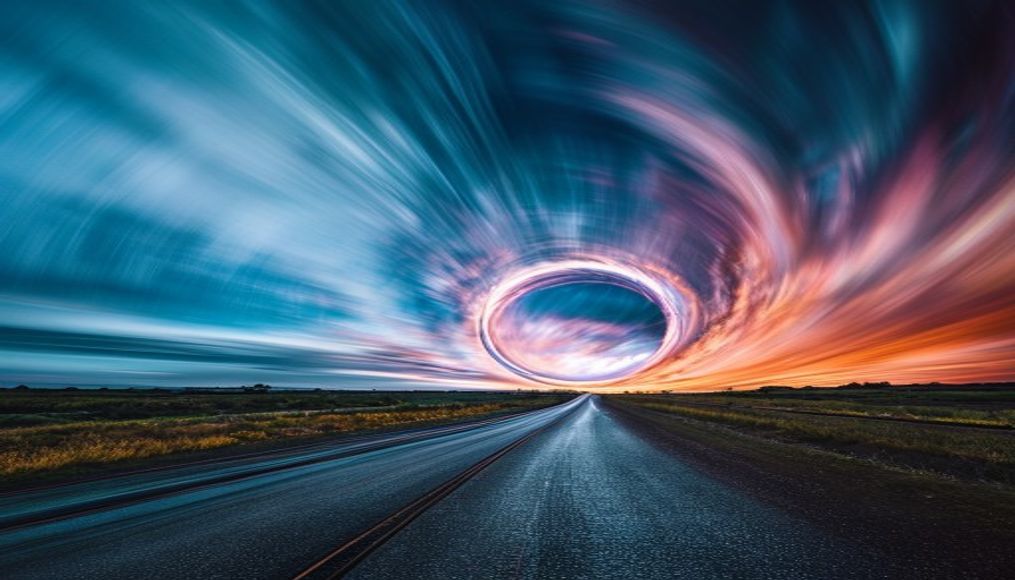
Dark matter visualization
1344×768 · AVIF · CC BY 4.0

Dark matter, which makes up 27% of the universe, is visualized through gravitational lensing maps and computer simulations of structure formation.
About this subject
Dark matter is a form of matter that does not emit, absorb, or reflect light, making it invisible to traditional telescopes. Its existence was first proposed by Fritz Zwicky in the 1930s when studying galaxy clusters, but it was solidified by Vera Rubin's work on spiral galaxy rotation curves. Today, dark matter is estimated to constitute about 27% of the universe's total mass-energy content, while ordinary baryonic matter accounts for only 5%.
To visualize dark matter, scientists use two main approaches: numerical simulations and gravitational lensing observations. Simulations like the Illustris project and the Millennium Simulation recreate the universe's evolution from the Big Bang, incorporating dark matter particles that interact only through gravity. Gravitational lensing exploits the distortion of light from distant galaxies due to spacetime curvature caused by foreground dark matter. Telescopes such as Hubble and Euclid produce detailed maps of dark matter distribution.
Visualizing dark matter is crucial for modern cosmology. It explains the formation of large-scale structures like galaxies and clusters, which could not have formed with visible matter alone. The cold dark matter (CDM) model is the most accepted, but its exact nature remains unknown. Particle candidates include WIMPs, axions, and sterile neutrinos. Underground experiments like LUX and XENON hunt for direct detection, while the LHC searches for production.
Interestingly, dark matter visualization has revealed that it is not uniformly distributed but forms halos around galaxies and filamentary structures known as the cosmic web. These representations help test modified gravity theories and refine cosmological parameters like the Hubble constant. Future missions such as the Nancy Grace Roman Telescope will further enhance the resolution of these maps.
Frequently Asked Questions
How do scientists visualize dark matter if it is invisible?
They use computer simulations that model dark matter distribution based on gravitational laws and observe indirect effects like gravitational lensing, where light from distant objects is distorted by dark matter's presence.
What is the difference between dark matter and dark energy?
Dark matter is a form of matter that attracts gravitationally and helps form cosmic structures. Dark energy is a repulsive force accelerating the universe's expansion. Dark matter makes up 27% of the universe, while dark energy accounts for 68%.
Why do we believe dark matter exists?
Because without it, galaxy rotation speeds would not be explained, galaxy cluster formation would be impossible, and fluctuations in the cosmic microwave background would not match observations. Multiple lines of evidence point to its existence.
Direct URL
https://pub-c7d6a6ea828543ac903a74a341ccb2e1.r2.dev/imagens/dark-matter-visualization-aerial-drone-shot-p1.avifHow to credit
Include a visible link back to UtilizAí. Copy one of the snippets below:
<a href="https://xn--utiliza-eza.com/en/midia/imagens/dark-matter-visualization-aerial-drone-shot-p1">Dark matter visualization</a> by <a href="https://xn--utiliza-eza.com">UtilizAí</a>, licensed under <a href="https://creativecommons.org/licenses/by/4.0/">CC BY 4.0</a>.
[Dark matter visualization](https://xn--utiliza-eza.com/en/midia/imagens/dark-matter-visualization-aerial-drone-shot-p1) by [UtilizAí](https://xn--utiliza-eza.com), CC BY 4.0
License: CC-BY-4.0