Cyclotron particle
1344×768 · AVIF · CC BY 4.0
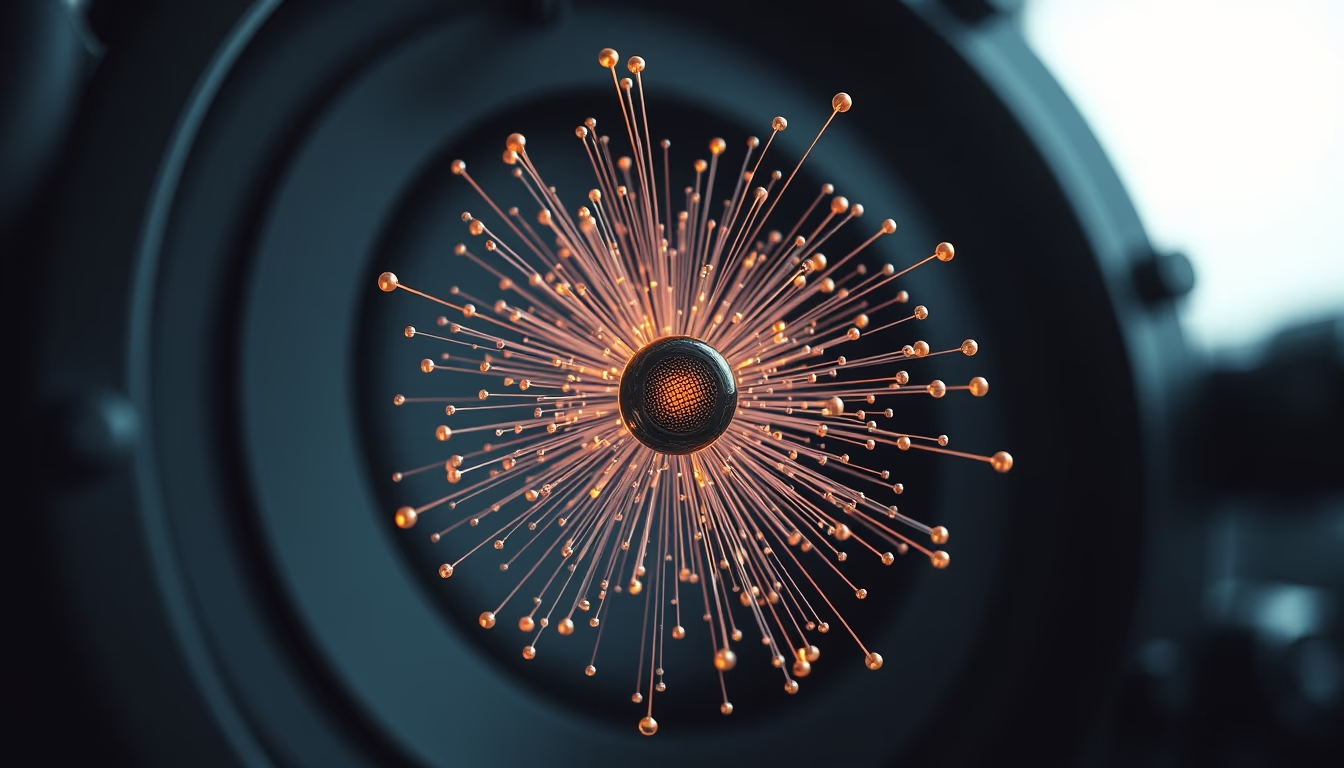
Cyclotrons accelerate charged particles using alternating electric and magnetic fields, crucial for nuclear physics research and medical applications.
About this subject
The cyclotron is a type of particle accelerator invented in 1932 by Ernest Lawrence, revolutionizing nuclear physics. It uses a constant magnetic field to bend the path of charged particles (such as protons or ions) into a spiral, while an alternating electric field applied across two semicircular plates (dees) accelerates each particle every half turn. This design allows particles to reach very high energies in a relatively compact space. In Brazil, the Institute for Energy and Nuclear Research (IPEN) in São Paulo operates a cyclotron to produce radioisotopes used in nuclear medicine, such as fluorine-18 for PET Scan diagnostics. The maximum theoretical energy is limited by relativistic effects, but modern cyclotrons can achieve energies in the tens of megaelectron-volts (MeV) range. Synchrocyclotrons and isochronous cyclotrons are variants that correct relativistic distortions, broadening their applications. These accelerators are also employed in fundamental physics research, studies of nuclear reactions, and materials testing under radiation.
Frequently Asked Questions
What is a cyclotron used for in medicine?
Cyclotrons produce short-lived radioisotopes like fluorine-18, used in PET scans to diagnose cancer and heart disease.
What is the difference between a cyclotron and a linear accelerator?
A cyclotron accelerates particles in a spiral path using a constant magnetic field, while a linear accelerator (linac) accelerates them in a straight line using electric fields.
What limits the energy in a cyclotron?
Very fast particles gain relativistic mass, falling out of sync with the alternating field. Synchrocyclotrons adjust frequency to compensate for this effect.
Direct URL
https://pub-c7d6a6ea828543ac903a74a341ccb2e1.r2.dev/imagens/cyclotron-particle-minimalist-composition-p11.avifHow to credit
Include a visible link back to UtilizAí. Copy one of the snippets below:
<a href="https://xn--utiliza-eza.com/en/midia/imagens/cyclotron-particle-minimalist-composition-p11">Cyclotron particle</a> by <a href="https://xn--utiliza-eza.com">UtilizAí</a>, licensed under <a href="https://creativecommons.org/licenses/by/4.0/">CC BY 4.0</a>.
[Cyclotron particle](https://xn--utiliza-eza.com/en/midia/imagens/cyclotron-particle-minimalist-composition-p11) by [UtilizAí](https://xn--utiliza-eza.com), CC BY 4.0
License: CC-BY-4.0