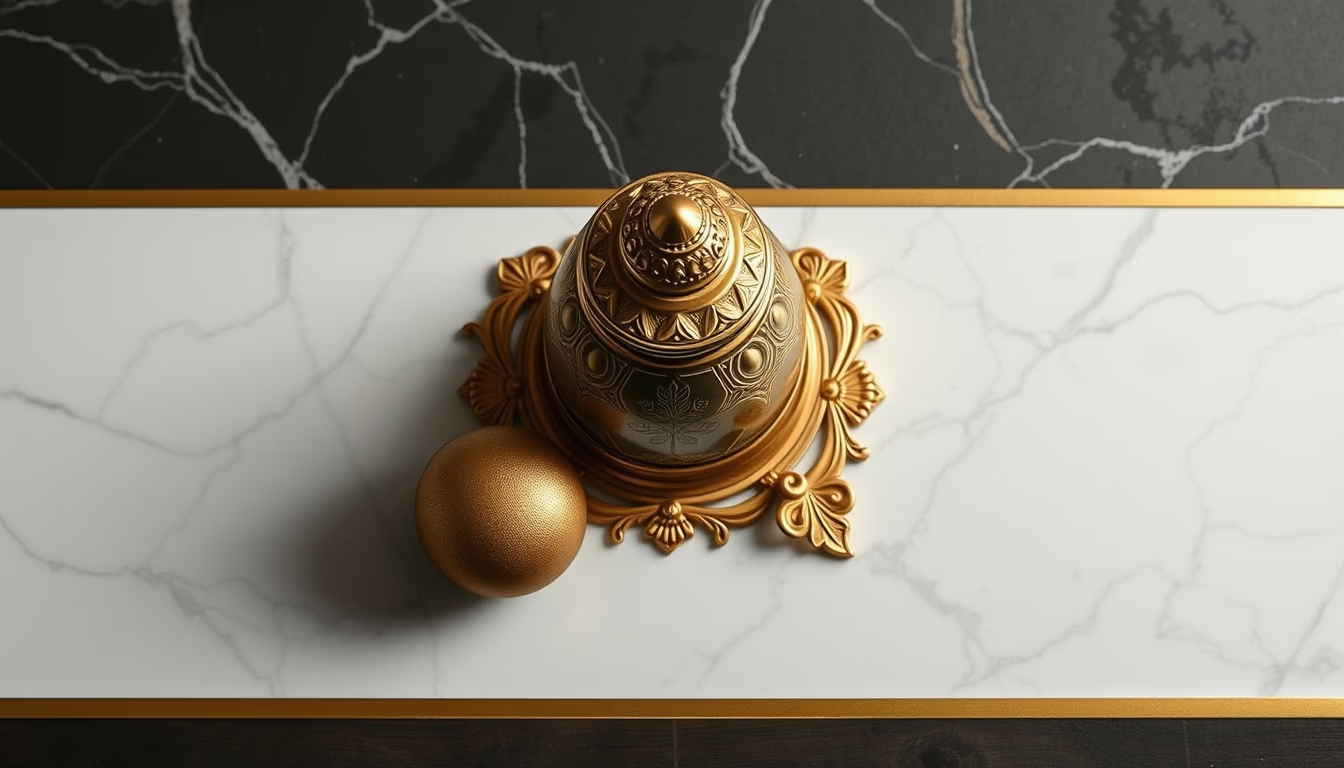
Cubist abstract picasso style
1344×768 · AVIF · CC BY 4.0

Cubism, the revolutionary art movement pioneered by Picasso, fractures reality into overlapping geometric forms.
About this subject
Cubism emerged between 1907 and 1914, primarily through Pablo Picasso and Georges Braque. Inspired by African art and Cézanne's work, the movement rejected Renaissance perspective, depicting objects from multiple viewpoints simultaneously on a two-dimensional surface. This approach evolved into two main phases: Analytical Cubism, which breaks forms into monochromatic geometric fragments, and Synthetic Cubism, which reintroduces vivid colors and collages, including newspaper clippings and sheet music.
Picasso, a Spanish artist based in France, created iconic works such as "Les Demoiselles d'Avignon" (1907), considered the movement's precursor, and "Guernica" (1937), a political manifesto using cubist language to portray war horrors. Cubism profoundly influenced sculpture, architecture, and design, paving the way for future abstractions like Constructivism and Abstract Expressionism.
The cubist technique relies on fragmenting forms into cubes, cones, and cylinders, blurring the distinction between figure and ground. Colors are often reduced to earthy tones and grays, but in the synthetic phase they gain intensity. Artists like Juan Gris and Fernand Léger expanded the style, applying it to still lifes and portraits. Cubism's legacy endures in contemporary art, serving as a reference for visual experiments that challenge traditional perception.
Frequently Asked Questions
What are the main characteristics of Cubism?
Cubism breaks objects into geometric forms, depicts multiple perspectives simultaneously, and uses reduced or vibrant colors depending on the phase. It abolished the illusion of depth and emphasized the flatness of the canvas.
Why is Picasso so closely associated with Cubism?
Picasso, alongside Braque, founded the movement and created seminal works like 'Les Demoiselles d'Avignon'. His constant experimentation and lasting influence made his name synonymous with Cubism.
Did Cubism influence fields beyond painting?
Yes, Cubism impacted sculpture, architecture, literature, and design. In sculpture, artists like Picasso and Julio González incorporated fragmented planes. In architecture, it inspired Constructivism and Art Deco style.
Direct URL
https://pub-c7d6a6ea828543ac903a74a341ccb2e1.r2.dev/imagens/cubist-abstract-picasso-style-macro-closeup-fresh8.avifHow to credit
Include a visible link back to UtilizAí. Copy one of the snippets below:
<a href="https://xn--utiliza-eza.com/en/midia/imagens/cubist-abstract-picasso-style-macro-closeup-fresh8">Cubist abstract picasso style</a> by <a href="https://xn--utiliza-eza.com">UtilizAí</a>, licensed under <a href="https://creativecommons.org/licenses/by/4.0/">CC BY 4.0</a>.
[Cubist abstract picasso style](https://xn--utiliza-eza.com/en/midia/imagens/cubist-abstract-picasso-style-macro-closeup-fresh8) by [UtilizAí](https://xn--utiliza-eza.com), CC BY 4.0
License: CC-BY-4.0