Crab nebula supernova
1344×768 · AVIF · CC BY 4.0
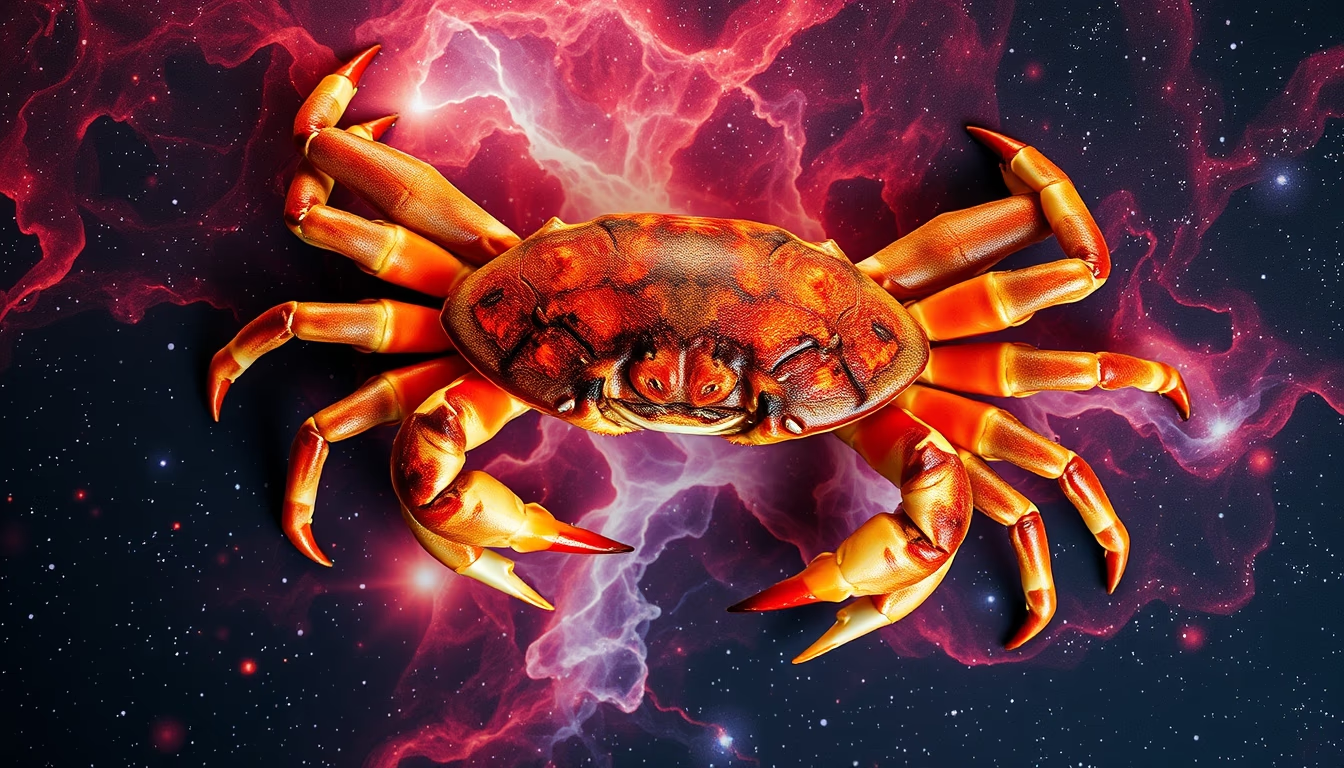
The Crab Nebula, remnant of supernova SN 1054, is one of the most studied deep-sky objects, located in the constellation Taurus.
About this subject
The Crab Nebula, cataloged as M1 or NGC 1952, is a supernova remnant resulting from the explosion of a massive star observed by Chinese astronomers in 1054 AD. The event was so bright that it remained visible to the naked eye for about two years. Located approximately 6,500 light-years from Earth in the constellation Taurus, this nebula expands at a speed of about 1,500 km/s. Its current diameter is roughly 11 light-years.
At the center of the Crab Nebula lies a pulsar, a neutron star that rotates about 30 times per second. Discovered in 1968, it was the first pulsar associated with a supernova remnant. This pulsar emits radiation across the entire electromagnetic spectrum, from radio waves to gamma rays, making it one of the most energetic sources in the sky. The nebula is one of the few objects where synchrotron radiation can be observed, resulting from the interaction of relativistic electrons with magnetic fields.
The Crab Nebula is a frequent target for amateur and professional astronomers. In 2008, the Fermi Gamma-ray Space Telescope detected gamma-ray emissions from the pulsar, confirming its nature as one of the brightest sources in that band. Images from the Hubble Space Telescope reveal a filamentary structure, with ionized gas and dust, resembling a spider web. The nebula continues to be used as a calibrator for astronomical instruments due to its stability and brightness.
Interestingly, the Crab Nebula was not observed by European astronomers until 1731, when it was discovered by John Bevis. Charles Messier cataloged it in 1758 while searching for Halley's Comet, making it the first object in his famous catalog. The name "Crab" was given by William Parsons, the third Earl of Rosse, who in 1844 drew a structure that reminded him of a crab, although modern drawings show a more elongated shape.
Frequently Asked Questions
What caused the Crab Nebula?
The Crab Nebula is the remnant of a Type II supernova, caused by the core collapse of a massive star that exploded in 1054 AD.
How far is the Crab Nebula from Earth?
The nebula is about 6,500 light-years away from Earth, located in the constellation Taurus.
Why is the Crab Nebula important for astronomy?
It is used as a calibrator for astronomical instruments, hosts a well-studied pulsar, and is one of the brightest sources of synchrotron radiation in the sky.
Direct URL
https://pub-c7d6a6ea828543ac903a74a341ccb2e1.r2.dev/imagens/crab-nebula-supernova-isometric-flat-lay-p5.avifHow to credit
Include a visible link back to UtilizAí. Copy one of the snippets below:
<a href="https://xn--utiliza-eza.com/en/midia/imagens/crab-nebula-supernova-isometric-flat-lay-p5">Crab nebula supernova</a> by <a href="https://xn--utiliza-eza.com">UtilizAí</a>, licensed under <a href="https://creativecommons.org/licenses/by/4.0/">CC BY 4.0</a>.
[Crab nebula supernova](https://xn--utiliza-eza.com/en/midia/imagens/crab-nebula-supernova-isometric-flat-lay-p5) by [UtilizAí](https://xn--utiliza-eza.com), CC BY 4.0
License: CC-BY-4.0