Cpu socket lga
1344×768 · AVIF · CC BY 4.0
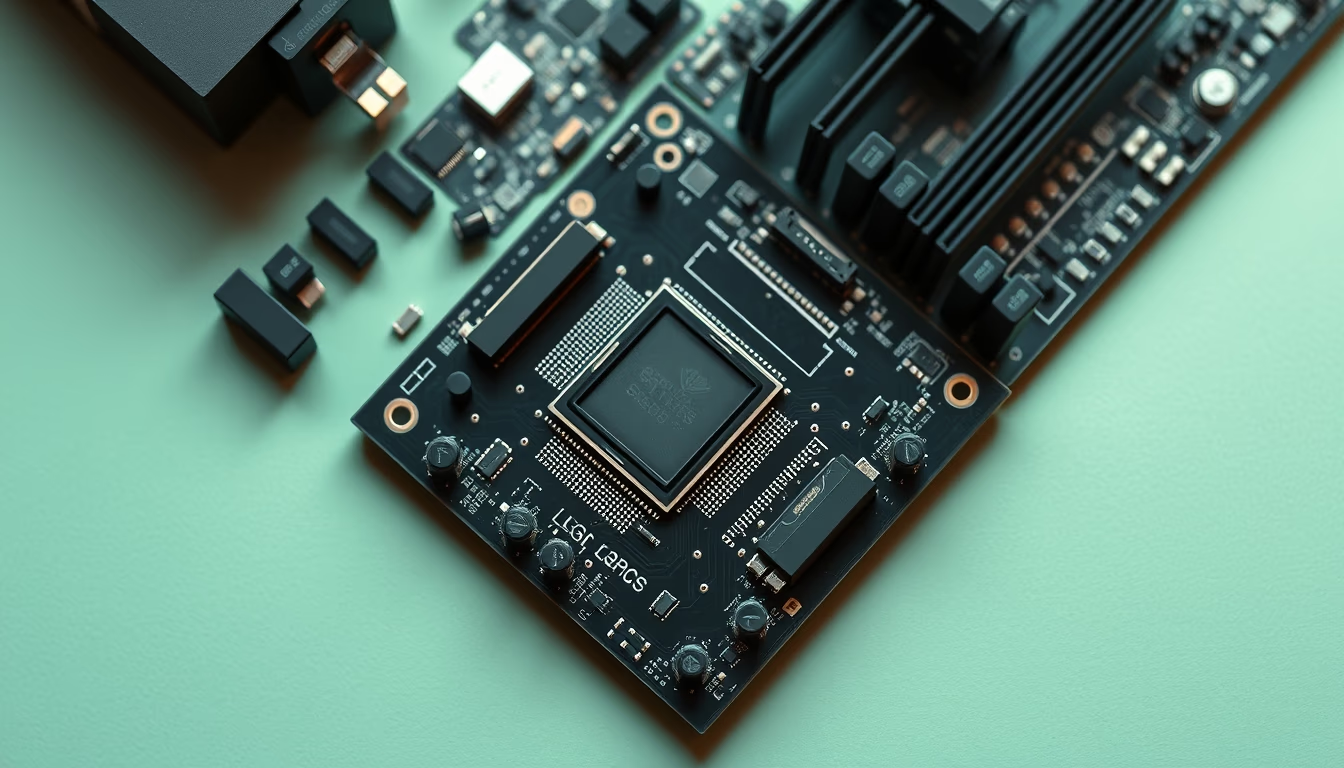
The LGA (Land Grid Array) socket is a CPU interface standard that uses flat contacts on the motherboard, widely used in modern Intel and AMD processors.
About this subject
The LGA (Land Grid Array) socket is a significant evolution in CPU packaging design. Unlike older PGA (Pin Grid Array) sockets where pins were on the processor, LGA places the contacts on the motherboard, while the CPU has gold pads. This change reduced pin damage during installation and allowed for more contacts for power and signals.
Intel introduced LGA in 2004 with the LGA775 socket for the Pentium 4 platform. Since then, Intel has adopted numerous variants: LGA1156, LGA1155, LGA1150, LGA1151, and the current LGA1700 (for Alder Lake and Raptor Lake). AMD moved to LGA in 2017 with the AM4 socket (1331 contacts) and later AM5 (LGA1718). Each new socket brought support for newer processor generations, higher memory bandwidth, and more PCIe lanes.
The main advantage of LGA is contact density, enabling high signal speeds and greater current capacity. Modern LGA sockets have hundreds of gold-plated contacts arranged in precise matrices. Installation requires controlled torque and proper thermal paste, as the cooler presses the processor against the socket. Errors like excessive torque or dirty contacts can cause poor connectivity or damage.
In the enthusiast market, LGA is also used in workstations and servers, such as Intel's LGA2066 (X299) and LGA3647 (Xeon). AMD, besides AM4/AM5, uses TR4 and sTRX4 for Threadripper processors. The trend is that future sockets will remain LGA, with increasing pin counts to accommodate more cores and high-speed interfaces like PCIe 5.0 and DDR5.
Frequently Asked Questions
What is the difference between LGA and PGA?
In LGA, the pins are on the motherboard; in PGA, the pins are on the processor. This makes LGA less prone to damage during installation and allows more contacts for modern CPUs.
Which LGA sockets are most common today?
Intel uses LGA1700 (12th and 13th gen) and LGA1200 (10th and 11th gen). AMD uses AM4 (Ryzen 1000 to 5000) and AM5 (Ryzen 7000 onward).
Can I swap the motherboard while keeping the processor?
Yes, as long as the new motherboard has the exact same socket. For example, an LGA1700 processor only fits in boards with the LGA1700 socket.
Direct URL
https://pub-c7d6a6ea828543ac903a74a341ccb2e1.r2.dev/imagens/cpu-socket-lga-isometric-flat-lay-p12.avifHow to credit
Include a visible link back to UtilizAí. Copy one of the snippets below:
<a href="https://xn--utiliza-eza.com/en/midia/imagens/cpu-socket-lga-isometric-flat-lay-p12">Cpu socket lga</a> by <a href="https://xn--utiliza-eza.com">UtilizAí</a>, licensed under <a href="https://creativecommons.org/licenses/by/4.0/">CC BY 4.0</a>.
[Cpu socket lga](https://xn--utiliza-eza.com/en/midia/imagens/cpu-socket-lga-isometric-flat-lay-p12) by [UtilizAí](https://xn--utiliza-eza.com), CC BY 4.0
License: CC-BY-4.0