Cpu socket lga
1344×768 · AVIF · CC BY 4.0
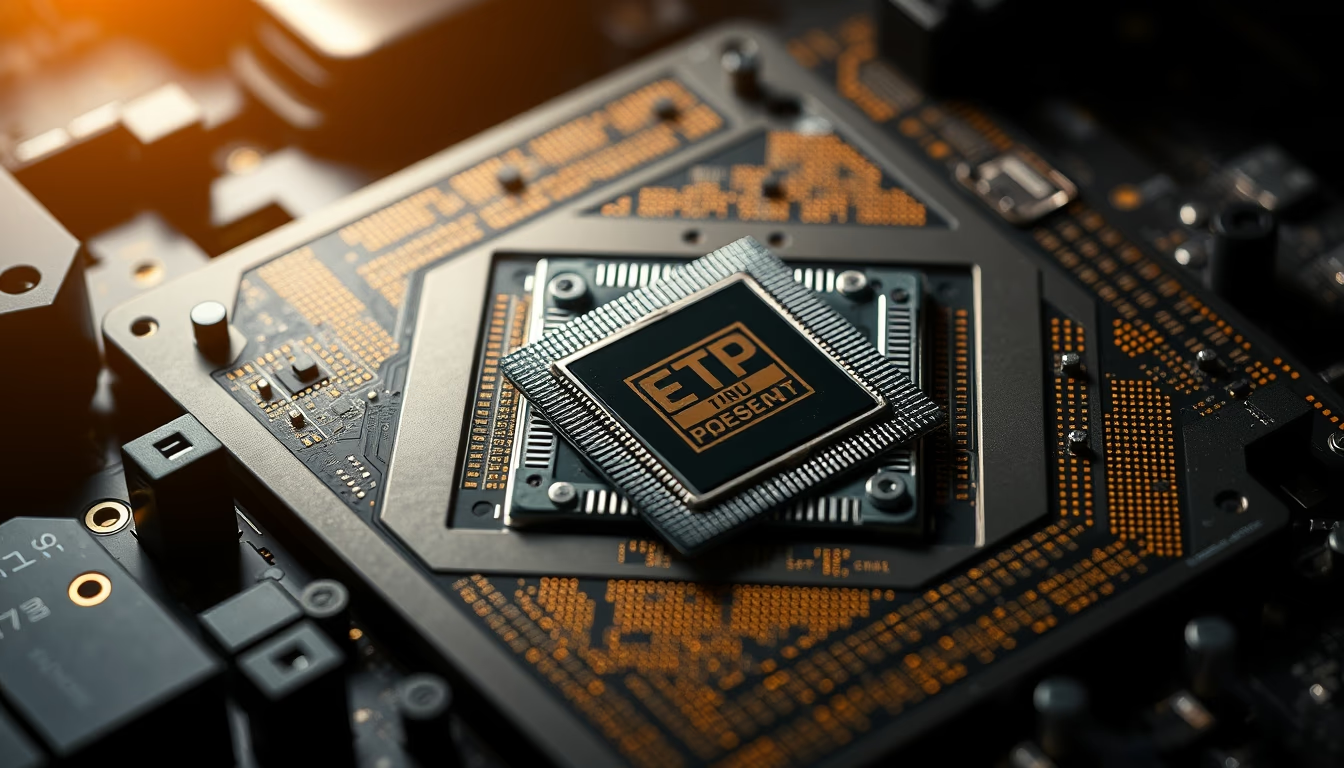
The LGA (Land Grid Array) socket is a modern CPU connection standard used by Intel and AMD, replacing fragile pins with flat contacts on the motherboard.
About this subject
The LGA (Land Grid Array) socket is a connection standard for modern CPUs, where the conductive pins are located on the motherboard socket rather than on the processor. This differs from the PGA (Pin Grid Array) standard, where pins are part of the chip. This design inversion reduces the risk of damaging pins during installation or removal and allows for higher pin density, which is essential for supporting multiple cores and high bus speeds.
Intel introduced the first general-purpose LGA socket with the LGA 775 in 2004, replacing the PGA 478. Since then, the company has released various variants, such as LGA 1156, LGA 1151, and LGA 1700, each with specific pin counts (1151 pins, 1700 pins, respectively). AMD adopted LGA sockets later, with the Ryzen series: AM4 has 1331 pins and AM5 (launched in 2022) features 1718 pins. The transition brought benefits like better thermal dissipation support, as the flat processor surface improves contact with cooler bases, and enhanced signal integrity at high frequencies.
Interestingly, the number of pins in LGA sockets is not random. Each pin has a specific function, such as power, ground, data, or control signals. For example, the LGA 1700 was designed for Intel's Alder Lake and Raptor Lake generations, supporting DDR5 memory and PCIe 5.0. Installing an LGA processor requires care: the processor must be aligned correctly with the orientation key, and the cooler pressure must be uniform, following the specified torque, to avoid PCB flexing and poor contact. In servers and workstations, sockets like the LGA 3647 (for Intel Xeon processors) allow configuring systems with many cores and high reliability. The trend is that future sockets will keep pace with increasing core counts and adoption of technologies like chiplet stacking, maintaining the LGA philosophy as the dominant standard.
Frequently Asked Questions
What is the difference between LGA and PGA?
In LGA, the pins are on the motherboard socket, while in PGA they are on the processor. This reduces the risk of damaging the CPU and allows for a higher number of contacts, improving electrical performance.
What does LGA 1700 mean?
LGA 1700 is an Intel socket with 1700 pins, used for 12th and 13th generation processors (Alder Lake and Raptor Lake). It supports DDR5 memory and PCIe 5.0, and requires specific coolers due to the rectangular processor shape.
Can I replace an LGA processor without damaging the motherboard?
Yes, with care: align the processor correctly, avoid touching the socket contacts, and apply uniform cooler torque as per manufacturer specifications to prevent damage.
Direct URL
https://pub-c7d6a6ea828543ac903a74a341ccb2e1.r2.dev/imagens/cpu-socket-lga-fine-art-photography-p1.avifHow to credit
Include a visible link back to UtilizAí. Copy one of the snippets below:
<a href="https://xn--utiliza-eza.com/en/midia/imagens/cpu-socket-lga-fine-art-photography-p1">Cpu socket lga</a> by <a href="https://xn--utiliza-eza.com">UtilizAí</a>, licensed under <a href="https://creativecommons.org/licenses/by/4.0/">CC BY 4.0</a>.
[Cpu socket lga](https://xn--utiliza-eza.com/en/midia/imagens/cpu-socket-lga-fine-art-photography-p1) by [UtilizAí](https://xn--utiliza-eza.com), CC BY 4.0
License: CC-BY-4.0