Cosmic microwave background
1344×768 · AVIF · CC BY 4.0
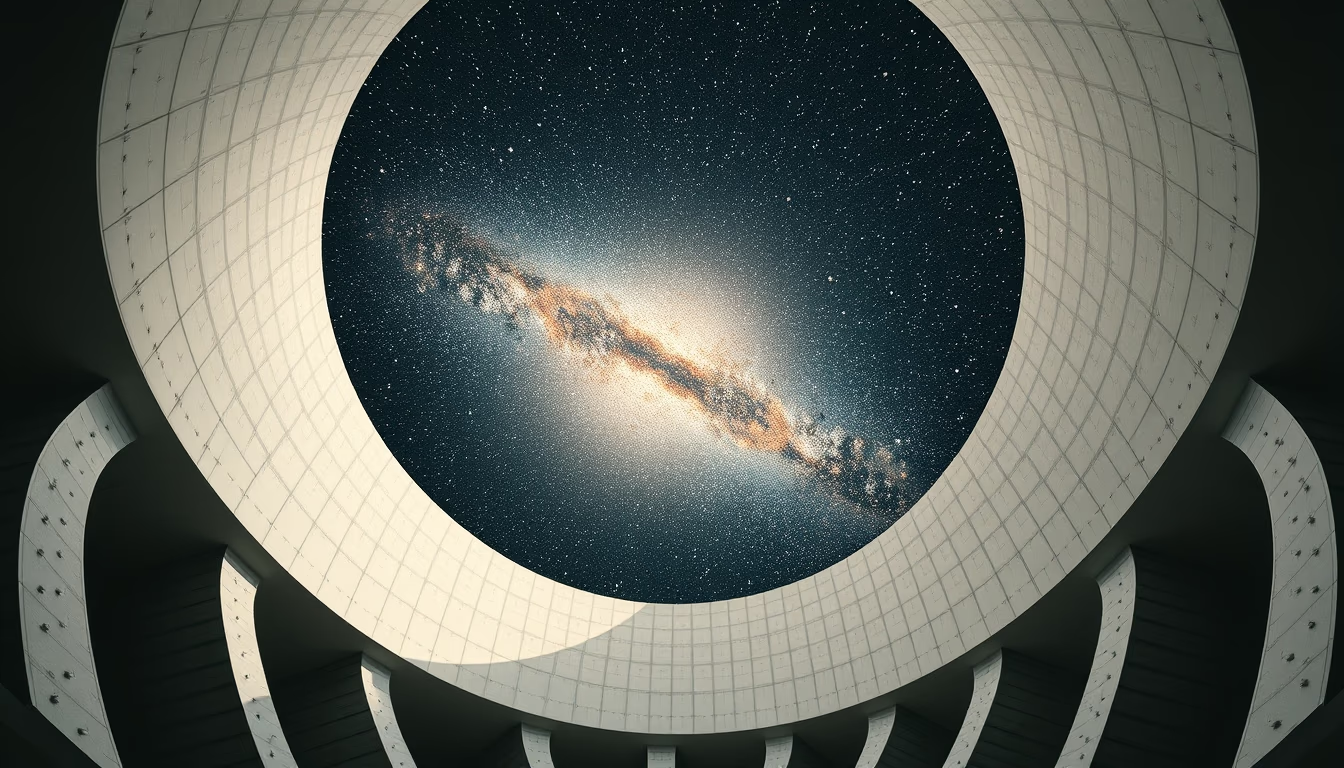
The cosmic microwave background is the luminous echo of the Big Bang, revealing the universe's infancy 13.8 billion years ago.
About this subject
The cosmic microwave background (CMB) is the electromagnetic radiation filling the universe, a remnant from the hot, dense early stage of the cosmos after the Big Bang. Accidentally discovered in 1965 by Arno Penzias and Robert Wilson while working at Bell Labs, the CMB provides the strongest evidence for the Big Bang model. This radiation exhibits a nearly perfect black-body spectrum with an average temperature of about 2.725 K, and contains tiny anisotropies (temperature fluctuations) that reflect the seeds of cosmic structures such as galaxies and clusters.
The study of the CMB is central to modern cosmology. Space missions like COBE (1989), WMAP (2001), and Planck (2009) have mapped the temperature fluctuations with increasing precision, enabling the determination of essential cosmological parameters: the age of the universe (13.8 billion years), its composition (approximately 5% ordinary matter, 26% dark matter, and 69% dark energy) and its flat geometry. CMB measurements also confirmed predictions of cosmic inflation, an exponential expansion in the first instants of the universe.
Interestingly, the CMB is everywhere, including in the static between analog television channels (about 1% of the static comes from the CMB). To detect it accurately, instruments must be cooled to near absolute zero and operated on stratospheric balloons or in space, away from terrestrial interference. The CMB map is one of the most iconic scientific images, showing a pattern of colored patches representing the primordial density fluctuations.
Frequently Asked Questions
What is the cosmic microwave background?
It is the radiation left over from the Big Bang, filling the universe uniformly at a temperature of about 2.7 K. Discovered in 1965, it provides direct evidence for the Big Bang model.
How was the cosmic microwave background discovered?
It was accidentally discovered by Arno Penzias and Robert Wilson in 1965 while testing a microwave antenna at Bell Labs in the US. They detected a constant, unavoidable noise that was later identified as the CMB.
Why is the cosmic microwave background important for cosmology?
It allows measurement of the universe's age, composition, and geometry, and confirms theories like cosmic inflation. Missions such as COBE, WMAP, and Planck mapped its fluctuations, revealing the seeds of galaxies.
Direct URL
https://pub-c7d6a6ea828543ac903a74a341ccb2e1.r2.dev/imagens/cosmic-microwave-background-architectural-photography-p9.avifHow to credit
Include a visible link back to UtilizAí. Copy one of the snippets below:
<a href="https://xn--utiliza-eza.com/en/midia/imagens/cosmic-microwave-background-architectural-photography-p9">Cosmic microwave background</a> by <a href="https://xn--utiliza-eza.com">UtilizAí</a>, licensed under <a href="https://creativecommons.org/licenses/by/4.0/">CC BY 4.0</a>.
[Cosmic microwave background](https://xn--utiliza-eza.com/en/midia/imagens/cosmic-microwave-background-architectural-photography-p9) by [UtilizAí](https://xn--utiliza-eza.com), CC BY 4.0
License: CC-BY-4.0