Compass map outdoor
1344×768 · AVIF · CC BY 4.0

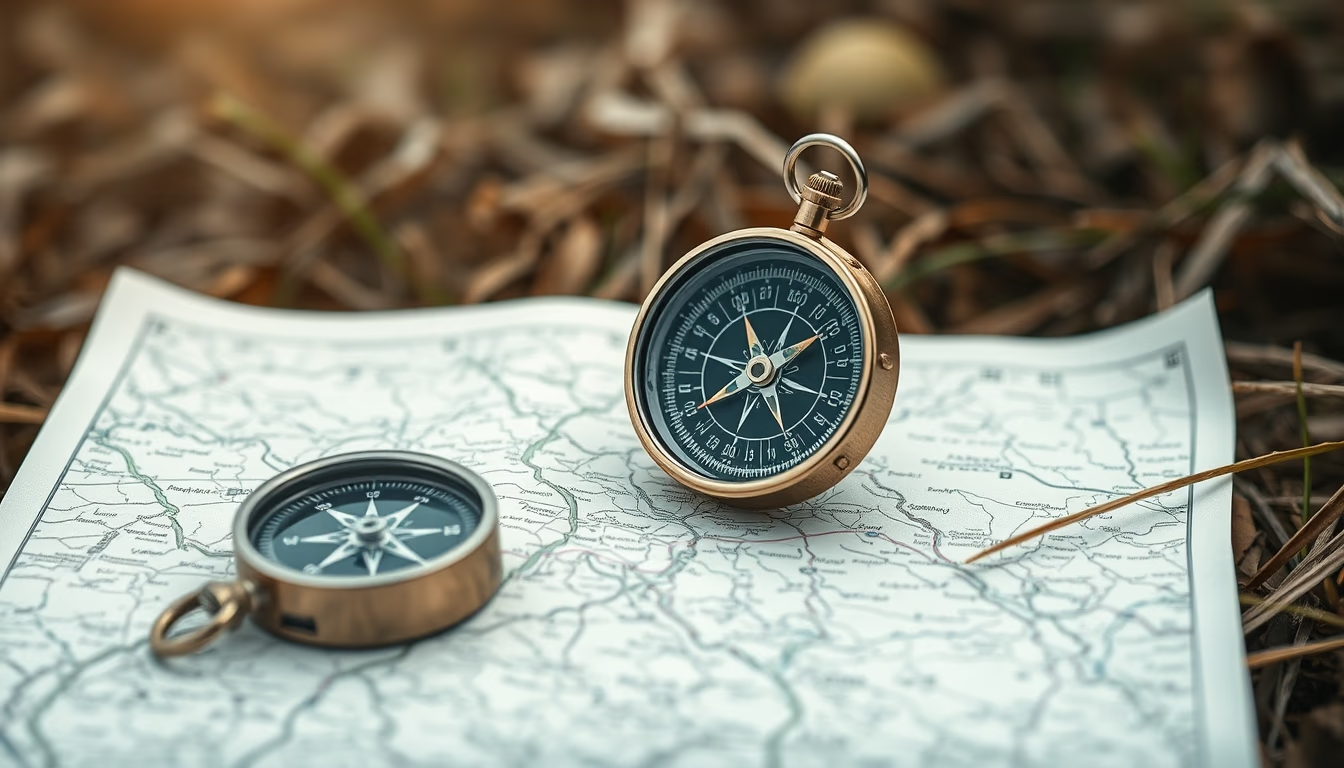
The compass is an essential navigation tool for outdoor activities, used for centuries for orientation on trails and expeditions.
About this subject
The compass is a navigation instrument that indicates the direction of Earth's magnetic north via a magnetized needle that aligns with the planet's magnetic field. Its basic principle is simple, but accuracy depends on the absence of nearby metallic or electromagnetic interference. The compass was invented in ancient China between the 2nd and 1st centuries BCE, initially used for divination and later for navigation. During the Middle Ages, it reached Europe and revolutionized maritime travel, enabling long-distance exploration even on cloudy days or at night.
In modern times, the compass remains a fundamental tool for outdoor activities such as hiking, mountaineering, camping, and professional orienteering. Unlike GPS devices, the compass does not rely on batteries or satellite signals, making it reliable in emergencies or remote areas. Various types exist, including the baseplate compass (common on trails), the lensatic compass (for precise readings), and the digital compass (integrated into watches or smartphones). Effective use requires combining it with a topographic map and calculating magnetic declination, the difference between magnetic north and true north.
An important fact is that magnetic north is not fixed; it drifts slowly over time, about 10 to 15 kilometers per year. This necessitates periodic updates to maps and compasses. Additionally, the compass points to the magnetic north pole, currently located in the Arctic Ocean near Ellesmere Island in Canada. Understanding these concepts is crucial to avoid navigation errors in natural environments.
Frequently Asked Questions
How to use a compass correctly on a trail?
Hold the compass level, turn the bezel until the needle points north (usually marked N), and align the direction arrow with the desired point on the map. Keep the compass away from metal objects and electronic devices.
What is the difference between magnetic north and true north?
Magnetic north is where the compass needle points, located at the moving magnetic pole. True north is the geographic North Pole, fixed. The difference is called magnetic declination, which varies by location.
Does a compass work anywhere in the world?
Yes, but accuracy can be affected by local magnetic anomalies (such as iron ore) and proximity to electronic devices. Near the magnetic poles, the needle may point downward, making it difficult to use.
Direct URL
https://pub-c7d6a6ea828543ac903a74a341ccb2e1.r2.dev/imagens/compass-map-outdoor-architectural-photography-fresh4.avifHow to credit
Include a visible link back to UtilizAí. Copy one of the snippets below:
<a href="https://xn--utiliza-eza.com/en/midia/imagens/compass-map-outdoor-architectural-photography-fresh4">Compass map outdoor</a> by <a href="https://xn--utiliza-eza.com">UtilizAí</a>, licensed under <a href="https://creativecommons.org/licenses/by/4.0/">CC BY 4.0</a>.
[Compass map outdoor](https://xn--utiliza-eza.com/en/midia/imagens/compass-map-outdoor-architectural-photography-fresh4) by [UtilizAí](https://xn--utiliza-eza.com), CC BY 4.0
License: CC-BY-4.0