Cassini saturn rings
1344×768 · AVIF · CC BY 4.0

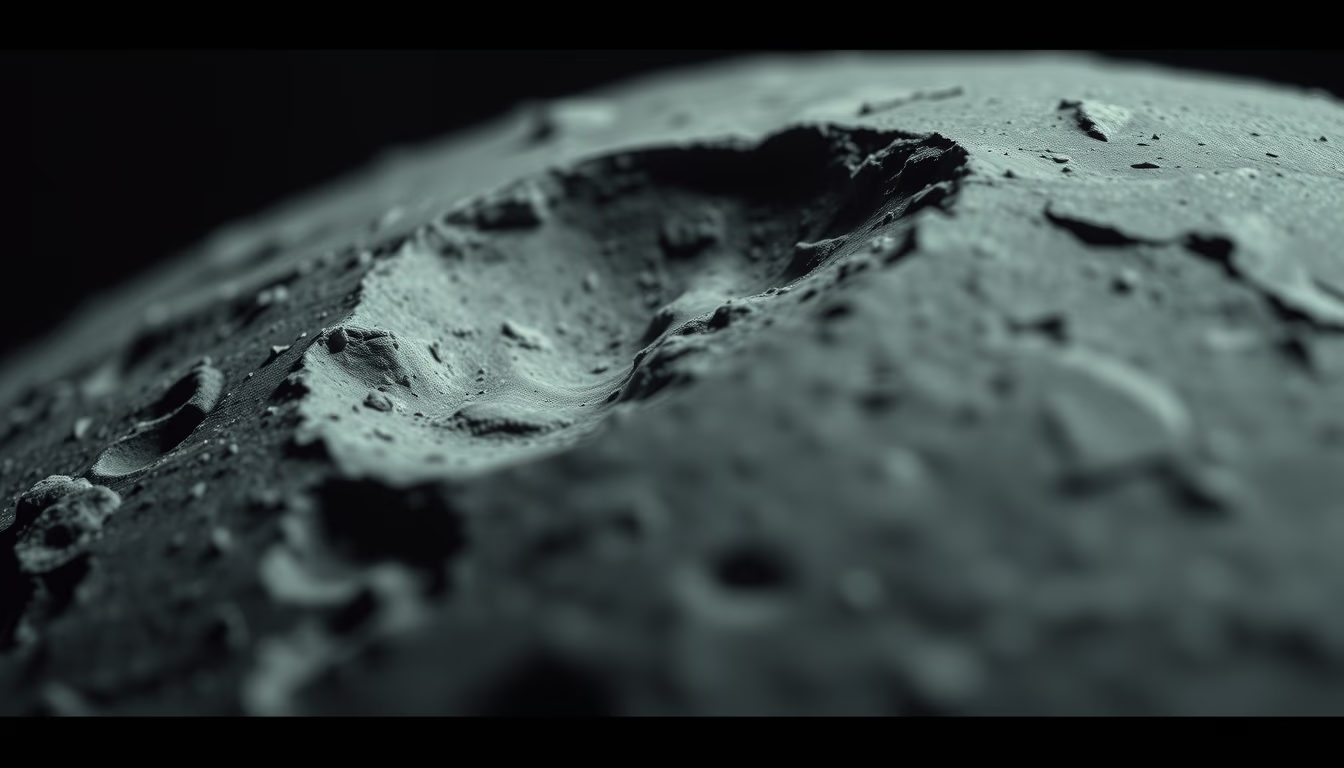
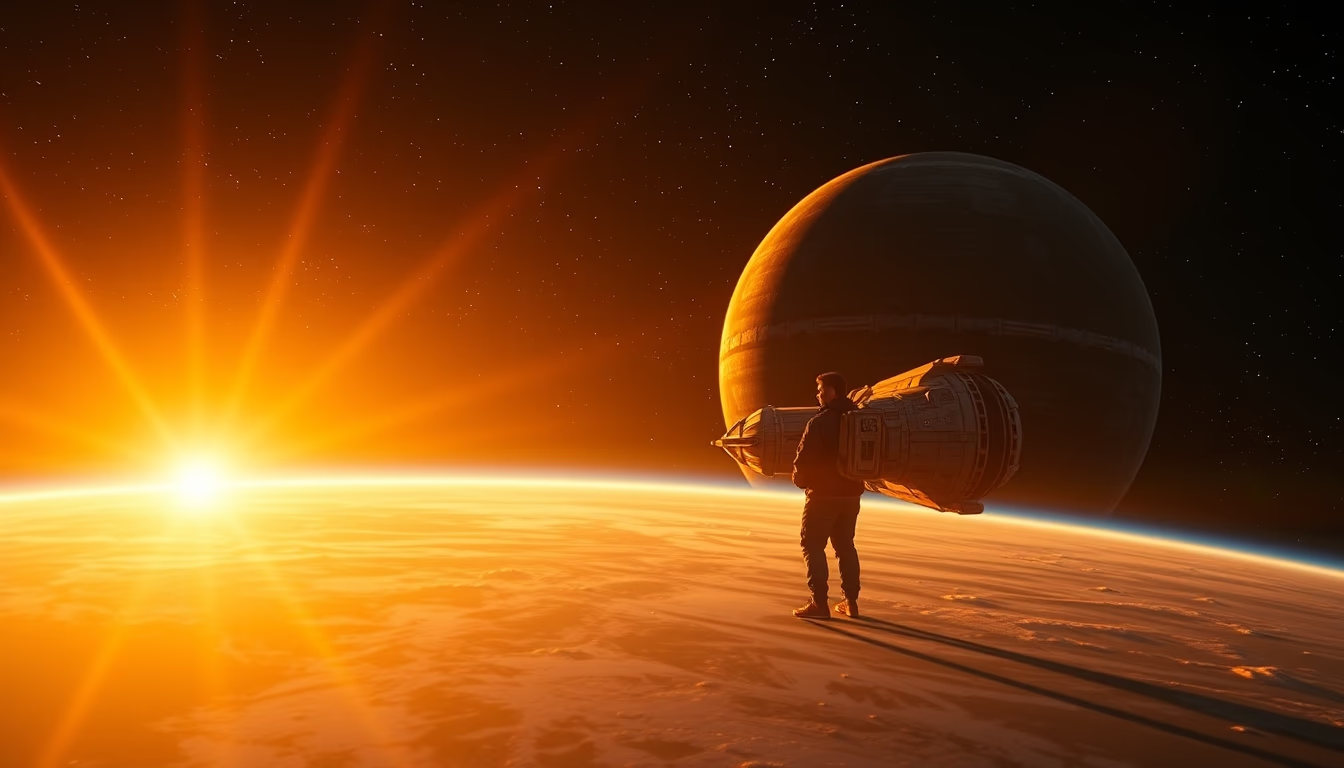
The Cassini spacecraft revealed unprecedented details of Saturn's rings, composed mainly of ice and dust, during its mission from 2004 to 2017.
About this subject
The Cassini-Huygens mission, a collaboration between NASA, ESA, and ASI, orbited Saturn from 2004 to 2017, transforming our knowledge of the planet and its rings. The Cassini spacecraft carried 12 instruments that analyzed the composition, structure, and dynamics of the rings. It was discovered that the rings are composed of water ice particles (99%) with traces of rocky dust, ranging from microscopic grains to car-sized chunks. The particles are organized into thousands of thin rings, maintained by gravitational interactions with Saturn's moons.
The main rings are designated by the letters A, B, C, D, E, F, and G, with the Cassini Division (4,800 km wide) separating the A and B rings. The mission revealed complex structures, such as ripples caused by comet impacts and the influence of shepherd moons (like Prometheus and Pandora) that confine the rings. In 2009, during Saturn's equinox, Cassini captured images showing particles protruding vertically from the rings, proving the existence of icy mountains up to 1.5 km high.
One of the biggest surprises was the discovery that the rings are relatively young, with an estimated age between 10 and 100 million years, much younger than Saturn itself (4.5 billion years). Cassini data suggest that the rings are continuously losing mass to the planet, a phenomenon known as ring rain, which could lead to their disappearance in the next 300 million years. Furthermore, the spacecraft detected complex organic molecules in the rings, indicating they may be remnants of a shattered icy moon or primordial material from the Solar System.
Frequently Asked Questions
How many rings does Saturn have?
Saturn has seven main ring groups, named by the letters A, B, C, D, E, F, and G, but each contains thousands of individual rings. The Cassini spacecraft identified even finer structures, totaling millions of rings.
What are Saturn's rings made of?
The rings are composed mainly of water ice (99%) with small amounts of rocky dust. The particles range in size from microscopic grains to car-sized objects.
Will Saturn's rings disappear?
Yes, the rings are continuously losing mass to Saturn in a process called ring rain. Estimates based on Cassini data suggest they may disappear in about 300 million years.
Direct URL
https://pub-c7d6a6ea828543ac903a74a341ccb2e1.r2.dev/imagens/cassini-saturn-rings-magazine-editorial-fresh2.avifHow to credit
Include a visible link back to UtilizAí. Copy one of the snippets below:
<a href="https://xn--utiliza-eza.com/en/midia/imagens/cassini-saturn-rings-magazine-editorial-fresh2">Cassini saturn rings</a> by <a href="https://xn--utiliza-eza.com">UtilizAí</a>, licensed under <a href="https://creativecommons.org/licenses/by/4.0/">CC BY 4.0</a>.
[Cassini saturn rings](https://xn--utiliza-eza.com/en/midia/imagens/cassini-saturn-rings-magazine-editorial-fresh2) by [UtilizAí](https://xn--utiliza-eza.com), CC BY 4.0
License: CC-BY-4.0