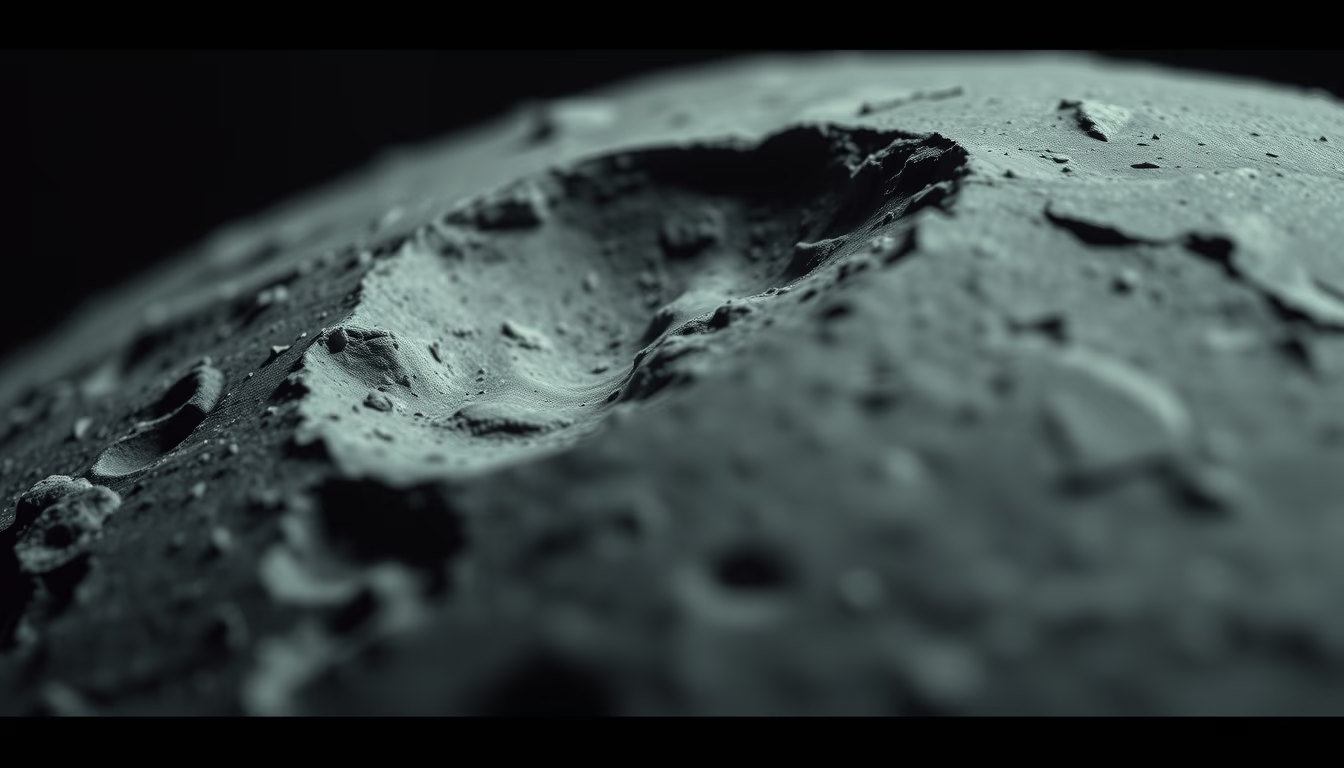
Cassini saturn rings
1344×768 · AVIF · CC BY 4.0

The Cassini spacecraft revolutionized our understanding of Saturn and its rings, revealing unprecedented details during its mission from 2004 to 2017.
About this subject
Saturn's rings are among the most iconic features in the Solar System, and the Cassini-Huygens mission, a collaboration between NASA, ESA, and ASI, provided the most detailed observations ever conducted. The spacecraft entered Saturn orbit in July 2004 and operated until September 2017, when it was deliberately plunged into the planet's atmosphere. During those 13 years, Cassini sent high-resolution images of the rings, revealing structures such as density waves, small shepherd moons, and ice particles ranging from micrometers to meters.
The rings are composed mainly of water ice with traces of rocky material, and their age is estimated between 10 million and 100 million years, relatively young in astronomical terms. Cassini discovered that the rings constantly lose material, falling into Saturn, which may indicate they are temporary. The Visual and Infrared Mapping Spectrometer (VIMS) mapped chemical composition, while radar allowed seeing through particles in some regions.
Beyond the main rings (A, B, C, and D), the mission revealed faint rings such as the E ring, fed by geysers from the moon Enceladus. The probe also detected spiral waves in the rings, caused by gravitational influence from moons like Prometheus and Pandora. These structures help understand orbital dynamics and system evolution.
Cassini's legacy continues: its data is still being analyzed, and the mission inspired future projects like Dragonfly on Titan. Understanding Saturn's rings is essential for studying protoplanetary disks and planet formation.
Frequently Asked Questions
What was Cassini's main discovery about Saturn's rings?
The discovery that the rings are constantly losing material to the planet, suggesting they may be relatively young and temporary formations.
How many main rings does Saturn have?
Saturn has four main rings designated A, B, C, and D, but there are fainter rings such as the E ring, discovered by Cassini.
What are Saturn's rings made of?
They are composed mainly of water ice, with small amounts of rocky material and dust. Particles range in size from micrometers to meters.
Direct URL
https://pub-c7d6a6ea828543ac903a74a341ccb2e1.r2.dev/imagens/cassini-saturn-rings-lo-fi-disposable-camera-fresh8.avifHow to credit
Include a visible link back to UtilizAí. Copy one of the snippets below:
<a href="https://xn--utiliza-eza.com/en/midia/imagens/cassini-saturn-rings-lo-fi-disposable-camera-fresh8">Cassini saturn rings</a> by <a href="https://xn--utiliza-eza.com">UtilizAí</a>, licensed under <a href="https://creativecommons.org/licenses/by/4.0/">CC BY 4.0</a>.
[Cassini saturn rings](https://xn--utiliza-eza.com/en/midia/imagens/cassini-saturn-rings-lo-fi-disposable-camera-fresh8) by [UtilizAí](https://xn--utiliza-eza.com), CC BY 4.0
License: CC-BY-4.0