Bubble chamber tracks
1344×768 · AVIF · CC BY 4.0

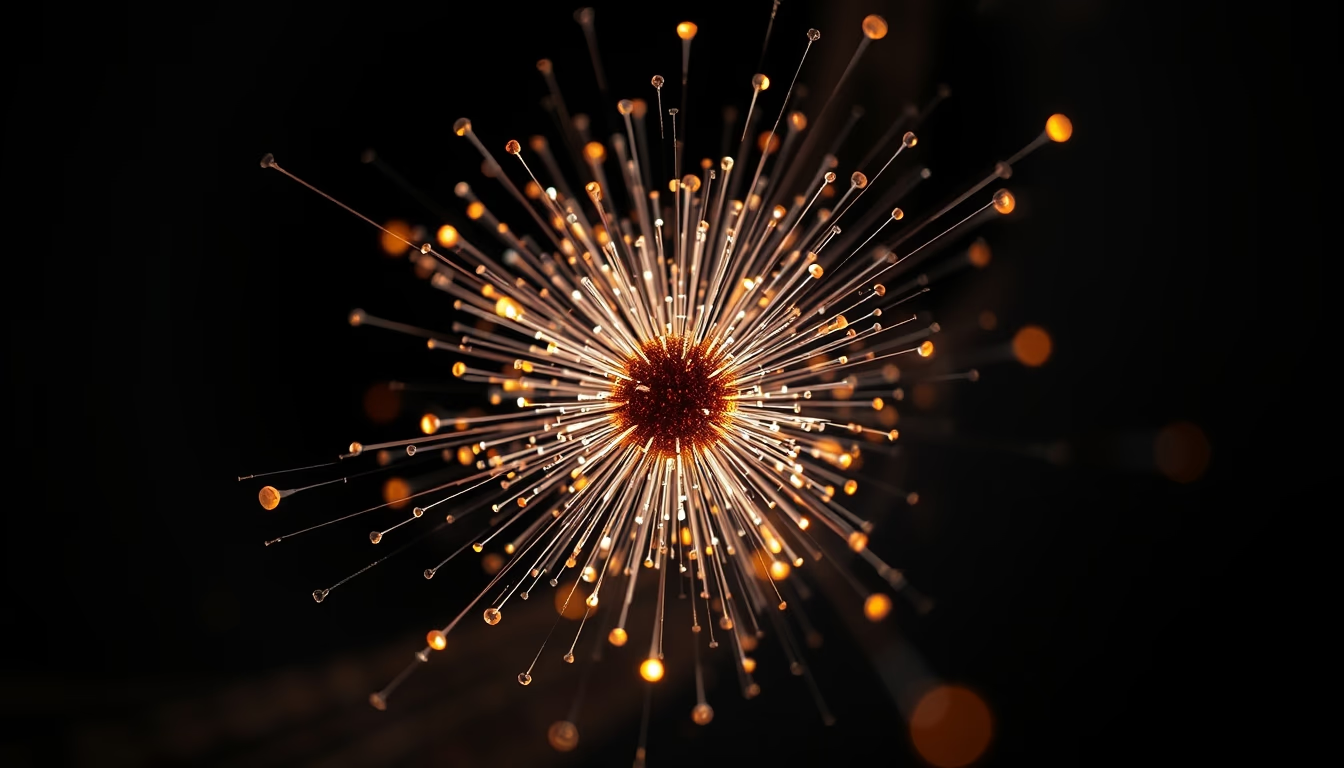
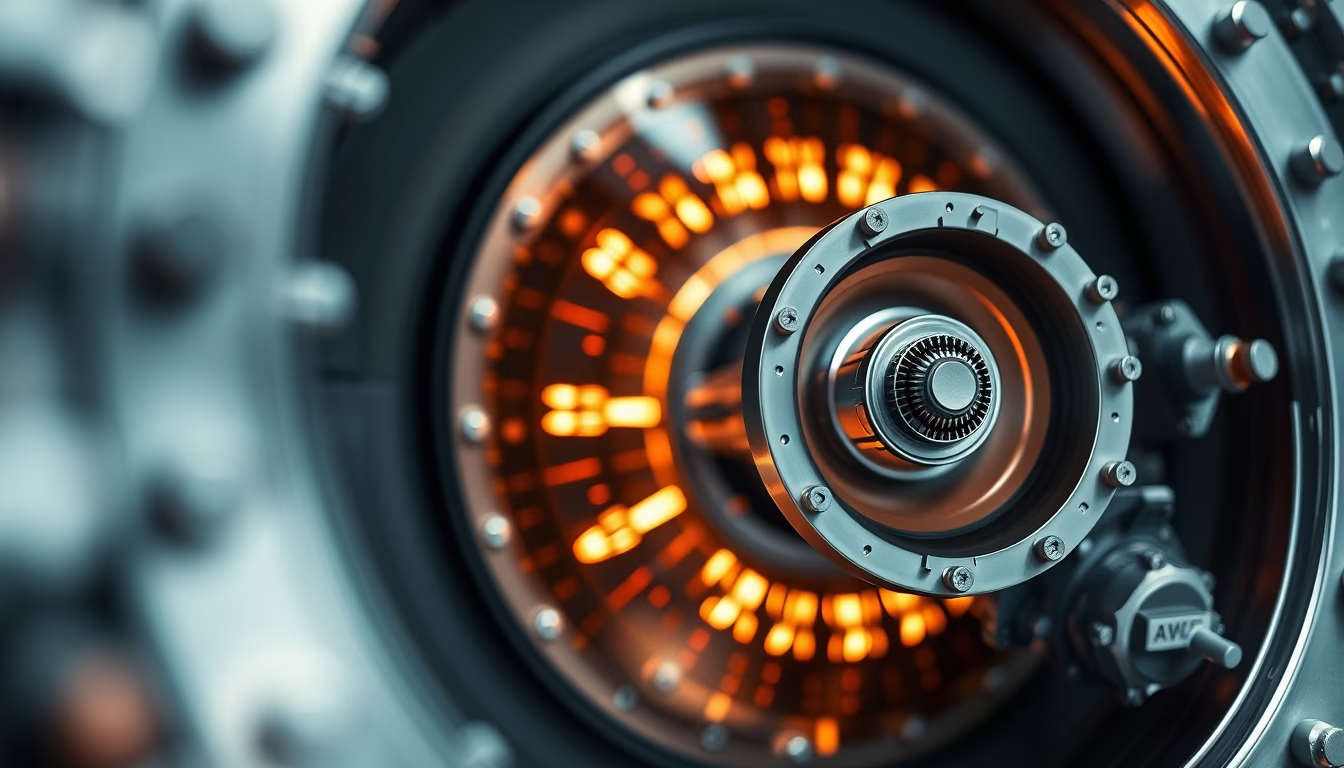
Bubble chamber tracks reveal the paths of subatomic particles, recording interactions in a superheated liquid.
About this subject
A bubble chamber is a subatomic particle detector invented by Donald A. Glaser in 1952, for which he won the Nobel Prize in Physics in 1960. The device consists of a container filled with a superheated liquid, usually liquid hydrogen or a noble gas mixture, maintained at a high temperature. When a charged particle passes through the liquid, it ionizes molecules along its path, creating vapor nuclei that form bubbles. These bubbles are photographed by multiple cameras from different angles, enabling three-dimensional reconstruction of the tracks.
Analyzing the tracks provides crucial information about the nature of the particles: their electric charge, mass, energy, and momentum. For instance, particles with higher ionization produce denser tracks, while high-energy particles leave straight lines. Curvatures in tracks indicate applied magnetic fields, allowing distinction between positive and negative charged particles. Bubble chambers were instrumental in discovering several particles, such as the neutrino, the K meson, and hadronic resonances.
Although now largely replaced by faster electronic detectors, bubble chambers left a visually striking legacy. Iconic images like the 1970 photograph of the first neutrino discovery show the elegance of experimental physics. Beyond scientific value, these images are appreciated for their aesthetics, combining fluid shapes with the precision of invisible particle paths. The study of tracks also aided in developing computer graphics techniques to simulate particle events.
Frequently Asked Questions
What is a bubble chamber?
A bubble chamber is a particle detector that records the trajectories of subatomic particles by creating bubbles in a superheated liquid along the particle's path.
How does a bubble chamber work?
A charged particle ionizes the superheated liquid, forming vapor nuclei that grow into visible bubbles. Cameras photograph these bubbles, and analysis of the images reveals properties of the particle.
What was the historical importance of the bubble chamber?
The bubble chamber was crucial for discovering several fundamental particles, such as the neutrino and the K meson, and significantly contributed to the development of particle physics from the 1950s to the 1970s.
Direct URL
https://pub-c7d6a6ea828543ac903a74a341ccb2e1.r2.dev/imagens/bubble-chamber-tracks-travel-photography-p3.avifHow to credit
Include a visible link back to UtilizAí. Copy one of the snippets below:
<a href="https://xn--utiliza-eza.com/en/midia/imagens/bubble-chamber-tracks-travel-photography-p3">Bubble chamber tracks</a> by <a href="https://xn--utiliza-eza.com">UtilizAí</a>, licensed under <a href="https://creativecommons.org/licenses/by/4.0/">CC BY 4.0</a>.
[Bubble chamber tracks](https://xn--utiliza-eza.com/en/midia/imagens/bubble-chamber-tracks-travel-photography-p3) by [UtilizAí](https://xn--utiliza-eza.com), CC BY 4.0
License: CC-BY-4.0