Bubble chamber tracks
1344×768 · AVIF · CC BY 4.0

Invented by Donald Glaser in 1952, the bubble chamber revolutionized subatomic particle physics by enabling direct visualization of particle trajectories.
About this subject
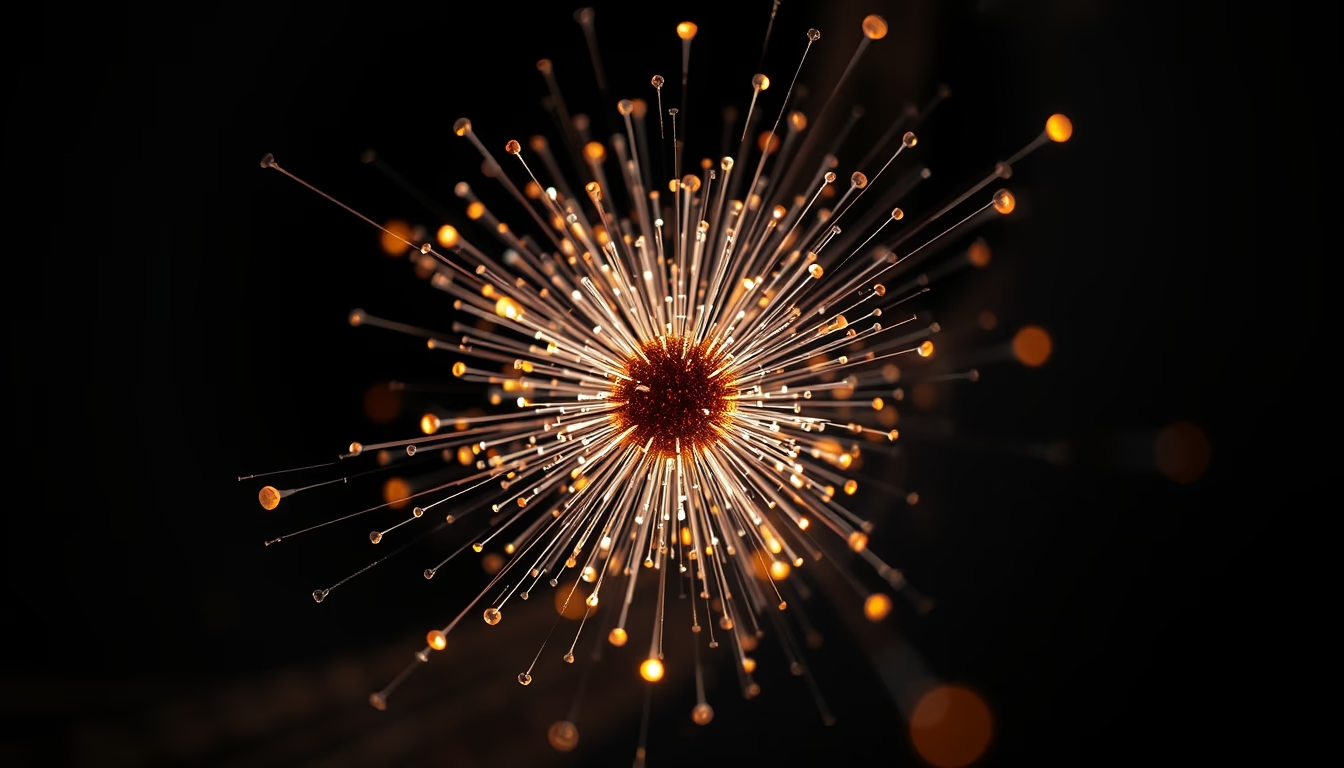
A bubble chamber is a particle detector that uses a superheated liquid, typically liquid hydrogen, to record the passage of charged particles. When a particle traverses the liquid, it ionizes molecules along its path, creating vapor nuclei that expand into tiny bubbles. These bubbles are photographed by high-speed cameras, forming the famous spiral and straight tracks that reveal particle trajectories.
Invented by American physicist Donald Glaser in 1952, the bubble chamber earned him the Nobel Prize in Physics in 1960. The technique was quickly adopted by major laboratories such as CERN and Fermilab, operating in conjunction with particle accelerators. The bubble chamber enabled the discovery of numerous exotic particles, such as the anti-sigma and omega baryon, and contributed to the confirmation of the quark model.
A fascinating fact is that spiral tracks indicate particles losing energy gradually under a magnetic field, while straight tracks belong to high-energy particles. Long-exposure photography captures multiple events in a single image, showing a tangle of tracks that required careful analysis by physicists. Although replaced by modern electronic detectors, the bubble chamber remains an icon of the golden age of particle physics.
Frequently Asked Questions
How does a bubble chamber work?
A bubble chamber contains a superheated liquid, such as liquid hydrogen. When a charged particle passes through, it ionizes the liquid, creating vapor nuclei that form visible bubbles along its path. The bubbles are photographed, revealing the particle's trajectory.
What do the different track shapes mean in a bubble chamber?
Straight tracks indicate high-energy particles that do not lose speed quickly. Spiral tracks show particles losing energy in a magnetic field, while curves can reveal the particle's charge and mass.
Why was the bubble chamber important for physics?
It led to the discovery of many subatomic particles and helped confirm theories such as the quark model. It was essential in early high-energy collision studies.
Direct URL
https://pub-c7d6a6ea828543ac903a74a341ccb2e1.r2.dev/imagens/bubble-chamber-tracks-long-exposure-p10.avifHow to credit
Include a visible link back to UtilizAí. Copy one of the snippets below:
<a href="https://xn--utiliza-eza.com/en/midia/imagens/bubble-chamber-tracks-long-exposure-p10">Bubble chamber tracks</a> by <a href="https://xn--utiliza-eza.com">UtilizAí</a>, licensed under <a href="https://creativecommons.org/licenses/by/4.0/">CC BY 4.0</a>.
[Bubble chamber tracks](https://xn--utiliza-eza.com/en/midia/imagens/bubble-chamber-tracks-long-exposure-p10) by [UtilizAí](https://xn--utiliza-eza.com), CC BY 4.0
License: CC-BY-4.0